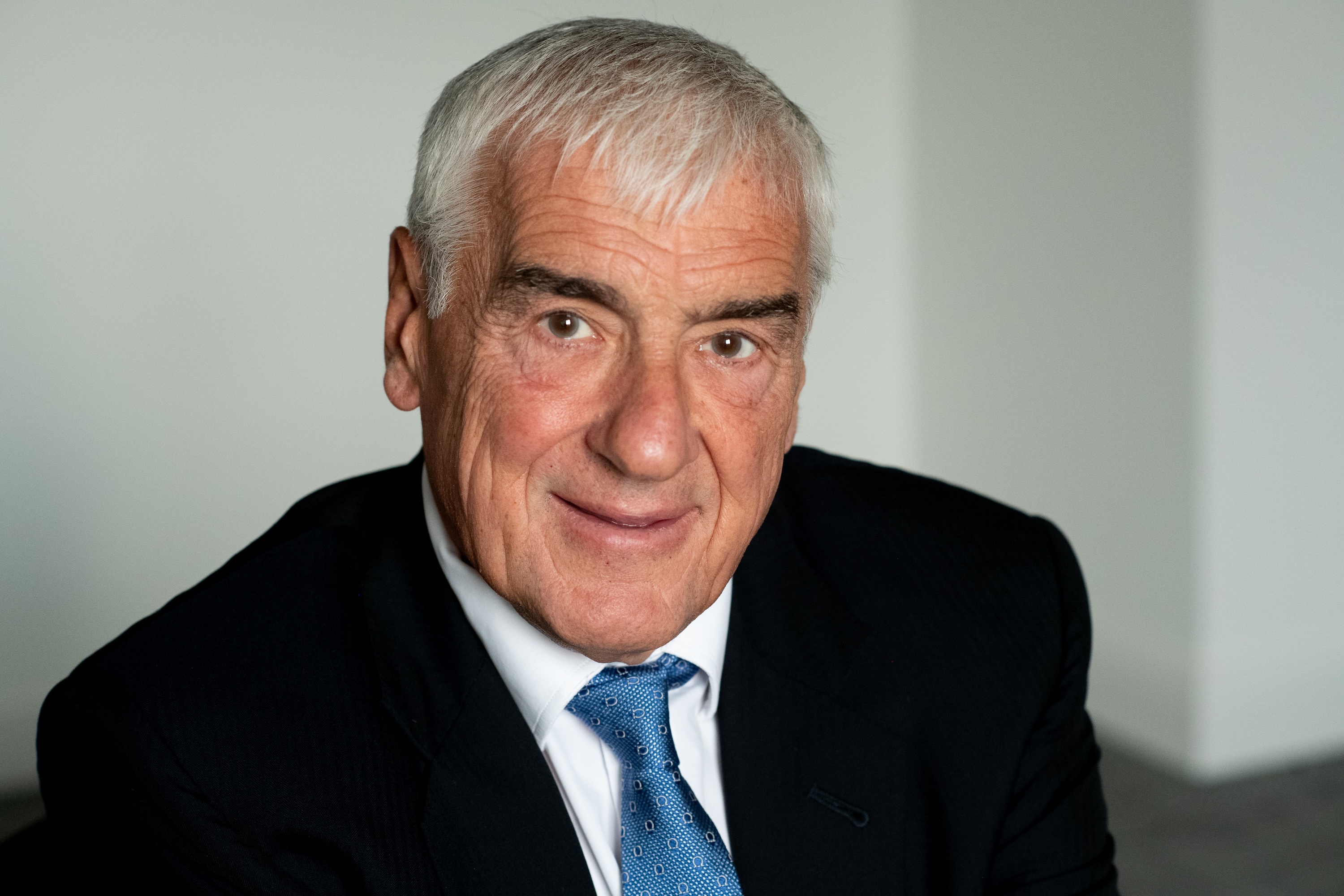
Billionaire hedge fund manager enacts ‘little short’ on the market

Investing veteran Lord Michael Hintze says he’s taking out insurance against expensive debt and equity markets that are being propelled by passive flows.

Jonathan Shapiro

Billionaire hedge fund manager enacts ‘little short’ on the market

October 1, 2025
Investing veteran Lord Michael Hintze says he’s taking out insurance against expensive debt and equity markets that are being propelled by passive flows.
Read Transcript

The journey of Lord Michael Hintze from Harbin, China, where he was born, to the House of Lords is a fascinating one.


The English-Australian billionaire served as a captain in the Australian Army, studied at Harvard and worked at Goldman Sachs before starting his own investment firm, which he sold last year.


Now 72, Hintze is back doing what he does best: trading the market.


“We are not running the biggest short we’ve ever had, but we are running a short side to our credit portfolio,” Hintze tells The Australian Financial Review.


In other words, he’s betting that the price of the debt will fall.


“We are also protecting ourselves through insurance on the equity market. Valuations are not totally unreasonable, but you have to be cautious.”


Hintze is arguably one of Australia’s most successful investors, having founded CQS, an investment firm which had $US20 billion ($30.3 billion) under management at its peak.


It was sold to Canadian investment giant Manulife in 2024, but the transaction excluded the hedge fund strategy, which Hintze has run since 2004 and continues to manage in his newly created entity.


“This is going back to the future,” Hintze says, referring to some of his long-serving lieutenants that he has brought with him to help him beat the market.


A well-known philanthropist, he will be making his debut at the Sohn Hearts & Minds charity investment conference that kicks off in Sydney next month.


He’s a UK Conservative Party donor, has been knighted by both the Pope and Queen Elizabeth, given an Order of Australia and in 2022 he was made a baron in the House of Lords by King Charles.


Richer trading opportunities

The billionaire has previously told the Financial Review that he developed his philanthropic bent while he served in the Australian army. It’s based on three principles: respect for institutions, protect the most fragile in society and foster aspiration.


His visit to Sydney next month gives Hintze the chance to visit some of his rural properties including one in Deltroit, near Gundagai in NSW, which is also the name of his new firm.


Deltroit Asset Management has $US1.5 billion under management including a “big chunk” of his own capital.


While Hintze trades anything from stocks and bonds to commodities, his forte is the credit markets, which he says are richer with trading opportunities.


The big discussion point is whether credit spreads – that is, the trading margin of corporate debt above the risk-free rate – have become too tight. That’s because on some measures, the return for lending money is as low as it’s been since the 2008 global financial crisis.


Hintze says it’s an important question, but not an easy one to answer.


“If we are in a world where there is an enormous amount of liquidity because every man and dog is running a deficit, it’s easier to pay off debt. The probability of default is going down.”


But he cautions, “the potential loss goes up,” when the defaults climb. It’s for this reason he’s taking short credit bets and buying insurance against corporate defaults.


“There is a huge appetite for credit. Frankly given the risks we have out there, I feel [credit spreads] are tighter than I would like.”


But what about the sharemarket? Is it overheated?


Well, it depends, according to Hintze. The trajectory and valuation of the S&P 500 Index is in the hands of a few companies such as dominant chipmaker Nvidia, which he says is actually cheap relative to its expected growth rate.


AI and the influx of passive funds

“This is a $US4.5 trillion company [compared] with a global GDP of $US110 trillion. At this point the growth is fine, but how much can it keep growing?”


Hintze says you really “have to have your wits about you” when trading fast-growing stocks on high valuations.


“You have to understand the G [growth] but you also have to understand the E [earnings] and you have to understand sentiment.”


“These things can change on a dime. What’s the difference between a PE [price-earnings ratio] of 38 times and a PE of 33? I don’t know, but it [equates to] a 10 per cent stock price move.”


There is one sector of the sharemarket, however, where Hintze does see value: electricity generators, which after years of being dismissed as low growth utilities are benefiting from increased electrification and the power demands of artificial intelligence.


He is torn about AI. While it’s driving productivity, innovation and scientific advancement, he also says that it’s creating “real societal dangers”.


“It’s powerful. We will probably need less analysts. But it’s unbundling the training process in our society and our ability to think.”


One other trend that most active fund managers have derided as dangerous is the increasing flow of money into low-cost passive funds. Today about half the sharemarket comprises price-agnostic rules-based capital that tracks a benchmark.


The passive money is also flooding into the credit markets via exchange-traded funds, making it far easier to trade corporate debt. Hintze says he’s had to adapt his strategy in a world where passive flows dominate.


“The fundamentals matter less until they matter a lot. It’s the reason why the short guys have walked away from the market.”

This article was originally posted by The Australian Financial Review here.

Licensed by Copyright Agency. You must not copy this work without permission.

The journey of Lord Michael Hintze from Harbin, China, where he was born, to the House of Lords is a fascinating one.


The English-Australian billionaire served as a captain in the Australian Army, studied at Harvard and worked at Goldman Sachs before starting his own investment firm, which he sold last year.


Now 72, Hintze is back doing what he does best: trading the market.


“We are not running the biggest short we’ve ever had, but we are running a short side to our credit portfolio,” Hintze tells The Australian Financial Review.


In other words, he’s betting that the price of the debt will fall.


“We are also protecting ourselves through insurance on the equity market. Valuations are not totally unreasonable, but you have to be cautious.”


Hintze is arguably one of Australia’s most successful investors, having founded CQS, an investment firm which had $US20 billion ($30.3 billion) under management at its peak.


It was sold to Canadian investment giant Manulife in 2024, but the transaction excluded the hedge fund strategy, which Hintze has run since 2004 and continues to manage in his newly created entity.


“This is going back to the future,” Hintze says, referring to some of his long-serving lieutenants that he has brought with him to help him beat the market.


A well-known philanthropist, he will be making his debut at the Sohn Hearts & Minds charity investment conference that kicks off in Sydney next month.


He’s a UK Conservative Party donor, has been knighted by both the Pope and Queen Elizabeth, given an Order of Australia and in 2022 he was made a baron in the House of Lords by King Charles.


Richer trading opportunities

The billionaire has previously told the Financial Review that he developed his philanthropic bent while he served in the Australian army. It’s based on three principles: respect for institutions, protect the most fragile in society and foster aspiration.


His visit to Sydney next month gives Hintze the chance to visit some of his rural properties including one in Deltroit, near Gundagai in NSW, which is also the name of his new firm.


Deltroit Asset Management has $US1.5 billion under management including a “big chunk” of his own capital.


While Hintze trades anything from stocks and bonds to commodities, his forte is the credit markets, which he says are richer with trading opportunities.


The big discussion point is whether credit spreads – that is, the trading margin of corporate debt above the risk-free rate – have become too tight. That’s because on some measures, the return for lending money is as low as it’s been since the 2008 global financial crisis.


Hintze says it’s an important question, but not an easy one to answer.


“If we are in a world where there is an enormous amount of liquidity because every man and dog is running a deficit, it’s easier to pay off debt. The probability of default is going down.”


But he cautions, “the potential loss goes up,” when the defaults climb. It’s for this reason he’s taking short credit bets and buying insurance against corporate defaults.


“There is a huge appetite for credit. Frankly given the risks we have out there, I feel [credit spreads] are tighter than I would like.”


But what about the sharemarket? Is it overheated?


Well, it depends, according to Hintze. The trajectory and valuation of the S&P 500 Index is in the hands of a few companies such as dominant chipmaker Nvidia, which he says is actually cheap relative to its expected growth rate.


AI and the influx of passive funds

“This is a $US4.5 trillion company [compared] with a global GDP of $US110 trillion. At this point the growth is fine, but how much can it keep growing?”


Hintze says you really “have to have your wits about you” when trading fast-growing stocks on high valuations.


“You have to understand the G [growth] but you also have to understand the E [earnings] and you have to understand sentiment.”


“These things can change on a dime. What’s the difference between a PE [price-earnings ratio] of 38 times and a PE of 33? I don’t know, but it [equates to] a 10 per cent stock price move.”


There is one sector of the sharemarket, however, where Hintze does see value: electricity generators, which after years of being dismissed as low growth utilities are benefiting from increased electrification and the power demands of artificial intelligence.


He is torn about AI. While it’s driving productivity, innovation and scientific advancement, he also says that it’s creating “real societal dangers”.


“It’s powerful. We will probably need less analysts. But it’s unbundling the training process in our society and our ability to think.”


One other trend that most active fund managers have derided as dangerous is the increasing flow of money into low-cost passive funds. Today about half the sharemarket comprises price-agnostic rules-based capital that tracks a benchmark.


The passive money is also flooding into the credit markets via exchange-traded funds, making it far easier to trade corporate debt. Hintze says he’s had to adapt his strategy in a world where passive flows dominate.


“The fundamentals matter less until they matter a lot. It’s the reason why the short guys have walked away from the market.”

This article was originally posted by The Australian Financial Review here.

Licensed by Copyright Agency. You must not copy this work without permission.

Disclaimer: This material has been prepared by Australian Financial Review, published on October 1, 2025. HM1 is not responsible for the content of linked websites or content prepared by third party. The inclusion of these links and third-party content does not in any way imply any form of endorsement by HM1 of the products or services provided by persons or organisations who are responsible for the linked websites and third-party content. This information is for general information only and does not consider the objectives, financial situation or needs of any person. Before making an investment decision, you should read the relevant disclosure document (if appropriate) and seek professional advice to determine whether the investment and information is suitable for you.

facebook
linkedin
All
Thank you! Your submission has been received!
Oops! Something went wrong while submitting the form.
November 14, 2022

Think outside the box for green investment opportunities

James Miller, Portfolio Manager at Firetrail Investments, believes investors need to stop seeing the global decarbonisation push as a risk – and start seeing it as an opportunity.

Read More
October 30, 2022

Why this fundie is betting big on two losing companies

Speaking to the AFR before the SH&M conference, Sandler named global on-demand ride-sharing and food delivery service Uber Technologies among his top picks, alongside real estate marketplace Zillow.

Read More
October 13, 2022

It’s Trump I fear, says Putin’s nemesis

Bill Browder, once the largest foreign investor in Russia and the man behind the global Magnitsky justice campaign, says the US is the weakest link in the war in Ukraine.

Read More
October 13, 2022

This fundie fought Vladimir Putin. He says there can be no peace deal

Bill Browder, the fund manager who has become one of Vladimir Putin’s fiercest critics, says the Russian leader is increasingly desperate, but no less dangerous.

Read More
August 31, 2022

‘Putin’s number one foreign enemy’ to address Aussie finance event

Bill Browder, who is viewed as a key enemy of Russia’s government will address Australian investors on the war in Ukraine at this year’s Sohn Hearts & Minds conference.

Read More
August 31, 2022

Putin critic and author Bill Browder to headline Sohn investor conference

Bill Browder, one of Putin's fiercest critics, the founder of Hermitage Capital and the man behind the Magnitsky Law, will headline this year's Sohn Hearts & Minds investor conference.

Read More
August 31, 2022

Sohn Hearts & Minds looks beyond tech ahead of Hobart event

Keynote speaker Bill Browder is the former Hermitage Capital hedge fund manager who has lobbied governments to black-list senior Russian officials attempting to shift their assets offshore.

Read More
December 3, 2021

Hamish Corlett picks Spotify as his top stock again at Sohn Hearts & Minds Conference

Hamish Corlett is the only stock picker in the history of the Sohn Hearts & Minds Investment Conference to pitch exactly the same company twice.

Read More
December 3, 2021

Sohn Hearts and Minds: The Australian Fund Manager Coverage

Leading fund managers reveal their top stock picks for the year ahead at the Sohn Hearts & Minds Conference. Read The Australian live coverage.

Read More
December 2, 2021

Here comes the Sohn: big names battle over conference music

For all that heavyweight finance names Michael Walsh, David ­Paradice, Matthew Grounds and Gary Weiss have in common professionally, one thing they can’t seem to find consensus on is music.

Read More
December 10, 2024

Professor Jane Butler: Sparking Hope for Spinal Cord Injuries

In this episode of the Hearts & Minds Podcast, we sit down with Professor Jane Butler to discuss her groundbreaking research into spinal cord injuries.

Read More
impact-podcasts
September 24, 2024

Asian Market Potential with Tom Naughton of Prusik

CIO Charlie Lanchester sits down with Tom Naughton, CIO of Prusik Investment Mgmt. Tom shares his investment philosophy, the opportunities and challenges in Asian markets, and how his 2023 conference stock pick, Swire Pacific (0019.HK), delivered an impressive 30% return.

Read More
investing
September 4, 2024

Building Hearts and Minds with Co-Founders Matthew Grounds and Guy Fowler

In this episode, co-founders Matthew Grounds AM and Guy Fowler OAM discuss their journey in building Hearts & Minds and its philanthropic model that has donated over $70 million to medical research.

Read More
investing
June 25, 2024

Navigating the Resource Sector with Jeremy Bond of Terra Capital

In this episode, we chat with Jeremy Bond, Founder of Terra Capital and HM1 Conference Fund Manager. Tune in for insights into the world of resource investments and the exciting opportunities that lie ahead.

Read More
investing
June 11, 2024

Prof. Nadia Badawi on Cerebral Palsy Breakthroughs and Neonatal Care

Dive deep into the groundbreaking work of Professor Nadia Badawi, an internationally recognised neonatologist and expert in Cerebral Palsy.

Read More
impact-podcasts
May 28, 2024

Investment Insights: Rikki Bannan on Top Picks and Trends

Join us for an engaging episode featuring Rikki Bannan, Portfolio Manager of IFM Investors and HM1 Conference Fund Manager. This episode explores Rikki's career journey, investment strategies, and her 2023 conference stock pick, Telix Pharmaceuticals (ASX.TLX).

Read More
investing
December 6, 2023

Peter Cooper talks building and instilling a culture of humility and excellence

In this episode, our guest is the renowned investor, Peter Cooper, founder and Chief Investment Officer of Cooper Investors (Core Fund Manager). A founding supporter of Hearts and Minds, Peter is a staunch advocate of our model and its philanthropic purpose, actively engaging in every facet of Hearts and Minds.

Read More
investing
November 28, 2023

Jun Bei Liu on her high conviction investment strategy

In this episode, HM1 Chief Investment Officer Charlie Lanchester is joined by Jun Bei Liu. Jun Bei is the Portfolio Manager of Tribeca’s Alpha Plus Fund and since taking over managing the Fund, she has quadrupled AUM.

Read More
investing
November 21, 2023

The world of rare genetic disease research

In this episode, we speak to Associate Professor Gina Ravenscroft. Gina is an Associate Professor in Neurogenetics at the Harry Perkins Institute of Medical Research in Perth. Her research interests are in rare genetic diseases, with a particular focus on neurogenetic diseases in babies and children.

Read More
impact-podcasts
November 14, 2023

Learn what makes a high conviction investment and how to avoid short-term noise

In this episode, our Core Fund Manager Magellan shares how they select top stocks for the HM1 portfolio.

Read More
investing
November 7, 2023

Delve into the world of kids critical care and trauma research

In thie episode, we are joined by Dr. Marino Festa, or Rino for short. He is the Medical Director of NSW Kids ECMO Referral Service and a senior specialist in Paediatric Intensive Care at Children’s Hospital at Westmead.

Read More
impact-podcasts
October 31, 2023

Where Regal's Phil King is searching for opportunities

HM1's CIO, Charlie Lanchester, talks to Phil King of Regal Funds about his passion for stocks, his ongoing search for opportunities, and some of the sectors he’s excited by right now. Phil King of Regal Funds, has been a tremendous supporter of Hearts & Minds since the beginning.

Read More
investing
October 24, 2023

Preventing recurrent miscarriages and birth defects

In this episode, CEO Paul Rayson is joined by renowned biomedical researcher Professor Sally Dunwoodie. Prof. Dunwoodie's groundbreaking work has revolutionised clinical practices and enabled genetic diagnostic tests worldwide. In 2017, her team achieved a double breakthrough with the potential to prevent recurrent miscarriages and various birth defects.

Read More
impact-podcasts
October 17, 2023

Nick Griffin on how he finds global winners

In this episode, CIO Charlie Lanchester chats with Nick Griffin, the founding partner and CIO of Munro Partners, one of HM1's Core Fund Managers. They go over his career to date, reflect on the lessons he’s learned, and trace the decisions that led to him starting Munro.

Read More
investing
October 10, 2023

How A/Prof Matt Call is teaching our body to kill cancer

In this episode, CEO Paul Rayson is joined by WEHI’s Associate Professor Matt Call to talk about his incredible research. Matt’s team teaches and trains the body's own immune cells to target and kill cancer cells.

Read More
impact-podcasts

No results found.

Please try a different search keyword or filter.