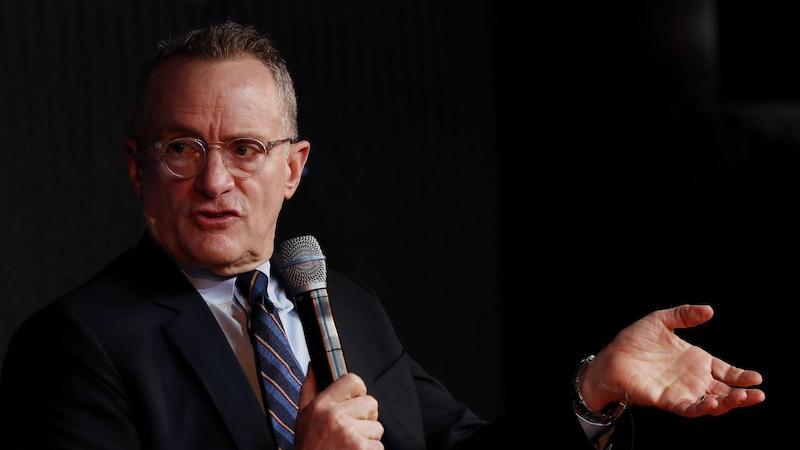

If Howard Marks has a superpower, it’s his ability to stay above the fray.
Marks’ famous investment memos are so revered because he’s the model of common sense in a world often bereft of it. While investors swing from euphoria to panic, Marks always keeps his head.
Which is why Marks’ latest analysis of the artificial intelligence revolution, released ahead of his appearance at The Australian Financial Review Business Summit on Tuesday, is required reading. After two weeks in which markets have been rocked by viral blog posts painting a gloomy picture of the damage AI might wreak on society, Marks has attempted to be as analytical as possible. But his verdict is equally stark: speed kills.
“Nothing has ever taken hold at the pace AI has,” he says. “It’s able to change the world at a speed that approaches instantaneous, outpacing the ability of most observers to anticipate or even comprehend. In the past, infrastructure was built for a new technology, and it often took years for that infrastructure to be fully utilised. In the case of AI inference, however, demand already exists and is growing rapidly, and I’m told AI is supply constrained.”
While Marks doesn’t profess to understand how AI does what it does, his examination of its development, strengths and weaknesses has led him to conclude that its power lies not its ability to think – he says there’s an open question as to whether it will be ever able to come up with truly new ideas – but in its ability to find, order and process information in a way that is broadly similar to humans.
“AI may not be able to remember everything, operate without errors, recognise every time it doesn’t know something, or solve problems it hasn’t been taught to solve. But neither can most people. The bottom line is that AI is capable of performing far better than most of us.”
This is an important point, and one often forgotten. The speed with which AI has become “good enough” at a range of tasks – and the way it’s particularly accelerated in recent months – is why, as Marks says, we may be underestimating its impact today, rather than exaggerating it.
And that potentially creates a nasty gap for society.
“The negative implications for society are greatly compounded by AI’s speed of adoption as described earlier. AI can rapidly put people out of work for whom it will take years to find and be trained for new careers. It’s hard to think the speed of change under AI won’t vastly outstrip society’s ability to adjust,” Marks says.
“Think of the damage offshoring did to manufacturing jobs in the US and other developed nations; this will impact more jobs and faster. For me, the bottom line is that not only are we unable to fully understand AI’s abilities and what it will do for us (or to us), but it thinks and moves faster than we can.
“The bottom line for me is that AI is very real, capable of doing a lot of work that heretofore has been done by knowledge workers, and growing extremely rapidly in terms of applications. What we see today is only the beginning.”
Gulp.
So what about the big questions investors are asking?
Are the companies pouring hundreds of billions of dollars into AI infrastructure contributing to a bubble? History says yes, capital will be “malinvested” and destroyed, but we are at least 10 years away from judging whether the returns warrant the investment made, Marks reckons.
Are the valuations assigned to AI companies irrational? That depends. Marks says that “it’s unlikely that today’s prices for enormously profitable companies like Microsoft, Amazon, and Google are going to turn out to have been ruinously excessive” and we’ll have to see how the likes of OpenAI and Anthropic are valued when they eventually go public.
But “the start-ups to which multibillion-dollar valuations are being assigned – some of which have yet to describe their strategies or announce products – can only be viewed as lottery tickets”.
If there’s hope for investors in Marks’ assessment, it’s this; he thinks investing is actually a field where humans can still beat the machines.
“AI doesn’t have skin in the game,” he adds. “It doesn’t feel the weight of concentrated positions or the fear of capital loss. Its willingness to take risks might not be constrained by humans’ normal risk aversion. The best investors sense potential risk intuitively, and this contributes greatly to their success.”
Let’s hope that’s right, because there’s an awful lot of risk for investors to wrap their heads around right now.
This article was originally posted by The Australian Financial Review here.
Licensed by Copyright Agency. You must not copy this work without permission.


.jpg)