Qiao Ma on life in the ‘Darwinian’ world of funds management

The globetrotting stock picker, who reads dense corporate history books for fun, says AI will only replace those people who don’t know how to use it.
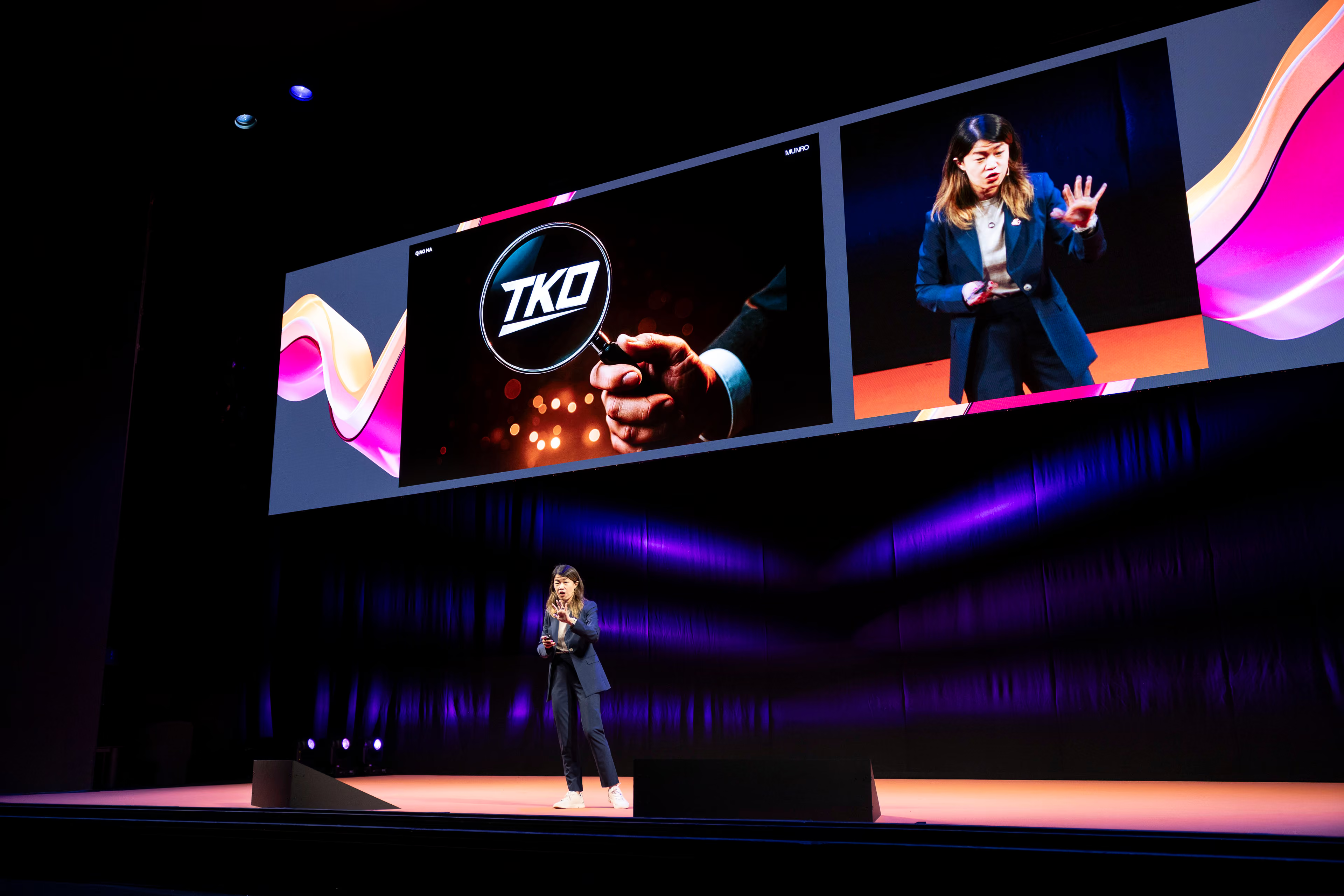
QIao Ma presenting at the 2025 Sohn Hearts & Minds Conference. Picture: Renee Nowytarger

Gus McCubbing

Qiao Ma on life in the ‘Darwinian’ world of funds management

February 20, 2026
The globetrotting stock picker, who reads dense corporate history books for fun, says AI will only replace those people who don’t know how to use it.
Read Transcript

Qiao Ma arrives on the dot for our lunch at Frederic in Melbourne’s Cremorne, one of those miniature suburbs that in my mind is really Richmond. We’re just getting seated when I demonstrate a habit shared by only vegans and new parents, blurting out apropos of nothing that I’m the proud father of a newborn and am all caffeine and no sleep, apologies in advance.

Ma, who has a faint American accent courtesy of her roughly 15 years in the United States, obliges by asking to see photos. She has two boys her of own, aged 5 and 7, and the parenting chat turns to what you do during those long hours of feeding in the middle of the night. I’ve been catching up on Billions and Tokyo Vice. Ma read ASML’s Architects, a 600-page history of the European semiconductor manufacturing giant.

“You’re away from work for so long, awake at so many random hours, it finally gave me the time to read,” the star fund manager at the Melbourne-based Munro Partners tells AFR Weekend. “I’ll always associate my parental leave with reading that book and patting his little head at 4am.”

Frederic is the third restaurant from siblings Antoine, Edouard and Nathalie Reymond, whose father is the famed French-Australian chef Jacques Reymond, and the place Ma normally likes to catch up with her girlfriends.

Somewhere between chic casual and fine dining, it has a New York loft vibe, and is quieter than Lupino, the Italian bistro on Little Collins Street where her Munro colleagues unwind in the city.

Ma has tried everything before and basically recommends the entire menu – modern European bistro fare, which actually fills you up. Frederic, she adds, has the added bonus of being far enough away from the CBD that she won’t constantly bump into people she knows.

As we settle in and start scanning the specials, Ma confirms she is reluctant to join the frenzied daily exchanges between stock pickers and journalists. While many of her industry colleagues find benefit in the straight swap of quotes for exposure, Ma says she doesn’t find it helpful because things change every day in markets.

“I really don’t like giving quick quotes in the papers,” she explains. “I would much rather take the time to say something properly.”

Like many fund managers, Ma is also reluctant to share too much about her personal life. All that matters, they say, are the returns. Did you beat your index benchmark, or not?

But beneath those raw and often unforgiving numbers are, of course, egos, rivalries, and characters – some of whom are more interesting than others.

The 41-year-old grew up in China before winning a scholarship to a US college. She worked at Lehman Brothers on the eve of its collapse, did an MBA, cut her teeth in stock picking working for tech hedge fund icon Philippe Laffont, and is now a portfolio manager specialising in high-growth global investing at Munro Partners, which handles $7.5 billion of investments.

Ma speaks three languages, lives in Brighton, barracks for Richmond in the AFL and loves listening to Mozart. She does not, however, want to drink at lunch, opting for sparkling water. We are in the middle of a turbulent earnings season, and she needs to stay at the top of her game, she says, but insists I enjoy one myself.

It’s time to order and, thinking aloud, she chooses her dessert first (a caramelised apple souffle with vanilla ice cream), then turns to entrées and a main. We order an heirloom tomato salad with pickled shallot, basil, and bocconcini, along with Fremantle grilled octopus with salsa verde and grilled chorizo, as shared starters.

Ma then opts for the flank steak special with fries, while I choose the Loddon Estate chicken breast with wholegrain mustard cream, pickled onion, and farro. We share a cos lettuce salad with parmesan buttermilk dressing and dill oil.

This sounds like a big order for the diminutive Ma, but I guess being a fitness addict who runs, cycles, swims and spends time in the gym and doing Pilates gives you a healthy appetite.

And in a nod to the juicy political cannibalism taking place that afternoon in Canberra, as Angus Taylor topples Sussan Ley to take over the Liberal Party, I ask for a glass of 2022 Nick O’Leary shiraz, from the ACT.

Ma’s returns are strong – we wouldn’t be sitting here otherwise. While the 12-person team at Munro all pitch in to the outfit’s various strategies, she heads up its long-only global small- and mid-cap fund, which has $550 million invested in about 30 stocks, mostly listed in the US.

It has beaten the MSCI global index for small- to mid-cap companies by 17.9 percentage points a year since the fund was launched in November 2023.

And while global markets have been turned upside down this year amid a brutal sell-down of software stocks as investors were spooked by the potential for AI to render their products obsolete – dubbed the SaaSpocalypse – Ma cut hers loose well ahead of time.

She takes a beat when I ask how she finds being a woman in one of the most male-dominated industries in the country, before explaining that she is bemused by how frequently she’s asked the question. Echoing the reason why she is relatively guarded about her personal life, Ma says your age, gender, sexuality, and racial background are immaterial in her trade.

“I don’t know why people make such a big fuss about women in funds management. It is the ultimate Darwinian industry. If you’re losing money, everybody knows. So you need a thick skin, for sure, but investors don’t care if you’re a man or woman,” she tells me.

A fair point. But more about funds management later.

Ma was born in Beijing to a pair of academics and was a small child when the tanks rolled into Tiananmen Square, an episode that is referred to in Mandarin by the heavily sterilised phrase “June Fourth Incident”.

“It was a pretty chaotic and crazy time, especially for academics. But I was only young and don’t remember much about it,” she said. “My family was already planning on leaving – they didn’t speak about it afterwards.”

When she was six years old, Ma’s family moved south to a city called Jiangmen, near Guangzhou and Shenzhen in the economic hub of Guangdong province, after her father, a mechanical engineer, won a posting at a local university (her mother was a chemical engineer and Ma quips she failed to pick up the family trade).

This placed the family in the middle of a boom in the Chinese economy following Deng Xiaoping’s 1992 Great Southern Tour, when he urged the country to open up and embrace capitalism.

It is also why she speaks Mandarin in the softer southern accent, rather than the rougher, and often ridiculed, Beijing accent, as well as Cantonese.

In Jiangmen, Ma pored over company tickers and share price fluctuations, a habit picked up from her retail investor father. She was also an early adopter of QQ, the instant chat service launched by Tencent in 1999, which could be loosely compared to MSN Messenger.

Ma studied hard, taught herself English, and got her first pay cheque writing about the life of a high school student for a magazine. “It was great fun growing up with Mandarin and Cantonese, and the two different cultures from the north and the south,” she says of her youth.

Three months before sitting China’s notoriously gruelling university entrance exam, the gaokao, Ma was offered a full scholarship to the University of Virginia, based on her high school transcript and TOEFL English test scores, after sending off a blitz of applications to overseas universities (in a sliding doors moment, she was also accepted at UNSW).

She received a colour brochure, hundreds of pages long, with every course the university offered – the students didn’t need to finalise their major until the third year. “I was like a kid in the candy shop,” Ma said.

Starting university in the US aged 18, Ma studied history, foreign relations, maths, sociology, and anthropology before settling on a commerce and economics degree. She heard lectures by UVA alumnus John Griffin, who founded the hedge fund Blue Ridge Capital, as well as Tiger Management founder Julian Robertson. They planted the seed for her career pathway.

Before we get to the global financial crisis, the waiter returns. Having polished off the octopus and tomato salad, which combine beautifully, we attack our mains.

I take the opportunity to grab some Chinese restaurant tips from Ma – her local favourites include New Shanghai in Melbourne Central, as well as South Yarra’s Pacific Seafood Barbecue, and Dainty Sichuan in the CBD.

After graduating from UVA, Ma landed her first job in 2006, aged 22, at Lehman Brothers. But within two years, the investment banking giant collapsed, triggering a meltdown in global sharemarkets. The signs of demise were never there internally, she said, with Lehman employees holding more than 30 per cent of the bank’s stock when it collapsed.

Ma got out in the nick of time. She was offered a place to study at Harvard Business School, and asked to resign and sell her Lehman shares to pay for her MBA. With some time off before classes, she returned to Beijing to watch the 2008 Olympics. Lehman Brothers fell the next month.

The main thing she learned from the Lehman failure? You have to look risk in the face.

“The easy part of our job is finding and hanging onto winners,” Ma says. “The hard part is knowing when to cut your losers – sometimes you need to confront your colleagues about this, other times you have to be humble enough to step off yourself. But many investors don’t get it. The sharemarket will forever be made up of a handful of winners, and a tonne of losers.

“So don’t be shocked, surprised, or personally humiliated if you own something that is losing money. It is not an affront to your intelligence – most stocks just don’t work out.”

Ma went on to work in New York at both Jericho Capital and Coatue Management, a technology-focused firm founded by Laffont.

She married an Australian, who also works in banking, and, after a long discussion, they agreed to go back to his hometown.

Her first Australian gig was at Cooper Investors’ Asian equities fund, before joining Munro Partners, where she is focused on the US market.

“I just wanted to try Melbourne originally, but I fell in love with the place and my two kids, who were both born here, are 100 per cent Aussie,” Ma said.

“I also love picking stocks globally from here. You’re away from the chaos of Manhattan, and the constant rumour mill. I have enough people in the US I can call, so I can get what I need. In the US, you have brokers calling you 12 times a day about ServiceNow or Atlassian.”

Ma’s biggest exposure is TKO Group, a business formed by the merger of Endeavor’s Ultimate Fighting Championship and World Wrestling Entertainment. She pitched the stock at November’s Sohn Hearts & Minds conference – her third appearance at the event where top investment bankers, fund managers, and philanthropists gather to pitch their best stock ideas in the name of medical research.

Ma told the VIP crowd it was a bet on UFC chief executive Dana White and super agent Ari Emanuel. The stock is up about 20 per cent since then. She tells me she likes that ultimate fighting is owned top-to-bottom by the group, including everything from merch to TV rights.

I ask what looks like the biggest winner in her portfolio right now? Ma, who likes to use ChatGPT rival Perplexity to help with some of the drudgery of her work – she is also a fan of tapping prediction markets to get a read on earnings expectations, but cautions they haven’t been that helpful to her yet – says her most bullish bet is Ciena Corp.

The networking hardware manufacturer comprises about 4 per cent of Ma’s portfolio, making it her third-largest play. Ciena, which sells products for high-speed fibre optical networks, this month rejoined the S&P 500 after it was booted off 17 years ago. Its market cap has nearly tripled in the past year.

Investors fell back in love with the company amid the soaring demand for data centre infrastructure that can run generative artificial intelligence models. “It’s the best in the world at what it does,” Ma says.

After about two hours my head is spinning and my stomach too full for much more than a bite of my profiteroles. But there’s one final question. Is AI going to put us all out of a job?

“AI won’t replace humans,” Ma begins. “But it will replace those who don’t know how to work with it. So my advice for everyone would be: learn how to use it, and then you can focus on areas of work that actually add value.”

This article was originally posted by The Australian Financial Review here.

Licensed by Copyright Agency. You must not copy this work without permission.

Qiao Ma arrives on the dot for our lunch at Frederic in Melbourne’s Cremorne, one of those miniature suburbs that in my mind is really Richmond. We’re just getting seated when I demonstrate a habit shared by only vegans and new parents, blurting out apropos of nothing that I’m the proud father of a newborn and am all caffeine and no sleep, apologies in advance.

Ma, who has a faint American accent courtesy of her roughly 15 years in the United States, obliges by asking to see photos. She has two boys her of own, aged 5 and 7, and the parenting chat turns to what you do during those long hours of feeding in the middle of the night. I’ve been catching up on Billions and Tokyo Vice. Ma read ASML’s Architects, a 600-page history of the European semiconductor manufacturing giant.

“You’re away from work for so long, awake at so many random hours, it finally gave me the time to read,” the star fund manager at the Melbourne-based Munro Partners tells AFR Weekend. “I’ll always associate my parental leave with reading that book and patting his little head at 4am.”

Frederic is the third restaurant from siblings Antoine, Edouard and Nathalie Reymond, whose father is the famed French-Australian chef Jacques Reymond, and the place Ma normally likes to catch up with her girlfriends.

Somewhere between chic casual and fine dining, it has a New York loft vibe, and is quieter than Lupino, the Italian bistro on Little Collins Street where her Munro colleagues unwind in the city.

Ma has tried everything before and basically recommends the entire menu – modern European bistro fare, which actually fills you up. Frederic, she adds, has the added bonus of being far enough away from the CBD that she won’t constantly bump into people she knows.

As we settle in and start scanning the specials, Ma confirms she is reluctant to join the frenzied daily exchanges between stock pickers and journalists. While many of her industry colleagues find benefit in the straight swap of quotes for exposure, Ma says she doesn’t find it helpful because things change every day in markets.

“I really don’t like giving quick quotes in the papers,” she explains. “I would much rather take the time to say something properly.”

Like many fund managers, Ma is also reluctant to share too much about her personal life. All that matters, they say, are the returns. Did you beat your index benchmark, or not?

But beneath those raw and often unforgiving numbers are, of course, egos, rivalries, and characters – some of whom are more interesting than others.

The 41-year-old grew up in China before winning a scholarship to a US college. She worked at Lehman Brothers on the eve of its collapse, did an MBA, cut her teeth in stock picking working for tech hedge fund icon Philippe Laffont, and is now a portfolio manager specialising in high-growth global investing at Munro Partners, which handles $7.5 billion of investments.

Ma speaks three languages, lives in Brighton, barracks for Richmond in the AFL and loves listening to Mozart. She does not, however, want to drink at lunch, opting for sparkling water. We are in the middle of a turbulent earnings season, and she needs to stay at the top of her game, she says, but insists I enjoy one myself.

It’s time to order and, thinking aloud, she chooses her dessert first (a caramelised apple souffle with vanilla ice cream), then turns to entrées and a main. We order an heirloom tomato salad with pickled shallot, basil, and bocconcini, along with Fremantle grilled octopus with salsa verde and grilled chorizo, as shared starters.

Ma then opts for the flank steak special with fries, while I choose the Loddon Estate chicken breast with wholegrain mustard cream, pickled onion, and farro. We share a cos lettuce salad with parmesan buttermilk dressing and dill oil.

This sounds like a big order for the diminutive Ma, but I guess being a fitness addict who runs, cycles, swims and spends time in the gym and doing Pilates gives you a healthy appetite.

And in a nod to the juicy political cannibalism taking place that afternoon in Canberra, as Angus Taylor topples Sussan Ley to take over the Liberal Party, I ask for a glass of 2022 Nick O’Leary shiraz, from the ACT.

Ma’s returns are strong – we wouldn’t be sitting here otherwise. While the 12-person team at Munro all pitch in to the outfit’s various strategies, she heads up its long-only global small- and mid-cap fund, which has $550 million invested in about 30 stocks, mostly listed in the US.

It has beaten the MSCI global index for small- to mid-cap companies by 17.9 percentage points a year since the fund was launched in November 2023.

And while global markets have been turned upside down this year amid a brutal sell-down of software stocks as investors were spooked by the potential for AI to render their products obsolete – dubbed the SaaSpocalypse – Ma cut hers loose well ahead of time.

She takes a beat when I ask how she finds being a woman in one of the most male-dominated industries in the country, before explaining that she is bemused by how frequently she’s asked the question. Echoing the reason why she is relatively guarded about her personal life, Ma says your age, gender, sexuality, and racial background are immaterial in her trade.

“I don’t know why people make such a big fuss about women in funds management. It is the ultimate Darwinian industry. If you’re losing money, everybody knows. So you need a thick skin, for sure, but investors don’t care if you’re a man or woman,” she tells me.

A fair point. But more about funds management later.

Ma was born in Beijing to a pair of academics and was a small child when the tanks rolled into Tiananmen Square, an episode that is referred to in Mandarin by the heavily sterilised phrase “June Fourth Incident”.

“It was a pretty chaotic and crazy time, especially for academics. But I was only young and don’t remember much about it,” she said. “My family was already planning on leaving – they didn’t speak about it afterwards.”

When she was six years old, Ma’s family moved south to a city called Jiangmen, near Guangzhou and Shenzhen in the economic hub of Guangdong province, after her father, a mechanical engineer, won a posting at a local university (her mother was a chemical engineer and Ma quips she failed to pick up the family trade).

This placed the family in the middle of a boom in the Chinese economy following Deng Xiaoping’s 1992 Great Southern Tour, when he urged the country to open up and embrace capitalism.

It is also why she speaks Mandarin in the softer southern accent, rather than the rougher, and often ridiculed, Beijing accent, as well as Cantonese.

In Jiangmen, Ma pored over company tickers and share price fluctuations, a habit picked up from her retail investor father. She was also an early adopter of QQ, the instant chat service launched by Tencent in 1999, which could be loosely compared to MSN Messenger.

Ma studied hard, taught herself English, and got her first pay cheque writing about the life of a high school student for a magazine. “It was great fun growing up with Mandarin and Cantonese, and the two different cultures from the north and the south,” she says of her youth.

Three months before sitting China’s notoriously gruelling university entrance exam, the gaokao, Ma was offered a full scholarship to the University of Virginia, based on her high school transcript and TOEFL English test scores, after sending off a blitz of applications to overseas universities (in a sliding doors moment, she was also accepted at UNSW).

She received a colour brochure, hundreds of pages long, with every course the university offered – the students didn’t need to finalise their major until the third year. “I was like a kid in the candy shop,” Ma said.

Starting university in the US aged 18, Ma studied history, foreign relations, maths, sociology, and anthropology before settling on a commerce and economics degree. She heard lectures by UVA alumnus John Griffin, who founded the hedge fund Blue Ridge Capital, as well as Tiger Management founder Julian Robertson. They planted the seed for her career pathway.

Before we get to the global financial crisis, the waiter returns. Having polished off the octopus and tomato salad, which combine beautifully, we attack our mains.

I take the opportunity to grab some Chinese restaurant tips from Ma – her local favourites include New Shanghai in Melbourne Central, as well as South Yarra’s Pacific Seafood Barbecue, and Dainty Sichuan in the CBD.

After graduating from UVA, Ma landed her first job in 2006, aged 22, at Lehman Brothers. But within two years, the investment banking giant collapsed, triggering a meltdown in global sharemarkets. The signs of demise were never there internally, she said, with Lehman employees holding more than 30 per cent of the bank’s stock when it collapsed.

Ma got out in the nick of time. She was offered a place to study at Harvard Business School, and asked to resign and sell her Lehman shares to pay for her MBA. With some time off before classes, she returned to Beijing to watch the 2008 Olympics. Lehman Brothers fell the next month.

The main thing she learned from the Lehman failure? You have to look risk in the face.

“The easy part of our job is finding and hanging onto winners,” Ma says. “The hard part is knowing when to cut your losers – sometimes you need to confront your colleagues about this, other times you have to be humble enough to step off yourself. But many investors don’t get it. The sharemarket will forever be made up of a handful of winners, and a tonne of losers.

“So don’t be shocked, surprised, or personally humiliated if you own something that is losing money. It is not an affront to your intelligence – most stocks just don’t work out.”

Ma went on to work in New York at both Jericho Capital and Coatue Management, a technology-focused firm founded by Laffont.

She married an Australian, who also works in banking, and, after a long discussion, they agreed to go back to his hometown.

Her first Australian gig was at Cooper Investors’ Asian equities fund, before joining Munro Partners, where she is focused on the US market.

“I just wanted to try Melbourne originally, but I fell in love with the place and my two kids, who were both born here, are 100 per cent Aussie,” Ma said.

“I also love picking stocks globally from here. You’re away from the chaos of Manhattan, and the constant rumour mill. I have enough people in the US I can call, so I can get what I need. In the US, you have brokers calling you 12 times a day about ServiceNow or Atlassian.”

Ma’s biggest exposure is TKO Group, a business formed by the merger of Endeavor’s Ultimate Fighting Championship and World Wrestling Entertainment. She pitched the stock at November’s Sohn Hearts & Minds conference – her third appearance at the event where top investment bankers, fund managers, and philanthropists gather to pitch their best stock ideas in the name of medical research.

Ma told the VIP crowd it was a bet on UFC chief executive Dana White and super agent Ari Emanuel. The stock is up about 20 per cent since then. She tells me she likes that ultimate fighting is owned top-to-bottom by the group, including everything from merch to TV rights.

I ask what looks like the biggest winner in her portfolio right now? Ma, who likes to use ChatGPT rival Perplexity to help with some of the drudgery of her work – she is also a fan of tapping prediction markets to get a read on earnings expectations, but cautions they haven’t been that helpful to her yet – says her most bullish bet is Ciena Corp.

The networking hardware manufacturer comprises about 4 per cent of Ma’s portfolio, making it her third-largest play. Ciena, which sells products for high-speed fibre optical networks, this month rejoined the S&P 500 after it was booted off 17 years ago. Its market cap has nearly tripled in the past year.

Investors fell back in love with the company amid the soaring demand for data centre infrastructure that can run generative artificial intelligence models. “It’s the best in the world at what it does,” Ma says.

After about two hours my head is spinning and my stomach too full for much more than a bite of my profiteroles. But there’s one final question. Is AI going to put us all out of a job?

“AI won’t replace humans,” Ma begins. “But it will replace those who don’t know how to work with it. So my advice for everyone would be: learn how to use it, and then you can focus on areas of work that actually add value.”

This article was originally posted by The Australian Financial Review here.

Licensed by Copyright Agency. You must not copy this work without permission.
Disclaimer: This material has been prepared by Australian Financial Review, published on Feb 20, 2026. HM1 is not responsible for the content of linked websites or content prepared by third party. The inclusion of these links and third-party content does not in any way imply any form of endorsement by HM1 of the products or services provided by persons or organisations who are responsible for the linked websites and third-party content. This information is for general information only and does not consider the objectives, financial situation or needs of any person. Before making an investment decision, you should read the relevant disclosure document (if appropriate) and seek professional advice to determine whether the investment and information is suitable for you.

facebook
linkedin
All
Thank you! Your submission has been received!
Oops! Something went wrong while submitting the form.
May 7, 2025

On the Couch with Nick Griffin (Munro Partners): Talking AI, Tech and Trump

In this episode, Henry Jennings is joined by Nick Griffin, founding Partner and Chief Investment Officer at Munro Partners (HM1 Core Fund Manager).

Read More
May 5, 2025

Meta and Microsoft surprise, Aussie rate cuts “locked in” & Pimp my Portfolio

Discover the key takeaways on US earnings season—Big Tech, AI and more. Plus, fresh market insights on inflation, potential rate cuts and the latest edition of Pimp my Portfolio.

Read More
April 29, 2025

Three investment sectors offering growth, innovation and opportunity

Magellan’s investment team looks at three interconnected investment sectors that continue to offer growth opportunities.

Read More
May 26, 2025

Less than 5% of stocks are “genuine winners” – here’s how to find them

Interesting story or genuine growth company? "Show me the earnings growth, and I’ll show you what I think about it" says Munro's Qiao Ma.

Read More
Steven Marks presenting at the 2023 Sohn Hearts & Minds Conference in Sydney.Steven Marks presenting at the 2023 Sohn Hearts & Minds Conference in Sydney.Steven Marks presenting at the 2023 Sohn Hearts & Minds Conference in Sydney.Steven Marks presenting at the 2023 Sohn Hearts & Minds Conference in Sydney.
June 27, 2025

Still Obsessed - Steven Marks, Co-Founder and Co-CEO Guzman y Gomez

Discover the next chapter for GYG—what’s changed, what hasn’t, and what Steven’s learned along the way. It’s a candid look at what it takes to lead through hypergrowth without losing the heart of the brand.

Read More
July 1, 2025

Nick Griffin on finding stocks that can double earnings in 5 years

In this episode of Success and More Interesting Stuff, Griffin shares how he built Munro from $20 million to more than $5 billion in FUM, the key signals he looks for in structural winners, and what comes next for AI, healthcare, and defence investing.

Read More
July 22, 2025

The Power of Focus: Running a 20-Stock Global Portfolio

In this episode of Inside the Rope, David Clark is joined by Nikki Thomas, one of Australia's most respected global equity investors and Portfolio Manager at Magellan.

Read More
June 24, 2025

Disruption, Valuation and AI with Alex Pollak of Loftus Peak

Alex Pollak, Chief Investment Officer at Loftus Peak, has built a reputation for investing on the cutting-edge of disruption. And no doubt, US tech has been a good place to invest over the past decade. But a lot of Australian fund managers have invested in that space, few have matched his returns.

Read More
Block is one of HM1's Top Core Holdings recommended by TDM Growth Partners.Block is one of HM1's Top Core Holdings recommended by TDM Growth Partners.Block is one of HM1's Top Core Holdings recommended by TDM Growth Partners.Block is one of HM1's Top Core Holdings recommended by TDM Growth Partners.
September 7, 2025

Block by Block: Building the Future of Money with Owen Jennings

TDM Growth Partners had the pleasure of speaking with Owen Jennings, the product leader of one of the world’s most influential tech companies - Block Inc (NYSE:XYZ).

Read More
October 17, 2025

The Bull Market is Just Getting Started | In the Money with Amber Kanwar

“The best of the bull market is still ahead of us.” That’s how Nick Griffin, Founding Partner and CIO of Munro Partners, sees it. Nick joins In the Money with Amber Kanwar to explain why the AI boom isn’t a bubble — it’s the start of a once-in-a-generation expansion.

Read More
November 4, 2025

Labubu, AI infrastructure & renewable energy: Why China is full of opportunity

It is time we rethink our approach to China? Eric Wong of Stillpoint Investments believes it is time. And between AI, electric vehicles and renewable energy, there are more and more cutting edge industries that China is emerging as a leader.

Read More
December 8, 2025

Stock Story: Nvidia

Munro Partners recently shared a stock story on Nvidia, one of their recommended stocks for HM1's Core Portfolio.

Read More
November 13, 2025

The case for and against an AI bubble

Alan Pullen sits down with Equity Mates to discuss the current market landscape, how investors can navigate an AI-driven environment, and the big question on everyone’s mind: are we in a stock market bubble?

Read More
October 14, 2025

Relevancy and Reinvention – Bruce Buchanan, CEO & Co-Founder, Rokt.

Rokt’s revenue has grown more than eightfold. The company is now strongly profitable and has built on its original insight - the power of relevancy. Tune in for Rokt’s next chapter of growth.

Read More
December 19, 2025

Munro Partners | Wrapping up the year that was and looking to the year ahead

Chief Investment Officer, Nick Griffin of Munro Partners (HM1 Core Fund Manager) reflects on 2025, and outlines how the team are positioning to take on 2026.

Read More