This Hedge Fund Manager Is Making A 100-Year Bet On Luxury

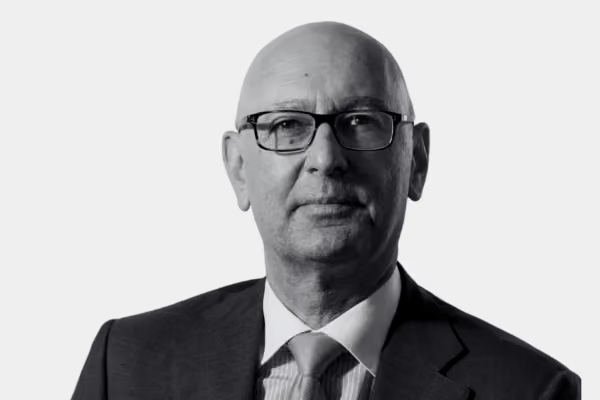
European leisure and luxury – a designer handbag, a last-minute flight to Monte Carlo, a stay in a five-star hotel – is where many choose to spend their hard-earned cash. For Sharif el Khazen, it’s where he makes it.

Joshua Peach

This Hedge Fund Manager Is Making A 100-Year Bet On Luxury

November 13, 2023
European leisure and luxury – a designer handbag, a last-minute flight to Monte Carlo, a stay in a five-star hotel – is where many choose to spend their hard-earned cash. For Sharif el Khazen, it’s where he makes it.
Read Transcript

European leisure and luxury – a designer handbag, a last-minute flight to Monte Carlo, a stay in a five-star hotel – is where many choose to spend their hard-earned cash. For Sharif el Khazen, it’s where he makes it.

Khazen manages London-based hedge fund Metronome Capital, which he launched in 2013 after leaving a partner position with renowned European manager Parvus Asset Management.

Ten years on, the firm’s long-short fund has developed a reputation for betting big on the luxury and leisure end of the consumer discretionary sector.

“A big area for us since inception has been luxury,” Khazen tells The Australian Financial Review as he prepares to present his latest stock pick at Sohn Hearts & Minds in Sydney next week.

“Luxury is pretty unique because you only have three or four high-quality brands that will be here in 100 years. You just need to buy them at the right price.”

But sometimes buying at the right price can mean wading in when the markets get jittery, a skill Khazen says he learnt to master whilst working at Parvus.

“Once I started at Parvus I was bitten by the passion to invest in stocks,” he says.

“When things do get volatile, you need to lean into them in order to generate the returns over the next decades.”

It was this kind of experience that proved vital in Metronome’s first few years, when Khazen and his team were able to capitalise on a downturn in the often maligned consumer discretionary space.

“When we launched there was an anti-corruption clamp down in China, terrorist attacks in Europe and FX was very volatile, which meant that the industry didn’t grow for a couple of quarters,” he said.

But during that time, Metronome began adding to its luxury holdings, picking up Italian luxury fashion house Moncler, Cartier owner Richemont as well as Kering, which owns brands like Gucci, Balenciaga and Yves Saint Laurent.

Alongside Metronome’s existing large stake in French luxury conglomerate LVMH, Khazen says the fund’s luxury holdings have helped fuel returns in the firm’s first decade in operation.

Canary in the coal mine

‍Metronome’s success in luxury is also at odds with the consumer discretionary sector’s reputation of being the canary in the coal mine during economic downturns. But as Khazen points out, not all segments of the sector are alike.

“In times of economic pressure or when inflation has been very high, those companies that cater to the top end of the pyramid are much more resilient,” he says.

“It’s a resilient industry, and we’ve just come out of three years of incredible growth for some of these players.”

Looking ahead, Khazen believes several tailwinds continue to bolster the case for luxury stocks, including a large still untapped market in the world’s second-largest economy.

“We know that there’s a huge reservoir of growth coming from Asia and China in particular,” Khazen says.

“China has 140 million people in the upper middle [class] and that is expected to become 200 million within a couple of years. So you have 60 million more people that can start affording luxury items.”

China’s expanding interest in the market adds to the region’s already bustling appetite for luxury goods. As Khazen points out, on a per capita basis South Korea ranks as the largest luxury market in the world.

“If you survey people and ask people how important is it for you to be seen to be rich, in South Korea, it’s 60 per cent and in China, it’s 50 per cent. In Europe and the US, it’s roughly 25 per cent,” he adds.

“The spend on luxury items in South Korea is over six times that of China, when the GDP per capita is only two and a half times that of China. So you have a massive structural tailwind, coming just from that.”

And while many have been looking in recent months to insurers, industrials or even miners for the pricing power needed to withstand a high inflationary environment, luxury stocks may be overlooked, according to Khazen.

“Luxury has almost infinite pricing power,” he says.

“Look at the Chanel flap bag: The price has doubled in the last three years to over €10,000 ($16,700) and it didn’t really impact the business.”

Leisure is another area that Khazen says is often avoided when it is actually well-placed to maximise returns as the world’s GDP and living standards continue to lift in the decades to come.

“Once you’ve bought your furniture, your car, or your house, and you have more disposable income, you’re going to spend more on experiences and travel,” he says.

“If you used to fly economy and get a budget hotel, you will fly business and get a villa somewhere else. You don’t have that same lever to pull when buying furniture, or cars.”

Metronome has been capitalising on this trend by buying stakes in companies such as online travel website booking.com.


Cyclical panic

‍And while inflation-driven cost of living pressures have turned investors bearish on the outlook for discretionary stocks, Khazen says it’s that kind of cyclical panic that his fund uses to its advantage.

“They will get sold by a portion of the market, but we feel that even if you are wrong for a quarter or two, and earnings are below what you think, it will not matter over a lifetime.”

It hasn’t been smooth sailing as, Khazen points out, having a portfolio significantly exposed to travel and leisure can make a once-in-a-lifetime pandemic a bumpy ride.

“Maybe 14 out of 15 names had their business stop overnight,” he says. “At first we had a pretty aggressive drawdown, but we were very disciplined and stuck to our philosophy.

“We had some businesses that were big victims of COVID, but we thought they would come out better businesses, post COVID. We just had to be patient and make sure they had the financial resources to survive that year or two without profits.”

A few years, on and Khazen says his team is continuing to find businesses that were hit by the pandemic and remain undervalued.

“It wasn’t all smooth sailing, but I think we’re in a great position today to build and to expand the business.”

Among the luxury brands, Metronome has retained just one of the names it held in the past, LVMH, alongside stakes in betting companies, bowling alleys and caterers.

“Today we only own one name in the luxury space, but we would love to own more. Either some stocks are too expensive or we have some fundamental issues with some of their brands – we’re watching that space very closely.

“There’s a period of normalisation today and yes, a weak consumer,” he concedes.

“We’re not really sure where it will land, but what we know with a high conviction is that the scale player will gain [market] share in any downturn and will come out a better business at the other end.”

This article was originally posted by The Australian Financial Review here.

Licensed by Copyright Agency. You must not copy this work without permission.

European leisure and luxury – a designer handbag, a last-minute flight to Monte Carlo, a stay in a five-star hotel – is where many choose to spend their hard-earned cash. For Sharif el Khazen, it’s where he makes it.

Khazen manages London-based hedge fund Metronome Capital, which he launched in 2013 after leaving a partner position with renowned European manager Parvus Asset Management.

Ten years on, the firm’s long-short fund has developed a reputation for betting big on the luxury and leisure end of the consumer discretionary sector.

“A big area for us since inception has been luxury,” Khazen tells The Australian Financial Review as he prepares to present his latest stock pick at Sohn Hearts & Minds in Sydney next week.

“Luxury is pretty unique because you only have three or four high-quality brands that will be here in 100 years. You just need to buy them at the right price.”

But sometimes buying at the right price can mean wading in when the markets get jittery, a skill Khazen says he learnt to master whilst working at Parvus.

“Once I started at Parvus I was bitten by the passion to invest in stocks,” he says.

“When things do get volatile, you need to lean into them in order to generate the returns over the next decades.”

It was this kind of experience that proved vital in Metronome’s first few years, when Khazen and his team were able to capitalise on a downturn in the often maligned consumer discretionary space.

“When we launched there was an anti-corruption clamp down in China, terrorist attacks in Europe and FX was very volatile, which meant that the industry didn’t grow for a couple of quarters,” he said.

But during that time, Metronome began adding to its luxury holdings, picking up Italian luxury fashion house Moncler, Cartier owner Richemont as well as Kering, which owns brands like Gucci, Balenciaga and Yves Saint Laurent.

Alongside Metronome’s existing large stake in French luxury conglomerate LVMH, Khazen says the fund’s luxury holdings have helped fuel returns in the firm’s first decade in operation.

Canary in the coal mine

‍Metronome’s success in luxury is also at odds with the consumer discretionary sector’s reputation of being the canary in the coal mine during economic downturns. But as Khazen points out, not all segments of the sector are alike.

“In times of economic pressure or when inflation has been very high, those companies that cater to the top end of the pyramid are much more resilient,” he says.

“It’s a resilient industry, and we’ve just come out of three years of incredible growth for some of these players.”

Looking ahead, Khazen believes several tailwinds continue to bolster the case for luxury stocks, including a large still untapped market in the world’s second-largest economy.

“We know that there’s a huge reservoir of growth coming from Asia and China in particular,” Khazen says.

“China has 140 million people in the upper middle [class] and that is expected to become 200 million within a couple of years. So you have 60 million more people that can start affording luxury items.”

China’s expanding interest in the market adds to the region’s already bustling appetite for luxury goods. As Khazen points out, on a per capita basis South Korea ranks as the largest luxury market in the world.

“If you survey people and ask people how important is it for you to be seen to be rich, in South Korea, it’s 60 per cent and in China, it’s 50 per cent. In Europe and the US, it’s roughly 25 per cent,” he adds.

“The spend on luxury items in South Korea is over six times that of China, when the GDP per capita is only two and a half times that of China. So you have a massive structural tailwind, coming just from that.”

And while many have been looking in recent months to insurers, industrials or even miners for the pricing power needed to withstand a high inflationary environment, luxury stocks may be overlooked, according to Khazen.

“Luxury has almost infinite pricing power,” he says.

“Look at the Chanel flap bag: The price has doubled in the last three years to over €10,000 ($16,700) and it didn’t really impact the business.”

Leisure is another area that Khazen says is often avoided when it is actually well-placed to maximise returns as the world’s GDP and living standards continue to lift in the decades to come.

“Once you’ve bought your furniture, your car, or your house, and you have more disposable income, you’re going to spend more on experiences and travel,” he says.

“If you used to fly economy and get a budget hotel, you will fly business and get a villa somewhere else. You don’t have that same lever to pull when buying furniture, or cars.”

Metronome has been capitalising on this trend by buying stakes in companies such as online travel website booking.com.


Cyclical panic

‍And while inflation-driven cost of living pressures have turned investors bearish on the outlook for discretionary stocks, Khazen says it’s that kind of cyclical panic that his fund uses to its advantage.

“They will get sold by a portion of the market, but we feel that even if you are wrong for a quarter or two, and earnings are below what you think, it will not matter over a lifetime.”

It hasn’t been smooth sailing as, Khazen points out, having a portfolio significantly exposed to travel and leisure can make a once-in-a-lifetime pandemic a bumpy ride.

“Maybe 14 out of 15 names had their business stop overnight,” he says. “At first we had a pretty aggressive drawdown, but we were very disciplined and stuck to our philosophy.

“We had some businesses that were big victims of COVID, but we thought they would come out better businesses, post COVID. We just had to be patient and make sure they had the financial resources to survive that year or two without profits.”

A few years, on and Khazen says his team is continuing to find businesses that were hit by the pandemic and remain undervalued.

“It wasn’t all smooth sailing, but I think we’re in a great position today to build and to expand the business.”

Among the luxury brands, Metronome has retained just one of the names it held in the past, LVMH, alongside stakes in betting companies, bowling alleys and caterers.

“Today we only own one name in the luxury space, but we would love to own more. Either some stocks are too expensive or we have some fundamental issues with some of their brands – we’re watching that space very closely.

“There’s a period of normalisation today and yes, a weak consumer,” he concedes.

“We’re not really sure where it will land, but what we know with a high conviction is that the scale player will gain [market] share in any downturn and will come out a better business at the other end.”

This article was originally posted by The Australian Financial Review here.

Licensed by Copyright Agency. You must not copy this work without permission.

Disclaimer: This material has been prepared by Australian Financial Review, published on Nov 13, 2023. HM1 is not responsible for the content of linked websites or content prepared by third party. The inclusion of these links and third-party content does not in any way imply any form of endorsement by HM1 of the products or services provided by persons or organisations who are responsible for the linked websites and third-party content. This information is for general information only and does not consider the objectives, financial situation or needs of any person. Before making an investment decision, you should read the relevant disclosure document (if appropriate) and seek professional advice to determine whether the investment and information is suitable for you.

facebook
linkedin
All
Thank you! Your submission has been received!
Oops! Something went wrong while submitting the form.
November 5, 2024

The fundie betting big on China – with help from AI

Mr Mehta is sticking to his well-worn strategy: he’s hunting for companies across Asia that aren’t battling intense competition and have management teams focused on costs, cash generation and high payouts to shareholders.

Read More
Beeneet Kothari is ready to shock the Sohn Hearts & Minds event.Beeneet Kothari is ready to shock the Sohn Hearts & Minds event.Beeneet Kothari is ready to shock the Sohn Hearts & Minds event.Beeneet Kothari is ready to shock the Sohn Hearts & Minds event.
October 29, 2024

Why this fundie wants you to ‘wince’ at his stock picks

When fund managers come to pitch their favourite stock at the annual Sohn Hearts & Minds conference, there are two ways they can go: they can play it safe, or they can take a risk and shock the room.

Read More
Ellerston Capital portfolio manager Chris Kourtis. Picture: Britta CampionEllerston Capital portfolio manager Chris Kourtis. Picture: Britta CampionEllerston Capital portfolio manager Chris Kourtis. Picture: Britta CampionEllerston Capital portfolio manager Chris Kourtis. Picture: Britta Campion
October 21, 2024

Why Ellerston Capital’s Chris Kourtis plans to back a ‘hated’ stock

Chris Kourtis of Ellerston Capital plans to tip one of the “most hated” stocks in Australia when he presents at the 2024 Sohn Hearts & Minds Conference.

Read More
September 9, 2024

The Wellcome Trust’s Nick Moakes made a 100-year bet. It’s paying off

Chief Investment Officer, Nick Moakes raised almost $3 billion at ultra-low rates. Sometimes the long view can be the most profitable.

Read More
September 5, 2024

Why Howard Marks says you’re making a big mistake

Howard Marks says investors must ignore manic depressive markets and focus on the bigger picture. Rates will be higher for longer and that will bring pain – and opportunity.

Read More
November 17, 2023

The 12 Hottest Stock Tips From This Year’s Sohn Experts

It might be time to look beyond big names. That was the message from top fund managers, company founders and super funds at the Sohn Hearts & Minds.

Read More
Azora Capital founder Ravi Chopra. Picture: Renee NowytargerAzora Capital founder Ravi Chopra. Picture: Renee NowytargerAzora Capital founder Ravi Chopra. Picture: Renee NowytargerAzora Capital founder Ravi Chopra. Picture: Renee Nowytarger
November 17, 2023

Webster Financial ‘Avoided The Mistakes Of US Bank Failures’

The US financial sector is not without its problems but Ravi Chopra backs Webster Financial Corporation as his stock pick for the 2023 Sohn Hearts & Minds Investment Leaders Conference.

Read More
November 17, 2023

Why Stock Picker Cathie Wood Of ARK Can’t Stand Google

The world’s highest-profile tech investor, Cathie Wood, might be bruised but she is certainly bullish. Nor is she holding back.

Read More
Munro Partners partner and portfolio manager Kieran Moore at the Sohn Hearts & Minds conference in Sydney. Picture: Renee NowytargerMunro Partners partner and portfolio manager Kieran Moore at the Sohn Hearts & Minds conference in Sydney. Picture: Renee NowytargerMunro Partners partner and portfolio manager Kieran Moore at the Sohn Hearts & Minds conference in Sydney. Picture: Renee NowytargerMunro Partners partner and portfolio manager Kieran Moore at the Sohn Hearts & Minds conference in Sydney. Picture: Renee Nowytarger
November 17, 2023

Wise Share Price Could Rise 50pc By 2025, Says Munro Partners

Global growth fund manager Munro has about $4.3bn in funds under management across four global funds, and usually invests in companies that are poised to win from massive structural change.

Read More
November 16, 2023

The ‘Armageddon Scenario’ Worrying The Future Fund CIO

Mr Samild shared his thoughts on the bond market – which underpins the returns of other assets – ahead of his appearance at Friday’s Sohn Hearts & Minds charity conference at the Sydney Opera House.

Read More
November 12, 2023

The Australian At The Centre Of Dalio’s Bridgewater – Who Loves It

The culture at Ray Dalio’s massive hedge fund has been a source of intrigue, and with a new book, controversy. Atul Lele says it’s made him a better investor.

Read More
November 8, 2023

Tom Naughton - There's Money In Mi Goreng | Prusik Investment

Tom Naughton is Managing Partner and CIO at Prusik Investment. In this episode, he chats to Equity Mates ahead of his appearance at the 2023 Sohn Hearts and Minds Conference.

Read More
November 6, 2023

Why Chris Kourtis just bought CSL and ResMed

A true contrarian investor, Chris Kourtis can find himself sounding a lot like a bull when in the company of bears, and there’s a lot to be bearish about at the moment.

Read More
October 23, 2023

US Bank Run Has Slowed To A Walk, But Instability Remains

When Ravi Chopra reveals his stock pick at the prestigious Sohn Hearts & Minds conference at the Opera House in Sydney next month, it could well be a short bet on a US bank.

Read More
October 18, 2023

Two small caps: Propel Funeral Services (ASX: PFP) and Clarity Pharmaceuticals (ASX: CU6)

Get to know our 2023 Conference Fund Manager Rikki Bannan of IFM Investors who recently featured on the Equity Mates Media podcast.

Read More