Trump unifies top investors in decade-long bullish outlook for US

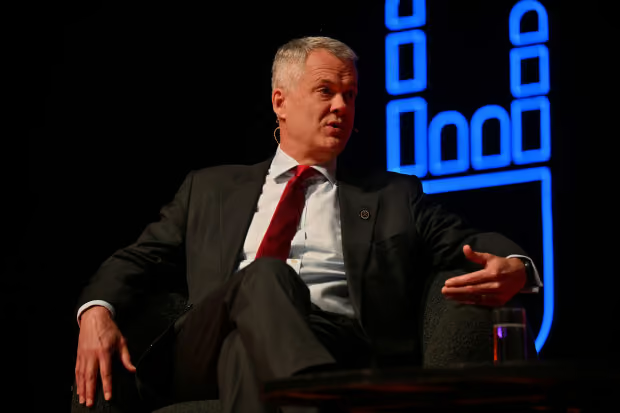
Nick Moakes, CIO of the $72 billion Wellcome Trust, told the conference that too many investors were banking on a return to the ultra-low interest rates that prevailed over the past decade.

Jonathan Shapiro, Joshua Peach and Daniel Arbon

Trump unifies top investors in decade-long bullish outlook for US

November 20, 2024
Nick Moakes, CIO of the $72 billion Wellcome Trust, told the conference that too many investors were banking on a return to the ultra-low interest rates that prevailed over the past decade.
Read Transcript

Donald Trump has unified the world’s biggest investors with his plan to slash red tape and taxes, setting the US economy up for what Oaktree Capital’s Howard Marks described as a decade of peerless returns.

“Warren Buffett said it: don’t bet against the United States. He’s probably right about that,” the Wall Street veteran told the Sohn Hearts & Minds investment conference in Adelaide on Friday.

“The US economy is the envy of the world, and likely to stay that way.”

‍Trump’s win at last week’s presidential election over Democrat rival Kamala Harris has already led to a surge in US stocks. It has also sent the price of bitcoin surging, up about 30 per cent to touch a record above $US90,000.

Throughout the day at the charity conference, Australian and international fund managers pitched their best share market tips over the coming 12 months. Of the 11 stocks presented, five were listed in the US, two in Australia, two in China and two in Europe.

Mike Novogratz, the billionaire former president of Fortress Investment Group, said the Trump administration would “ignite a renaissance” in cryptocurrencies. Mr Novogratz, now the chief executive of specialist investment bank Galaxy Digital, told the conference he was “one of the few crypto guys that wasn’t a pro-Trump”.

“But I woke up and said, ‘Wow, this is going to make my business more fun’,” he said.

The pending return of Trump to the White House has upended global markets. During the election campaign, Trump made a number of pledges, including steep tariffs on Chinese imports and spending measures that would add billions of dollars to debts and likely fuel higher inflation.

The surge in US stocks has filtered into the returns of Australia’s big superannuation funds, which have allocated about a third of their assets to US-dominated global markets. A dollar invested in the US five years ago would now be worth over $2.20, compared to $1.17 in Australia.

On Thursday, Future Fund chief executive Raphael Arndt said Trump’s tax, deregulation and trade plans would accelerate both inflation and growth. “Like every investor, we’ve made money off the US election,” he said. “That’s actually a reasonably positive picture for an investor like Australia.”

For investors, there are now new questions about how high stocks will go. Peter Cooper, who oversees an $11 billion portfolio at Cooper Investments, said: “It’s been a brilliant success story in economic terms and in terms of stock market terms … the worry is: can America actually keep it going?”

Oaktree’s Mr Marks made a similar point. The valuations of stocks in New York were already high, he said: “You’re getting a great deal of merit, but you’re paying for it. You’re not getting that excellence for nothing.”

Ajay Rajadhyaksha, chairman of research at Barclays, the British bank that is now a minority investor in Barrenjoey, told the Sohn conference that the US was in an “incredibly strong macro position” to cement its status as a financial and technological superpower.

But he cautioned that the market may be overestimating the ability of the Trump administration to implement its policies. “There’s far more checks and balances within the US system of government than people sometimes realise, especially for the domestic economy,” he said.

New tariffs – and a trade war with China – would be a “much worse thing for the rest of the world than it is for the US”, Mr Rajadhyaksha added.

Mr Marks, who was speaking from Beijing, also warned that Trump would “come out swinging” against China, Australia’s largest trading partner.

“Trump is an avowed China basher, and the one thing that there’s consistency on in the US now is that it’s a winning strategy,” he said.

Mr Marks added that while Australia would continue to benefit from its relationships with both the US and China, from a geopolitical perspective it may be forced to pick a side. “If the situation evolves into real hostilities, and, of course, military hostilities – then, of course, Australia would have to choose. My hope is that it won’t.”

Treasurer Jim Chalmers this week warned that economic growth in Australia could suffer because of Trump’s policies, and his concerns were echoed by Treasury Secretary Steven Kennedy, Reserve Bank of Australia governor Michele Bullock, and two of the country’s top bank bosses last week.

AMP chief economist Shane Oliver said Australia’s $2.5 trillion economy would be worse off as a result of Trump’s policies. “Assuming Trump goes all the way with tariffs, then you could be looking at, in the first year or so, a 0.5 per cent hit to economic activity here,” he said.

While shares have soared since Trump’s election, bond market investors have had a more difficult time. Long-term bond rates have drifted higher as traders factor in the prospect of higher growth and inflation. The US 10-year rate has jumped from 3.62 per cent in mid-September to 4.45 per cent, while the Australian equivalent has risen from 3.83 per cent to 4.65 per cent.

Nick Moakes, the chief investment officer of the $72 billion Wellcome Trust, told the conference that too many investors were banking on a return to the ultra-low interest rates that prevailed over the past decade.

In 2018 and 2021, the Wellcome Trust issued 100-year bonds at rates of just 2.5 per cent and 1.5 per cent, locking in funding at historically low rates.

“The bonds that we’ve issued all trade now with an interest rate of, roughly speaking, 5 per cent, and that’s much more realistic,” Mr Moakes said. “That’s a world that we all need to get used to, and it’s got implications for everything. It’s got implications for private equity, it’s got implications for discount rates that you use to value stocks.”

This article was originally posted by The Australian Financial Review here. 

Licensed by Copyright Agency. You must not copy this work without permission.

Disclaimer: This material has been prepared by the Harry Perkins Institute of Medical Research, published on 3 October 2024. HM1 is not responsible for the content of linked websites or content prepared by third party. The inclusion of these links and third-party content does not in any way imply any form of endorsement by HM1 of the products or services provided by persons or organisations who are responsible for the linked websites and third-party content. This information is for general information only and does not consider the objectives, financial situation or needs of any person. Before making an investment decision, you should read the relevant disclosure document (if appropriate) and seek professional advice to determine whether the investment and information is suitable for you.

Donald Trump has unified the world’s biggest investors with his plan to slash red tape and taxes, setting the US economy up for what Oaktree Capital’s Howard Marks described as a decade of peerless returns.

“Warren Buffett said it: don’t bet against the United States. He’s probably right about that,” the Wall Street veteran told the Sohn Hearts & Minds investment conference in Adelaide on Friday.

“The US economy is the envy of the world, and likely to stay that way.”

‍Trump’s win at last week’s presidential election over Democrat rival Kamala Harris has already led to a surge in US stocks. It has also sent the price of bitcoin surging, up about 30 per cent to touch a record above $US90,000.

Throughout the day at the charity conference, Australian and international fund managers pitched their best share market tips over the coming 12 months. Of the 11 stocks presented, five were listed in the US, two in Australia, two in China and two in Europe.

Mike Novogratz, the billionaire former president of Fortress Investment Group, said the Trump administration would “ignite a renaissance” in cryptocurrencies. Mr Novogratz, now the chief executive of specialist investment bank Galaxy Digital, told the conference he was “one of the few crypto guys that wasn’t a pro-Trump”.

“But I woke up and said, ‘Wow, this is going to make my business more fun’,” he said.

The pending return of Trump to the White House has upended global markets. During the election campaign, Trump made a number of pledges, including steep tariffs on Chinese imports and spending measures that would add billions of dollars to debts and likely fuel higher inflation.

The surge in US stocks has filtered into the returns of Australia’s big superannuation funds, which have allocated about a third of their assets to US-dominated global markets. A dollar invested in the US five years ago would now be worth over $2.20, compared to $1.17 in Australia.

On Thursday, Future Fund chief executive Raphael Arndt said Trump’s tax, deregulation and trade plans would accelerate both inflation and growth. “Like every investor, we’ve made money off the US election,” he said. “That’s actually a reasonably positive picture for an investor like Australia.”

For investors, there are now new questions about how high stocks will go. Peter Cooper, who oversees an $11 billion portfolio at Cooper Investments, said: “It’s been a brilliant success story in economic terms and in terms of stock market terms … the worry is: can America actually keep it going?”

Oaktree’s Mr Marks made a similar point. The valuations of stocks in New York were already high, he said: “You’re getting a great deal of merit, but you’re paying for it. You’re not getting that excellence for nothing.”

Ajay Rajadhyaksha, chairman of research at Barclays, the British bank that is now a minority investor in Barrenjoey, told the Sohn conference that the US was in an “incredibly strong macro position” to cement its status as a financial and technological superpower.

But he cautioned that the market may be overestimating the ability of the Trump administration to implement its policies. “There’s far more checks and balances within the US system of government than people sometimes realise, especially for the domestic economy,” he said.

New tariffs – and a trade war with China – would be a “much worse thing for the rest of the world than it is for the US”, Mr Rajadhyaksha added.

Mr Marks, who was speaking from Beijing, also warned that Trump would “come out swinging” against China, Australia’s largest trading partner.

“Trump is an avowed China basher, and the one thing that there’s consistency on in the US now is that it’s a winning strategy,” he said.

Mr Marks added that while Australia would continue to benefit from its relationships with both the US and China, from a geopolitical perspective it may be forced to pick a side. “If the situation evolves into real hostilities, and, of course, military hostilities – then, of course, Australia would have to choose. My hope is that it won’t.”

Treasurer Jim Chalmers this week warned that economic growth in Australia could suffer because of Trump’s policies, and his concerns were echoed by Treasury Secretary Steven Kennedy, Reserve Bank of Australia governor Michele Bullock, and two of the country’s top bank bosses last week.

AMP chief economist Shane Oliver said Australia’s $2.5 trillion economy would be worse off as a result of Trump’s policies. “Assuming Trump goes all the way with tariffs, then you could be looking at, in the first year or so, a 0.5 per cent hit to economic activity here,” he said.

While shares have soared since Trump’s election, bond market investors have had a more difficult time. Long-term bond rates have drifted higher as traders factor in the prospect of higher growth and inflation. The US 10-year rate has jumped from 3.62 per cent in mid-September to 4.45 per cent, while the Australian equivalent has risen from 3.83 per cent to 4.65 per cent.

Nick Moakes, the chief investment officer of the $72 billion Wellcome Trust, told the conference that too many investors were banking on a return to the ultra-low interest rates that prevailed over the past decade.

In 2018 and 2021, the Wellcome Trust issued 100-year bonds at rates of just 2.5 per cent and 1.5 per cent, locking in funding at historically low rates.

“The bonds that we’ve issued all trade now with an interest rate of, roughly speaking, 5 per cent, and that’s much more realistic,” Mr Moakes said. “That’s a world that we all need to get used to, and it’s got implications for everything. It’s got implications for private equity, it’s got implications for discount rates that you use to value stocks.”

This article was originally posted by The Australian Financial Review here. 

Licensed by Copyright Agency. You must not copy this work without permission.

Disclaimer: This material has been prepared by the Harry Perkins Institute of Medical Research, published on 3 October 2024. HM1 is not responsible for the content of linked websites or content prepared by third party. The inclusion of these links and third-party content does not in any way imply any form of endorsement by HM1 of the products or services provided by persons or organisations who are responsible for the linked websites and third-party content. This information is for general information only and does not consider the objectives, financial situation or needs of any person. Before making an investment decision, you should read the relevant disclosure document (if appropriate) and seek professional advice to determine whether the investment and information is suitable for you.

Disclaimer: This material has been prepared by Australian Financial Review, published on November 20, 2024. HM1 is not responsible for the content of linked websites or content prepared by third party. The inclusion of these links and third-party content does not in any way imply any form of endorsement by HM1 of the products or services provided by persons or organisations who are responsible for the linked websites and third-party content. This information is for general information only and does not consider the objectives, financial situation or needs of any person. Before making an investment decision, you should read the relevant disclosure document (if appropriate) and seek professional advice to determine whether the investment and information is suitable for you.

facebook
linkedin
All
Thank you! Your submission has been received!
Oops! Something went wrong while submitting the form.
November 14, 2022

Think outside the box for green investment opportunities

James Miller, Portfolio Manager at Firetrail Investments, believes investors need to stop seeing the global decarbonisation push as a risk – and start seeing it as an opportunity.

Read More
October 30, 2022

Why this fundie is betting big on two losing companies

Speaking to the AFR before the SH&M conference, Sandler named global on-demand ride-sharing and food delivery service Uber Technologies among his top picks, alongside real estate marketplace Zillow.

Read More
October 13, 2022

It’s Trump I fear, says Putin’s nemesis

Bill Browder, once the largest foreign investor in Russia and the man behind the global Magnitsky justice campaign, says the US is the weakest link in the war in Ukraine.

Read More
October 13, 2022

This fundie fought Vladimir Putin. He says there can be no peace deal

Bill Browder, the fund manager who has become one of Vladimir Putin’s fiercest critics, says the Russian leader is increasingly desperate, but no less dangerous.

Read More
August 31, 2022

‘Putin’s number one foreign enemy’ to address Aussie finance event

Bill Browder, who is viewed as a key enemy of Russia’s government will address Australian investors on the war in Ukraine at this year’s Sohn Hearts & Minds conference.

Read More
August 31, 2022

Putin critic and author Bill Browder to headline Sohn investor conference

Bill Browder, one of Putin's fiercest critics, the founder of Hermitage Capital and the man behind the Magnitsky Law, will headline this year's Sohn Hearts & Minds investor conference.

Read More
August 31, 2022

Sohn Hearts & Minds looks beyond tech ahead of Hobart event

Keynote speaker Bill Browder is the former Hermitage Capital hedge fund manager who has lobbied governments to black-list senior Russian officials attempting to shift their assets offshore.

Read More
December 3, 2021

Hamish Corlett picks Spotify as his top stock again at Sohn Hearts & Minds Conference

Hamish Corlett is the only stock picker in the history of the Sohn Hearts & Minds Investment Conference to pitch exactly the same company twice.

Read More
December 3, 2021

Sohn Hearts and Minds: The Australian Fund Manager Coverage

Leading fund managers reveal their top stock picks for the year ahead at the Sohn Hearts & Minds Conference. Read The Australian live coverage.

Read More
December 2, 2021

Here comes the Sohn: big names battle over conference music

For all that heavyweight finance names Michael Walsh, David ­Paradice, Matthew Grounds and Gary Weiss have in common professionally, one thing they can’t seem to find consensus on is music.

Read More