A golden year for Wall Street’s Australian stock picker

Matthew McLennan’s $14.5 billion position in gold bars and miners paid off handsomely for First Eagle this year. But he insists the precious metal still has room to run.
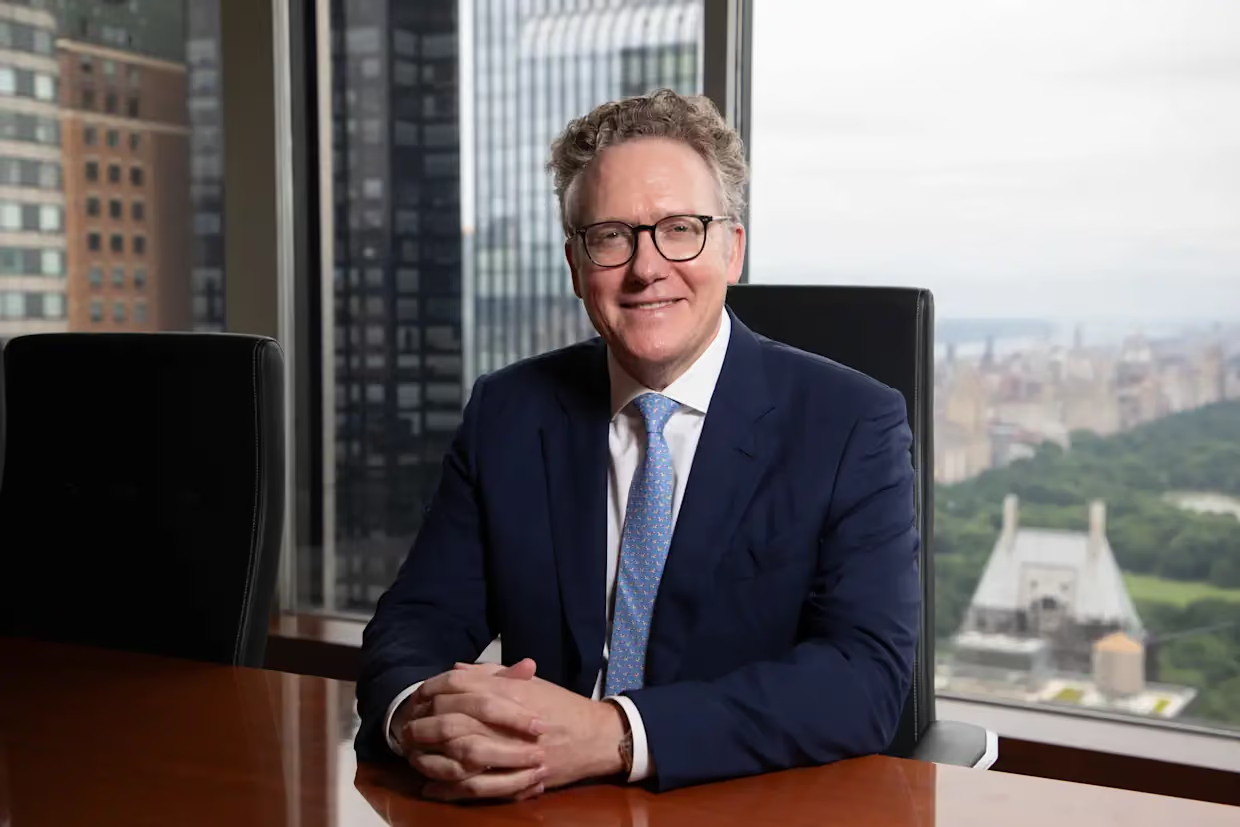
Matthew McLennan in his office at First Eagle Investments in New York. Picture: Jaclyn Licht

Jonathan Shapiro

A golden year for Wall Street’s Australian stock picker

July 7, 2025
Matthew McLennan’s $14.5 billion position in gold bars and miners paid off handsomely for First Eagle this year. But he insists the precious metal still has room to run.
Read Transcript

Of all the Australians who have made a name for themselves on Wall Street, Matthew McLennan can surely lay claim to be among the most prominent.

Born in Papua New Guinea and raised in Queensland, McLennan landed in New York via Sydney and London and is now the co-head of First Eagle’s global value team, overseeing the asset manager’s $US62.3 billion ($94.7 billion) global fund.

It’s far from your typical equities fund. In fact, more than 10 per cent of the portfolio is invested, not in stocks, but gold bullion. In addition, the fund has stakes in listed gold miners which lifts its total exposure to the precious metal to more than 14.5 per cent.

And in a year in which gold has been among the hottest commodities, it’s a position that has paid off for investors in the fund, which returned 19.07 per cent in the 12 months to July 1.

“The reason we own gold is it’s the embodiment of scarcity value,” McLennan tells The Australian Financial Review ahead of his appearance at the Sohn Hearts & Minds charity conference in November this year.

“You can create more nominal claims on a sovereign entity, but gold is relatively fixed in supply, and so it’s a good potential hedge against that nominal drift accelerating in the economy.”

In other words, gold is there to protect value in times when central banks are pumping the global economy with money or governments are flooding it with debt.

But is the rally in gold near its peak? McLennan doesn’t think so.

“I would argue that gold has recovered from depressed levels relative to equities, and depressed levels relative to the stock of government debt, to more rational price levels.”

McLennan insists he’s not a “gold bug” and in April amid the market rout, he was trimming the fund’s gold exposure to buy beaten-down stocks.

In fact, the past year has been unusual in that both stocks and gold have enjoyed a solid rally which has meant the precious metal hasn’t just protected the portfolio but enhanced it.

The global sharemarket gained 16.7 per cent, but the gold price jumped 42 per cent and the index of gold miners was even higher at 55.3 per cent.

For McLennan, the dual rise in stocks and gold is a “very important price signal in markets”.

“What it tells you is that the real value of money has gone down. The market is making a judgment that real assets, in aggregate, are worth more, and the symmetry of that is that there’s an expected greater supply of fixed nominal assets.”

By fixed nominal assets, he means bonds, and in particular government bonds. The worry he shares with the market is that we’re getting closer to the limits of how much money governments can borrow, and ultimately repay.

If the 1990s was a crisis in corporate debt, and the 2000s a crisis centred on household debt, “the emergent risk for the decade ahead has been sovereign in nature”.

McLennan is also concerned that United States indebtedness is high at a time when most Americans have jobs, and the country will lack the capacity to borrow what it needs if the economy turns.

In time, the market is going to demand higher interest rates to lend to the government either because inflation goes up or the risk of default or debasement goes up.

“The absence of a risk-free rate is global in nature, and it’s an interesting backdrop for what’s going on in markets at the moment,” the fund manager adds.


Risk of complacency


For now, the market appears to have set aside its worries about how the US will be able to finance its deficit as sharemarkets are back at record highs and corporate debt spreads have contracted to their lowest levels since the global financial crisis.

“When you have easy financial conditions, low credit spreads, high multiples, there’s less asymmetry between price and prospects,” McLennan says.

“Prospects can improve, but you’re already pricing some improvement. So, I think there may be a risk of complacency in risk assets.”

And if the next six months is as eventful as the last, the market’s confidence is set to be shaken again.

“If there’s one commodity, the market’s short of its patience.”

McLennan was first hired at Goldman Sachs in Sydney in 1994 before he eventually found his way to London where he ran a global equity fund for the firm’s private clients.

In September 2008 just as Lehman Brothers was collapsing, and the global financial system was on the brink, McLennan joined First Eagle, a firm with a heritage that dates back to the 1800s.

The timing was hardly ideal, but the real challenge was to come. Because the value style of investing, which can broadly be defined as buying stocks on low valuations, has been out of favour ever since.

Since January 2009, the MSCI value factor has lagged the global index while the MSCI growth factor is 43 per cent ahead.

“The essence of a value mindset is that you see risk as a permanent impairment of capital. For us, our primary objective as investors is to avoid the permanent impairment of capital.”

McLennan says the traditional value investing approach of buying the cheapest stocks based on certain crude measures left investors exposed to “adverse selection risk”. In other words, they may end up owning businesses with weak market positions, vulnerable balance sheets and poor management.

“We have to feel comfortable with a business first before we assess value,” he adds. “Ultimately, you have to feel comfortable that there’s some persistence to the cash flow stream and some integrity to the positional attributes of the business before you can capitalise earnings.”

Among First Eagle’s largest current holdings are Meta, Oracle, HCA Healthcare and Philip Morris.

The 56-year-old has managed to survive and flourish on Wall Street for three decades. So, what’s his secret?

Patience, he says.

“If there’s one commodity, the market’s short of its patience. Having a patient temperament enables you to weather protracted windows where your approach might be short on social acceptance.

“It helps you stick to a philosophy, even though there may be fads in between that lead other people into what turn out to be dead ends.”

Another essential quality in funds management is humility, he adds.

“The reality is that much of what you’ve learned in business school is how to model statistical risk. But the truth is, a complex system like the world economy is much better described by uncertainties.

“You just have to be open-minded to the fact that the reality can be quite strange. If you construct portfolios that can be robust in hard-to-imagine scenarios that gives you some staying power.”

The Sohn Hearts & Minds takes place at the Sydney Opera House on Friday, November 14, 2025. The Australian Financial Review is a media partner and tickets can be purchased here.

This article was originally posted by The Australian Financial Review here.

Licensed by Copyright Agency. You must not copy this work without permission.

Of all the Australians who have made a name for themselves on Wall Street, Matthew McLennan can surely lay claim to be among the most prominent.

Born in Papua New Guinea and raised in Queensland, McLennan landed in New York via Sydney and London and is now the co-head of First Eagle’s global value team, overseeing the asset manager’s $US62.3 billion ($94.7 billion) global fund.

It’s far from your typical equities fund. In fact, more than 10 per cent of the portfolio is invested, not in stocks, but gold bullion. In addition, the fund has stakes in listed gold miners which lifts its total exposure to the precious metal to more than 14.5 per cent.

And in a year in which gold has been among the hottest commodities, it’s a position that has paid off for investors in the fund, which returned 19.07 per cent in the 12 months to July 1.

“The reason we own gold is it’s the embodiment of scarcity value,” McLennan tells The Australian Financial Review ahead of his appearance at the Sohn Hearts & Minds charity conference in November this year.

“You can create more nominal claims on a sovereign entity, but gold is relatively fixed in supply, and so it’s a good potential hedge against that nominal drift accelerating in the economy.”

In other words, gold is there to protect value in times when central banks are pumping the global economy with money or governments are flooding it with debt.

But is the rally in gold near its peak? McLennan doesn’t think so.

“I would argue that gold has recovered from depressed levels relative to equities, and depressed levels relative to the stock of government debt, to more rational price levels.”

McLennan insists he’s not a “gold bug” and in April amid the market rout, he was trimming the fund’s gold exposure to buy beaten-down stocks.

In fact, the past year has been unusual in that both stocks and gold have enjoyed a solid rally which has meant the precious metal hasn’t just protected the portfolio but enhanced it.

The global sharemarket gained 16.7 per cent, but the gold price jumped 42 per cent and the index of gold miners was even higher at 55.3 per cent.

For McLennan, the dual rise in stocks and gold is a “very important price signal in markets”.

“What it tells you is that the real value of money has gone down. The market is making a judgment that real assets, in aggregate, are worth more, and the symmetry of that is that there’s an expected greater supply of fixed nominal assets.”

By fixed nominal assets, he means bonds, and in particular government bonds. The worry he shares with the market is that we’re getting closer to the limits of how much money governments can borrow, and ultimately repay.

If the 1990s was a crisis in corporate debt, and the 2000s a crisis centred on household debt, “the emergent risk for the decade ahead has been sovereign in nature”.

McLennan is also concerned that United States indebtedness is high at a time when most Americans have jobs, and the country will lack the capacity to borrow what it needs if the economy turns.

In time, the market is going to demand higher interest rates to lend to the government either because inflation goes up or the risk of default or debasement goes up.

“The absence of a risk-free rate is global in nature, and it’s an interesting backdrop for what’s going on in markets at the moment,” the fund manager adds.


Risk of complacency


For now, the market appears to have set aside its worries about how the US will be able to finance its deficit as sharemarkets are back at record highs and corporate debt spreads have contracted to their lowest levels since the global financial crisis.

“When you have easy financial conditions, low credit spreads, high multiples, there’s less asymmetry between price and prospects,” McLennan says.

“Prospects can improve, but you’re already pricing some improvement. So, I think there may be a risk of complacency in risk assets.”

And if the next six months is as eventful as the last, the market’s confidence is set to be shaken again.

“If there’s one commodity, the market’s short of its patience.”

McLennan was first hired at Goldman Sachs in Sydney in 1994 before he eventually found his way to London where he ran a global equity fund for the firm’s private clients.

In September 2008 just as Lehman Brothers was collapsing, and the global financial system was on the brink, McLennan joined First Eagle, a firm with a heritage that dates back to the 1800s.

The timing was hardly ideal, but the real challenge was to come. Because the value style of investing, which can broadly be defined as buying stocks on low valuations, has been out of favour ever since.

Since January 2009, the MSCI value factor has lagged the global index while the MSCI growth factor is 43 per cent ahead.

“The essence of a value mindset is that you see risk as a permanent impairment of capital. For us, our primary objective as investors is to avoid the permanent impairment of capital.”

McLennan says the traditional value investing approach of buying the cheapest stocks based on certain crude measures left investors exposed to “adverse selection risk”. In other words, they may end up owning businesses with weak market positions, vulnerable balance sheets and poor management.

“We have to feel comfortable with a business first before we assess value,” he adds. “Ultimately, you have to feel comfortable that there’s some persistence to the cash flow stream and some integrity to the positional attributes of the business before you can capitalise earnings.”

Among First Eagle’s largest current holdings are Meta, Oracle, HCA Healthcare and Philip Morris.

The 56-year-old has managed to survive and flourish on Wall Street for three decades. So, what’s his secret?

Patience, he says.

“If there’s one commodity, the market’s short of its patience. Having a patient temperament enables you to weather protracted windows where your approach might be short on social acceptance.

“It helps you stick to a philosophy, even though there may be fads in between that lead other people into what turn out to be dead ends.”

Another essential quality in funds management is humility, he adds.

“The reality is that much of what you’ve learned in business school is how to model statistical risk. But the truth is, a complex system like the world economy is much better described by uncertainties.

“You just have to be open-minded to the fact that the reality can be quite strange. If you construct portfolios that can be robust in hard-to-imagine scenarios that gives you some staying power.”

The Sohn Hearts & Minds takes place at the Sydney Opera House on Friday, November 14, 2025. The Australian Financial Review is a media partner and tickets can be purchased here.

This article was originally posted by The Australian Financial Review here.

Licensed by Copyright Agency. You must not copy this work without permission.

Disclaimer: This material has been prepared by Australian Financial Review, published on July 7, 2025. HM1 is not responsible for the content of linked websites or content prepared by third party. The inclusion of these links and third-party content does not in any way imply any form of endorsement by HM1 of the products or services provided by persons or organisations who are responsible for the linked websites and third-party content. This information is for general information only and does not consider the objectives, financial situation or needs of any person. Before making an investment decision, you should read the relevant disclosure document (if appropriate) and seek professional advice to determine whether the investment and information is suitable for you.

facebook
linkedin
All
Thank you! Your submission has been received!
Oops! Something went wrong while submitting the form.
November 14, 2022

Think outside the box for green investment opportunities

James Miller, Portfolio Manager at Firetrail Investments, believes investors need to stop seeing the global decarbonisation push as a risk – and start seeing it as an opportunity.

Read More
October 30, 2022

Why this fundie is betting big on two losing companies

Speaking to the AFR before the SH&M conference, Sandler named global on-demand ride-sharing and food delivery service Uber Technologies among his top picks, alongside real estate marketplace Zillow.

Read More
October 13, 2022

It’s Trump I fear, says Putin’s nemesis

Bill Browder, once the largest foreign investor in Russia and the man behind the global Magnitsky justice campaign, says the US is the weakest link in the war in Ukraine.

Read More
October 13, 2022

This fundie fought Vladimir Putin. He says there can be no peace deal

Bill Browder, the fund manager who has become one of Vladimir Putin’s fiercest critics, says the Russian leader is increasingly desperate, but no less dangerous.

Read More
August 31, 2022

‘Putin’s number one foreign enemy’ to address Aussie finance event

Bill Browder, who is viewed as a key enemy of Russia’s government will address Australian investors on the war in Ukraine at this year’s Sohn Hearts & Minds conference.

Read More
August 31, 2022

Putin critic and author Bill Browder to headline Sohn investor conference

Bill Browder, one of Putin's fiercest critics, the founder of Hermitage Capital and the man behind the Magnitsky Law, will headline this year's Sohn Hearts & Minds investor conference.

Read More
August 31, 2022

Sohn Hearts & Minds looks beyond tech ahead of Hobart event

Keynote speaker Bill Browder is the former Hermitage Capital hedge fund manager who has lobbied governments to black-list senior Russian officials attempting to shift their assets offshore.

Read More
December 3, 2021

Hamish Corlett picks Spotify as his top stock again at Sohn Hearts & Minds Conference

Hamish Corlett is the only stock picker in the history of the Sohn Hearts & Minds Investment Conference to pitch exactly the same company twice.

Read More
December 3, 2021

Sohn Hearts and Minds: The Australian Fund Manager Coverage

Leading fund managers reveal their top stock picks for the year ahead at the Sohn Hearts & Minds Conference. Read The Australian live coverage.

Read More
December 2, 2021

Here comes the Sohn: big names battle over conference music

For all that heavyweight finance names Michael Walsh, David ­Paradice, Matthew Grounds and Gary Weiss have in common professionally, one thing they can’t seem to find consensus on is music.

Read More