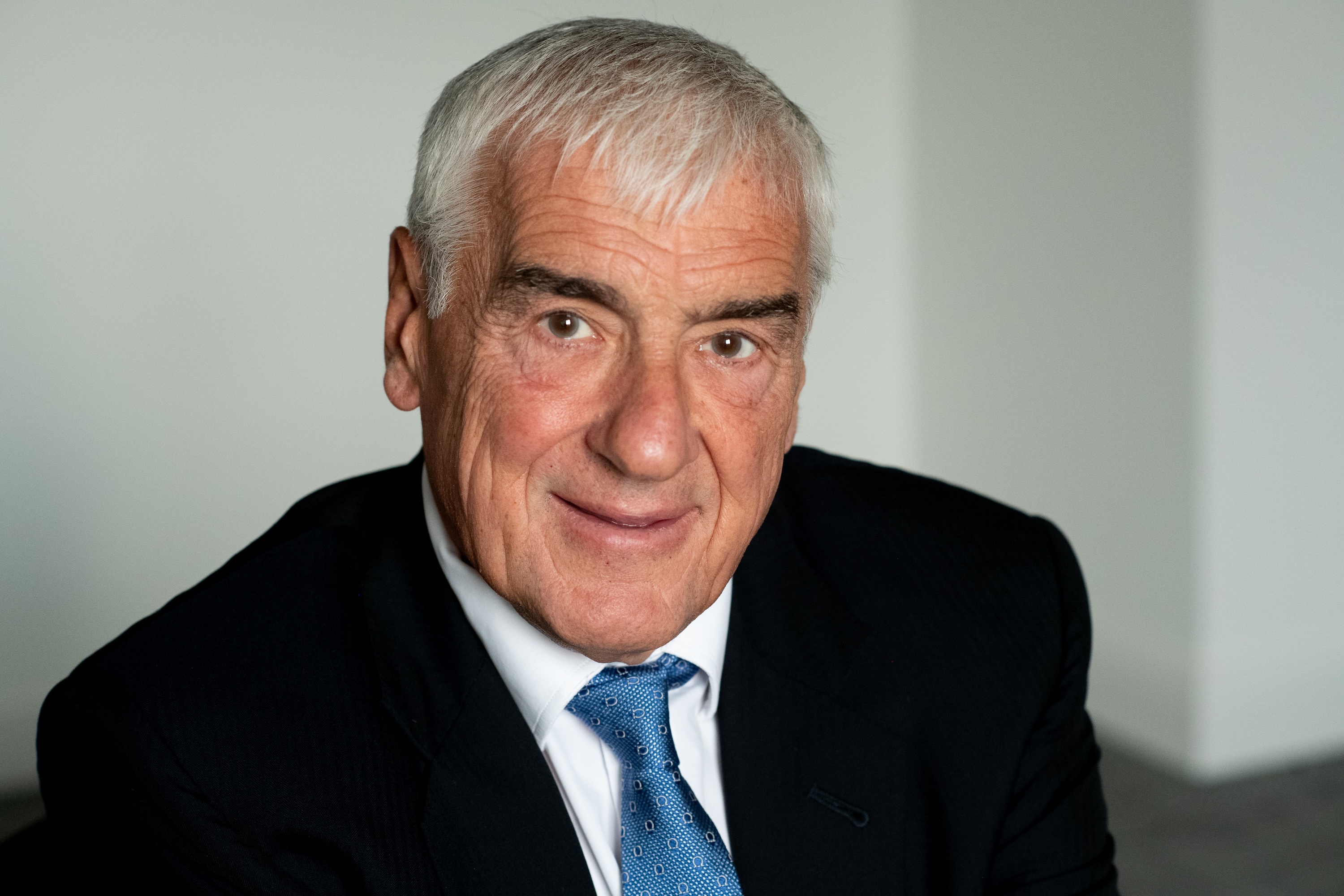
Billionaire hedge fund manager enacts ‘little short’ on the market

Investing veteran Lord Michael Hintze says he’s taking out insurance against expensive debt and equity markets that are being propelled by passive flows.

Jonathan Shapiro

Billionaire hedge fund manager enacts ‘little short’ on the market

October 1, 2025
Investing veteran Lord Michael Hintze says he’s taking out insurance against expensive debt and equity markets that are being propelled by passive flows.
Read Transcript

The journey of Lord Michael Hintze from Harbin, China, where he was born, to the House of Lords is a fascinating one.


The English-Australian billionaire served as a captain in the Australian Army, studied at Harvard and worked at Goldman Sachs before starting his own investment firm, which he sold last year.


Now 72, Hintze is back doing what he does best: trading the market.


“We are not running the biggest short we’ve ever had, but we are running a short side to our credit portfolio,” Hintze tells The Australian Financial Review.


In other words, he’s betting that the price of the debt will fall.


“We are also protecting ourselves through insurance on the equity market. Valuations are not totally unreasonable, but you have to be cautious.”


Hintze is arguably one of Australia’s most successful investors, having founded CQS, an investment firm which had $US20 billion ($30.3 billion) under management at its peak.


It was sold to Canadian investment giant Manulife in 2024, but the transaction excluded the hedge fund strategy, which Hintze has run since 2004 and continues to manage in his newly created entity.


“This is going back to the future,” Hintze says, referring to some of his long-serving lieutenants that he has brought with him to help him beat the market.


A well-known philanthropist, he will be making his debut at the Sohn Hearts & Minds charity investment conference that kicks off in Sydney next month.


He’s a UK Conservative Party donor, has been knighted by both the Pope and Queen Elizabeth, given an Order of Australia and in 2022 he was made a baron in the House of Lords by King Charles.


Richer trading opportunities

The billionaire has previously told the Financial Review that he developed his philanthropic bent while he served in the Australian army. It’s based on three principles: respect for institutions, protect the most fragile in society and foster aspiration.


His visit to Sydney next month gives Hintze the chance to visit some of his rural properties including one in Deltroit, near Gundagai in NSW, which is also the name of his new firm.


Deltroit Asset Management has $US1.5 billion under management including a “big chunk” of his own capital.


While Hintze trades anything from stocks and bonds to commodities, his forte is the credit markets, which he says are richer with trading opportunities.


The big discussion point is whether credit spreads – that is, the trading margin of corporate debt above the risk-free rate – have become too tight. That’s because on some measures, the return for lending money is as low as it’s been since the 2008 global financial crisis.


Hintze says it’s an important question, but not an easy one to answer.


“If we are in a world where there is an enormous amount of liquidity because every man and dog is running a deficit, it’s easier to pay off debt. The probability of default is going down.”


But he cautions, “the potential loss goes up,” when the defaults climb. It’s for this reason he’s taking short credit bets and buying insurance against corporate defaults.


“There is a huge appetite for credit. Frankly given the risks we have out there, I feel [credit spreads] are tighter than I would like.”


But what about the sharemarket? Is it overheated?


Well, it depends, according to Hintze. The trajectory and valuation of the S&P 500 Index is in the hands of a few companies such as dominant chipmaker Nvidia, which he says is actually cheap relative to its expected growth rate.


AI and the influx of passive funds

“This is a $US4.5 trillion company [compared] with a global GDP of $US110 trillion. At this point the growth is fine, but how much can it keep growing?”


Hintze says you really “have to have your wits about you” when trading fast-growing stocks on high valuations.


“You have to understand the G [growth] but you also have to understand the E [earnings] and you have to understand sentiment.”


“These things can change on a dime. What’s the difference between a PE [price-earnings ratio] of 38 times and a PE of 33? I don’t know, but it [equates to] a 10 per cent stock price move.”


There is one sector of the sharemarket, however, where Hintze does see value: electricity generators, which after years of being dismissed as low growth utilities are benefiting from increased electrification and the power demands of artificial intelligence.


He is torn about AI. While it’s driving productivity, innovation and scientific advancement, he also says that it’s creating “real societal dangers”.


“It’s powerful. We will probably need less analysts. But it’s unbundling the training process in our society and our ability to think.”


One other trend that most active fund managers have derided as dangerous is the increasing flow of money into low-cost passive funds. Today about half the sharemarket comprises price-agnostic rules-based capital that tracks a benchmark.


The passive money is also flooding into the credit markets via exchange-traded funds, making it far easier to trade corporate debt. Hintze says he’s had to adapt his strategy in a world where passive flows dominate.


“The fundamentals matter less until they matter a lot. It’s the reason why the short guys have walked away from the market.”

This article was originally posted by The Australian Financial Review here.

Licensed by Copyright Agency. You must not copy this work without permission.

The journey of Lord Michael Hintze from Harbin, China, where he was born, to the House of Lords is a fascinating one.


The English-Australian billionaire served as a captain in the Australian Army, studied at Harvard and worked at Goldman Sachs before starting his own investment firm, which he sold last year.


Now 72, Hintze is back doing what he does best: trading the market.


“We are not running the biggest short we’ve ever had, but we are running a short side to our credit portfolio,” Hintze tells The Australian Financial Review.


In other words, he’s betting that the price of the debt will fall.


“We are also protecting ourselves through insurance on the equity market. Valuations are not totally unreasonable, but you have to be cautious.”


Hintze is arguably one of Australia’s most successful investors, having founded CQS, an investment firm which had $US20 billion ($30.3 billion) under management at its peak.


It was sold to Canadian investment giant Manulife in 2024, but the transaction excluded the hedge fund strategy, which Hintze has run since 2004 and continues to manage in his newly created entity.


“This is going back to the future,” Hintze says, referring to some of his long-serving lieutenants that he has brought with him to help him beat the market.


A well-known philanthropist, he will be making his debut at the Sohn Hearts & Minds charity investment conference that kicks off in Sydney next month.


He’s a UK Conservative Party donor, has been knighted by both the Pope and Queen Elizabeth, given an Order of Australia and in 2022 he was made a baron in the House of Lords by King Charles.


Richer trading opportunities

The billionaire has previously told the Financial Review that he developed his philanthropic bent while he served in the Australian army. It’s based on three principles: respect for institutions, protect the most fragile in society and foster aspiration.


His visit to Sydney next month gives Hintze the chance to visit some of his rural properties including one in Deltroit, near Gundagai in NSW, which is also the name of his new firm.


Deltroit Asset Management has $US1.5 billion under management including a “big chunk” of his own capital.


While Hintze trades anything from stocks and bonds to commodities, his forte is the credit markets, which he says are richer with trading opportunities.


The big discussion point is whether credit spreads – that is, the trading margin of corporate debt above the risk-free rate – have become too tight. That’s because on some measures, the return for lending money is as low as it’s been since the 2008 global financial crisis.


Hintze says it’s an important question, but not an easy one to answer.


“If we are in a world where there is an enormous amount of liquidity because every man and dog is running a deficit, it’s easier to pay off debt. The probability of default is going down.”


But he cautions, “the potential loss goes up,” when the defaults climb. It’s for this reason he’s taking short credit bets and buying insurance against corporate defaults.


“There is a huge appetite for credit. Frankly given the risks we have out there, I feel [credit spreads] are tighter than I would like.”


But what about the sharemarket? Is it overheated?


Well, it depends, according to Hintze. The trajectory and valuation of the S&P 500 Index is in the hands of a few companies such as dominant chipmaker Nvidia, which he says is actually cheap relative to its expected growth rate.


AI and the influx of passive funds

“This is a $US4.5 trillion company [compared] with a global GDP of $US110 trillion. At this point the growth is fine, but how much can it keep growing?”


Hintze says you really “have to have your wits about you” when trading fast-growing stocks on high valuations.


“You have to understand the G [growth] but you also have to understand the E [earnings] and you have to understand sentiment.”


“These things can change on a dime. What’s the difference between a PE [price-earnings ratio] of 38 times and a PE of 33? I don’t know, but it [equates to] a 10 per cent stock price move.”


There is one sector of the sharemarket, however, where Hintze does see value: electricity generators, which after years of being dismissed as low growth utilities are benefiting from increased electrification and the power demands of artificial intelligence.


He is torn about AI. While it’s driving productivity, innovation and scientific advancement, he also says that it’s creating “real societal dangers”.


“It’s powerful. We will probably need less analysts. But it’s unbundling the training process in our society and our ability to think.”


One other trend that most active fund managers have derided as dangerous is the increasing flow of money into low-cost passive funds. Today about half the sharemarket comprises price-agnostic rules-based capital that tracks a benchmark.


The passive money is also flooding into the credit markets via exchange-traded funds, making it far easier to trade corporate debt. Hintze says he’s had to adapt his strategy in a world where passive flows dominate.


“The fundamentals matter less until they matter a lot. It’s the reason why the short guys have walked away from the market.”

This article was originally posted by The Australian Financial Review here.

Licensed by Copyright Agency. You must not copy this work without permission.

Disclaimer: This material has been prepared by Australian Financial Review, published on October 1, 2025. HM1 is not responsible for the content of linked websites or content prepared by third party. The inclusion of these links and third-party content does not in any way imply any form of endorsement by HM1 of the products or services provided by persons or organisations who are responsible for the linked websites and third-party content. This information is for general information only and does not consider the objectives, financial situation or needs of any person. Before making an investment decision, you should read the relevant disclosure document (if appropriate) and seek professional advice to determine whether the investment and information is suitable for you.

facebook
linkedin
All
Thank you! Your submission has been received!
Oops! Something went wrong while submitting the form.
October 6, 2023

Secret to a long life cheaper than you think celebrity physician Peter Attia reveals

Don't miss Dr Peter Attia who will speak at the Sohn Hearts & Minds Conference at the Sydney Opera House next month.

Read More
September 18, 2023

‘Volatility is opportunity’: why this manager loves shorting stocks

Angela Aldrich of Bayberry Capital Partners LP bet against Treasury Wine Estates at the top of the market and now she's preparing to make her next big call at this year's Sohn Hearts & Minds Conference.

Read More
September 11, 2023

Investors Sweeten On Hedge Funds As Rates Climb

After a decade of easy money pushing equity markets in one direction, Wall Street hedge fund manager Ricky Sandler says the return of volatility and higher interest rates is seeing money return to long-short strategies.

Read More
September 11, 2023

Stock Stars Look Under The Surface

Influential New York-hedge fund manager Ricky Sandler returns to Australia to make a new pick at this year’s Sohn Hearts & Minds conference that will be held at the Sydney Opera House on November 17.

Read More
Barrenjoey co-executive chairman Matthew Grounds and New York-based Eminence Capital fund manager Ricky Sandler will be at the eighth Sohn Hearts & Minds conference. Picture: Peter RaeBarrenjoey co-executive chairman Matthew Grounds and New York-based Eminence Capital fund manager Ricky Sandler will be at the eighth Sohn Hearts & Minds conference. Picture: Peter RaeBarrenjoey co-executive chairman Matthew Grounds and New York-based Eminence Capital fund manager Ricky Sandler will be at the eighth Sohn Hearts & Minds conference. Picture: Peter RaeBarrenjoey co-executive chairman Matthew Grounds and New York-based Eminence Capital fund manager Ricky Sandler will be at the eighth Sohn Hearts & Minds conference. Picture: Peter Rae
September 11, 2023

Top Ny Stock Picker Warns Inflation To Remain Above Pre-Covid Levels

Influential New York hedge fund manager Ricky Sandler of Eminence Capital returns for the 2023 Sohn Hearts & Minds Conference in Sydney and says no one is focused on picking interesting, idiosyncratic stocks.

Read More
August 4, 2023

New Relic

New Relic was pitched by Ricky Sandler of Eminence Capital at the 2022 Sohn Hearts & Minds Conference.

Read More
June 18, 2023

Investors can’t agree how to value the world’s hottest stock

Despite mixed investor opinions, Munro Partners (Core Fund Manager) remains a strong believer in Nvidia. They are standing firm in their investment and still consider it a solid buy.

Read More
January 5, 2023

Why Transurban will always be one step ahead of inflation

Loathed by motorists, but loved by investors. Transurban came under focus when Catherine Allfrey nominated the roads operator as her top pick at the recent Sohn Hearts & Minds Conference.

Read More
November 18, 2022

Don’t rush to invest yet, fund manager tells Sohn event

Fund manager turned anti-corruption campaigner Bill Browder is advising investors to hang on to their cash until central banks stop raising interest rates and the cost of living starts to come down.

Read More
November 18, 2022

Hearts racing: Rich listers rendezvous for speed-dating style stock picking

A room filled with 700 of the country’s financial luminaries and billionaires is a difficult place to pitch an investment idea but it’s a great place to raise money for charity.

Read More
November 18, 2022

How MONA’s David Walsh shocked our top stock pickers

Professional gambler and arts impresario David Walsh had a brutal message for successful top money managers – you may just be lucky.

Read More
November 18, 2022

Why Sohn’s top stock pickers want investors to play it safe

Top global money managers are telling investors to steer clear of companies that don’t make money and invest instead in unloved but profitable businesses.

Read More
November 17, 2022

Low debt counts for everything, says Perpetual’s Aboud

Perpetual’s top stock picker Anthony Aboud makes his money running against the crowd and this is why property trusts like Charter Hall are sitting right the top his list right now.

Read More
November 17, 2022

Perpetual’s Aboud says bet on balance sheets in turbulent markets

Perpetual’s Anthony Aboud says companies with strong balance sheets will finally be rewarded for their discipline in a time of global market upheaval.

Read More
November 16, 2022

How Gerry Cardinale of RedBird Capital tries to double his money investing in sport

The owner of AC Milan and a host of other soccer, cricket, baseball and ice hockey assets is trying to double his money in the ‘resilient’ asset class.

Read More