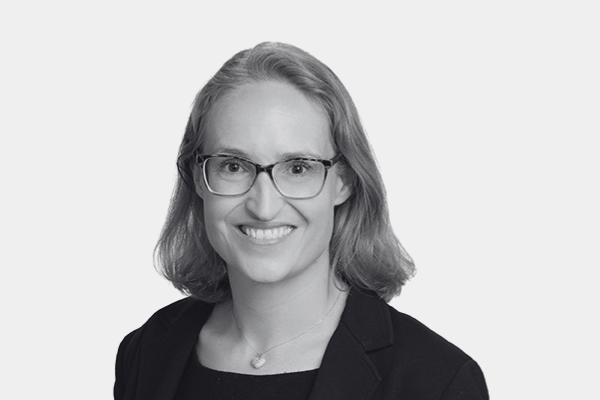
Why Samantha D'Amore of Cymer Capital is looking beyond US

Samantha D'Amore shares where she's finding compelling opportunities beyond the US and the global themes shaping her investment approach.

David Rogers

Why Samantha D'Amore of Cymer Capital is looking beyond US

October 24, 2026
Samantha D'Amore shares where she's finding compelling opportunities beyond the US and the global themes shaping her investment approach.
Read Transcript

There is a particular kind of confidence required to leave a secure, two-decade career on Wall Street and start a funds management business from scratch.

‍

Cymer Capital founder and chief investment officer Samantha D’Amore has plenty of it.

‍

Cymer is the Welsh word for “confluence” – the point where two rivers meet. It is a fitting choice for a woman from working-class Wales, the first in her family to finish high school and go to university.

‍

A news story inspired her to apply to Harvard; financial aid and cleaning bathrooms covered the rest. “Capitalism is just brilliant at solving problems,” D’Amore says. “But most of institutional asset management wants to put you in a box.”

‍

Her answer was to throw out the box altogether. Instead of starting with a sector or a region, she starts with the problem – ageing populations and care capacity, climate adaptation, digital complexity, food security, infrastructure resilience – then goes looking for the companies best placed to solve it, wherever they are listed.

‍

“If you ask the question that way, and be actually really inclusive, it opens up a really interesting array of companies,” she says.

‍

That creates durable, resilient growth that is underappreciated.”

‍

The scale of the search is deliberately wide. Cymer tracks 14 persistent problems and more than 60 solutions addressing them, drawing from a universe of roughly 800 non-US companies worth more than $US10bn ($14bn). Fundamental research narrows that to a working universe of about 300 names, from which the fund holds just 30-45 of its highest-conviction ideas at any time.

‍

Much of that opportunity, in D’Amore’s view, now sits outside the US. After years of extraordinary outperformance by US ­sharemarkets, many investors have become unintentionally overweight US stocks, just as the case for diversification is strengthening as the tech giants start to falter.

‍

“Policy coherence globally is problematic, and maybe the US doesn’t have as strong a foothold on superb policy coherence relative to the rest of the world,” she says. “For me, just from a pure diversification perspective, this creates a fantastic opportunity in those international markets.”

‍

Benchmarked against the MSCI ACWI ex-US index, Cymer’s active share runs in the high 80 per cent to low 90 per cent range. In plain terms, roughly 90 per cent of what she owns looks nothing like the index.

‍

The fund runs inside tight guardrails: no leverage, no shorting, no derivatives, no currency hedging, and no more than 15 per cent in any single position.

‍

It currently manages only D’Amore’s own capital and is not yet open to outside investors.

‍

Her process reflects a scientific instinct, built on a physics degree.

‍

The bulk of her time – roughly three-quarters – goes on assessing three to five-year fundamentals: competitive advantages, end markets, management execution and financial quality.

‍

Valuation is treated as a timing tool rather than the thesis itself.

‍

That rigour was sharpened by an unlikely early posting.

‍

Just before the subprime crisis morphed into the global financial crisis in 2008, D’Amore joined an energy-focused long/short hedge fund just as global markets turned sharply.

‍

“Stocks, from a valuation perspective, can go way higher and way lower than you think is ­rational,” she says. Underwriting the downside case first, she says, became a reflex – one she carried with her even after deciding long-only investing suits her best.

‍

She points to Mercado Libre, the Latin American e-commerce and fintech giant, as an example of that mindset at work. D’Amore admires the business but doesn’t own it, after an unexpected chief financial officer change in 2023 was followed by the founder stepping back in 2025. “Whenever you have a leadership transition, everybody should be allowed to transition off,” she says. “But when you have a change in the management team, you have to re-underwrite the thesis.”

‍

In a portfolio as concentrated as Cymer’s, every holding has to earn its place, and uncertainty over who really owns the strategy was enough to keep her out.

‍

More than a decade at Jennison Associates, covering industrials, materials and Asian infra­structure, gave D’Amore a “pattern library” of companies and cycles across geographies.

‍

A later stint at sustainable investor Trillium Asset Management taught her that non-financial data can be a genuine fundamental signal, not just a values screen.

‍

D’Amore is explicit that the strategy is thematically aligned but not an impact fund. Buying shares on the public market, she says, gives an investor no attribution to a company’s actions. Environmental, social and governance factors are “simply data points” that help explain the quality and durability of a company’s cash flow.

‍

“This is a financial-returns-first product,” she says – one that uses a lens around persistent global problems to find durable growth, without claiming to change company behaviour simply by buying shares on the public market.

‍

Cymer is also notable for being, in D’Amore’s words, “100 per cent woman-owned and founder-led” – a fact she states openly, given that fewer than 2 per cent of industry assets sit with female managers. But it’s less about identity than about a broader belief in diversity of thought.

‍

“I don’t really care where you’re from or what you look like,” she says. “I’m more interested in how you think.”

‍

That philosophy extends to hiring, where she looks for kindness and curiosity over finance degrees.

‍

“I’m living proof you can learn anything on the job,” she says, adding that she wants people around her willing to tell her when she is wrong, not simply nod along.

‍

Looking ahead, D’Amore sees two forces reshaping where the opportunities – and the risks – lie: shifting policy settings around the world, and the rapid, uneven rollout of artificial intelligence.

‍

“I don’t think anyone really has the answers to which companies are being honest about that, and where the opportunities lie,” she says. “That creates a tremendous amount of opportunity, and also a tremendous amount of instability.”

‍

The 2026 Sohn Hearts & Minds Investment Leaders Conference will be held in Queenstown, New Zealand on Friday, November 6.

The Australian is a media partner and tickets can be purchased at sohnheartsandminds.com.au

‍

This article was originally posted by The Australian here. Licensed by Copyright Agency. You must not copy this work without permission.

‍

Disclaimer: This material has been prepared by The Australian, published on October 24, 2026. HM1 is not responsible for the content of linked websites or content prepared by third party. The inclusion of these links and third-party content does not in any way imply any form of endorsement by HM1 of the products or services provided by persons or organisations who are responsible for the linked websites and third-party content. This information is for general information only and does not consider the objectives, financial situation or needs of any person. Before making an investment decision, you should read the relevant disclosure document (if appropriate) and seek professional advice to determine whether the investment and information is suitable for you.

facebook
linkedin
All
Thank you! Your submission has been received!
Oops! Something went wrong while submitting the form.
November 13, 2023

This Hedge Fund Manager Is Making A 100-Year Bet On Luxury

European leisure and luxury – a designer handbag, a last-minute flight to Monte Carlo, a stay in a five-star hotel – is where many choose to spend their hard-earned cash. For Sharif el Khazen, it’s where he makes it.

Read More
November 12, 2023

How Munro Will Pick Its Next Stock Winner

Munro partner and portfolio manager Kieran Moore must select a single company to pitch to an audience of industry heavyweights at the prestigious Sohn Hearts & Minds conference in Sydney.

Read More
November 12, 2023

The Australian At The Centre Of Dalio’s Bridgewater – Who Loves It

The culture at Ray Dalio’s massive hedge fund has been a source of intrigue, and with a new book, controversy. Atul Lele says it’s made him a better investor.

Read More
November 10, 2023

Meet The Goldman Sachs Legend Shaking Up Venture Capital

Sheila Patel says it was time for the venture capital sector to “grow up” and higher rates will help do that job. VC firms need to think differently about how they invest.

Read More
November 8, 2023

Tom Naughton - There's Money In Mi Goreng | Prusik Investment

Tom Naughton is Managing Partner and CIO at Prusik Investment. In this episode, he chats to Equity Mates ahead of his appearance at the 2023 Sohn Hearts and Minds Conference.

Read More
November 6, 2023

Why Chris Kourtis just bought CSL and ResMed

A true contrarian investor, Chris Kourtis can find himself sounding a lot like a bull when in the company of bears, and there’s a lot to be bearish about at the moment.

Read More
November 5, 2023

Five Secrets To Delivering The Perfect Pitch

Australia’s best stock pickers have just eight minutes to convince the country’s top money managers they have found an investment gem that the market has overlooked.

Read More
November 2, 2023

Meet the 2023 Conference Managers

Following a rigorous global search, the Conference Fund Manager Selection Committee is pleased to share ten new managers for 2023.

Read More
October 23, 2023

Dan Loeb to headline Sohn Hearts & Minds

Famed hedge fund manager Dan Loeb has been named as one of the headline acts for next month’s Sohn Hearts & Minds philanthropic investment conference to be held in Sydney.

Read More
October 23, 2023

US Bank Run Has Slowed To A Walk, But Instability Remains

When Ravi Chopra reveals his stock pick at the prestigious Sohn Hearts & Minds conference at the Opera House in Sydney next month, it could well be a short bet on a US bank.

Read More
October 18, 2023

Two small caps: Propel Funeral Services (ASX: PFP) and Clarity Pharmaceuticals (ASX: CU6)

Get to know our 2023 Conference Fund Manager Rikki Bannan of IFM Investors who recently featured on the Equity Mates Media podcast.

Read More
October 16, 2023

How this hedge fund pulled off 2023’s ‘big short’

Last year, Ravi Chopra was travelling through Europe to shop his latest short idea to potential investors. “Financials are really all in the weeds,” he told The Australian Financial Review in an interview from New York.

Read More
October 10, 2023

Beware the pitfalls of investing in healthcare, says IFM boss

“Healthcare is often viewed as a stable, defensive sector to invest in, but in small caps that hasn’t necessarily proven to be the case,” she says in an interview ahead of her appearance at the Sohn Hearts & Minds Conference 2023.

Read More
October 6, 2023

Secret to a long life cheaper than you think celebrity physician Peter Attia reveals

Don't miss Dr Peter Attia who will speak at the Sohn Hearts & Minds Conference at the Sydney Opera House next month.

Read More
September 18, 2023

‘Volatility is opportunity’: why this manager loves shorting stocks

Angela Aldrich of Bayberry Capital Partners LP bet against Treasury Wine Estates at the top of the market and now she's preparing to make her next big call at this year's Sohn Hearts & Minds Conference.

Read More