Why this fundie is betting big on two losing companies

Speaking to the AFR before the SH&M conference, Sandler named global on-demand ride-sharing and food delivery service Uber Technologies among his top picks, alongside real estate marketplace Zillow.

Why this fundie is betting big on two losing companies

October 30, 2022
Speaking to the AFR before the SH&M conference, Sandler named global on-demand ride-sharing and food delivery service Uber Technologies among his top picks, alongside real estate marketplace Zillow.
Read Transcript

As inflation burns a hole in consumers’ pockets and the US housing market hits the brakes, two sectors that investors are likely to be fearful of are food delivery and housing.

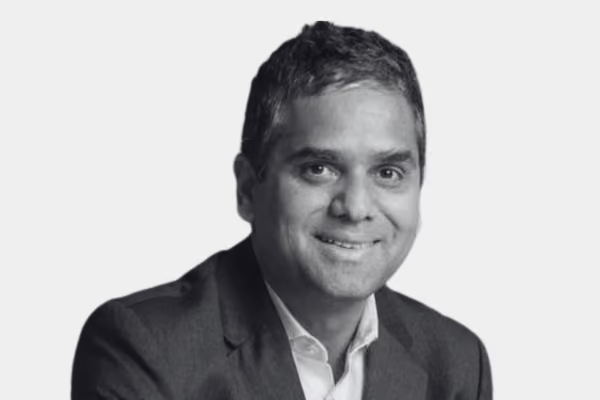
But that’s precisely where New York hedge fund manager Ricky Sandler is putting his clients’ money.

Speaking to The Australian Financial Review before the Sohn Hearts & Minds conference, Sandler named global on-demand ride-sharing and food delivery service Uber Technologies among his top picks, alongside real estate marketplace Zillow.

Both stocks have cratered over the past year; Uber declining almost 40 per cent and Zillow’s valuation slashed by 70 per cent, as rising interest rates killed the pandemic unprofitable-tech boom.

But Sandler says both are at bargain prices, anticipating Uber will double in the next 18 months. Zillow, he says, is still priced for its disastrous entry into home-flipping while quietly improving its platform.

“Sometimes we go against the macro because that’s obvious and priced in,” he says.

“That’s what everyone is worried about but no one is looking at what’s really happening underneath. The cycle will come and go. We make longer-term investments, look beyond what people are worried about in the short term but over a two-year period, will normalise.”

Three key reasons

Sandler’s Eminence Capital materially added to its Uber position in July at $US22.75, according to the firm’s latest shareholder letter.

Zillow is similarly a top 10 holding in the long/short fund alongside a basket of cannabis stocks, sports betting and gambling company Entain and chemical maker Ashland Global.

Sandler says Uber is a buy for three reasons: high margins; improving profitability; and structural advantages in food delivery that make it difficult for similar businesses to compete.

“When you look at Uber’s top five markets, they earn north of 30 per cent margins, but because they’re investing in the delivery business – because they’re investing in mobility markets – collectively today, they’re not there yet. But that’s going to become really visible over the next year or two, the profitability will go up.

“On the food delivery side, people compare Uber to DoorDash, but I think Uber has an advantage over everybody who is only in the food delivery business because they also have mobility.

“They can consolidate driver supply – their drivers can drive for Uber mobility or Uber Eats – and they can consolidate customers via Uber pass, offering savings on rides and eats, so they have a structural advantage.”

Uber is unprofitable today, but Sandler expects it to progress towards GAAP profitability, noting this will facilitate its entry into the S&P 500.

“Uber is one of the largest market cap companies not in the S&P 500, depriving the company of a meaningful passive ownership base,” he says.

“We expect this will change over the next couple of years.”

Asked about Uber’s exposure to the weakening consumer environment, Sandler thinks the market wrongly classifies ride services as a “high-price luxury” because it’s a cheaper option than hiring a car on a business trip or owning a vehicle and commuting.

He concedes there could be some weakness in food delivery but anticipates consumer habits will migrate from dining out to ordering in.

“Will some people stop ordering in from the local Italian and cook pasta at home? Yes, if they have to save,” he says.

“But today, the penetration rate of delivery is pretty slow and still going up and the potential for Uber to add delivery of packages or grocery.”

Sandler’s next pick Zillow, a real estate marketplace, is also faced by a tough set of economic circumstances.

US mortgage rates topped 7 per cent last week, the highest level in 20 years, and the latest sign that the Federal Reserve’s aggressive moves to slow the broader economy are hitting the housing market.

The company announced on Friday that it had laid off 300 staff as it contends with a slowing market. Last November, the Seattle-base company announced it was laying off a quarter of its headcount because of the closure of its home-buying business Offers.

Sandler is not deterred. “Zillow is priced this way because everyone is worried about the near term cyclically, and because historically they were in the home flipping business which lost them money,” he says.

“New management has come in and has made lots of changes; materially upgrading their technology, rolling out features that make it a better consumer experience and better monetising users.

“Everyone is worried about these macro things, and they’re missing what’s happening on a micro basis.”

No fan of fintech

Sandler is set to name his No.1 pick at the charitable Sohn Hearts & Minds conference in Tasmania on November 18. He says his trip to Australia is part pleasure, part scoping out opportunity as overseas investors eye Australia’s growing pension pot.

“There is an awful lot of money that needs to be invested offshore, and it’s growing at a good clip,” he said.

“We’re not trying to grow a lot, but asset diversity is really important to us in different markets.”

Eminence hasn’t “raised a penny” in Australia but has expanded across the Middle East. Assets under management across the firm sit at $5.6 billion with about $2.2 billion in the long/short strategy and $3.4 billion in the long strategy. Both strategies are open to new capital.

Performance in Eminence’s long/short strategy has delivered outperformance since its inception in 1999. Returns have been strong against the MSCI World Index this year, with net returns of negative 7.8 per cent versus negative 25.4 per cent. The fund has underperformed over a 10-year period, net 6.3 per cent versus index returns of 8.1 per cent.

Sandler says gains this year have come from the short side of the portfolio, generating positive 19.2 per cent alpha while longs generated negative 11.4 per cent alpha, a theme that echoes local trends as short sellers come in from the cold.

Success has come from shorting IPO and SPACs that hit the market in 2020 and last year, such as Beyond Meat and fintech disruptors Lemonade, Upstart and Affirm.

“Looking into IPOs, we learnt that after the first two or three months, they drastically underperformed the market – on average about 15 to 20 per cent over the next 18 months,” he says.

Scarier than the COVID-crash

An outspoken short seller, Sandler isn’t afraid of expressing his views, getting into stoushes with meme stock traders on Twitter.

“Dear AMC Apes, the executives at AMC thank you very much for making them rich. It’s a shame they all sold while you all HODL.” he wrote in a March tweet, before taking a months-long self-imposed break from the platform.

Asked why he engages, Sandler describes last year’s meme stock, short squeeze episode as more frighting than the COVID-19 market crash. Faced with a new and unknown force, he sought to understand what made the Reddit retail army tick.

Today, he’s managing meme risk by being “very diversified” on the short side, limiting exposure to meme stocks and tracking mentions on Reddit and options volume.

“It was a very challenging period,” he says.

“It was something new that we’d never experienced before from a group of people who were, in some ways, highly unsophisticated. And you would say, I’ll play poker against those people all day long, but in some ways, their actions created a lot of knock-on effects.

“We had enough risk management to ride through it, but it was almost more scary for me as an investor than the COVID drop because I understood it, I could understand why the market was down, but this thing on the short side was almost scarier because it was so hard to understand the behaviour, banding together on Reddit.

“Engaging with them on Twitter helped me to understand a little bit about their mindset.”

The Australian Financial Review is a media partner of sohnheartsandminds.com.au


This article was originally posted by The Australian Financial Review here.

Licensed by Copyright Agency. You must not copy this work without permission.

Disclaimer: This material has been prepared by AFR, published on 30 October 2022. HM1 is not responsible for the content of linked websites or content prepared by third party. The inclusion of these links and third-party content does not in any way imply any form of endorsement by HM1 of the products or services provided by persons or organisations who are responsible for the linked websites and third-party content. This information is for general information only and does not consider the objectives, financial situation or needs of any person. Before making an investment decision, you should read the relevant disclosure document (if appropriate) and seek professional advice to determine whether the investment and information is suitable for you.

As inflation burns a hole in consumers’ pockets and the US housing market hits the brakes, two sectors that investors are likely to be fearful of are food delivery and housing.

But that’s precisely where New York hedge fund manager Ricky Sandler is putting his clients’ money.

Speaking to The Australian Financial Review before the Sohn Hearts & Minds conference, Sandler named global on-demand ride-sharing and food delivery service Uber Technologies among his top picks, alongside real estate marketplace Zillow.

Both stocks have cratered over the past year; Uber declining almost 40 per cent and Zillow’s valuation slashed by 70 per cent, as rising interest rates killed the pandemic unprofitable-tech boom.

But Sandler says both are at bargain prices, anticipating Uber will double in the next 18 months. Zillow, he says, is still priced for its disastrous entry into home-flipping while quietly improving its platform.

“Sometimes we go against the macro because that’s obvious and priced in,” he says.

“That’s what everyone is worried about but no one is looking at what’s really happening underneath. The cycle will come and go. We make longer-term investments, look beyond what people are worried about in the short term but over a two-year period, will normalise.”

Three key reasons

Sandler’s Eminence Capital materially added to its Uber position in July at $US22.75, according to the firm’s latest shareholder letter.

Zillow is similarly a top 10 holding in the long/short fund alongside a basket of cannabis stocks, sports betting and gambling company Entain and chemical maker Ashland Global.

Sandler says Uber is a buy for three reasons: high margins; improving profitability; and structural advantages in food delivery that make it difficult for similar businesses to compete.

“When you look at Uber’s top five markets, they earn north of 30 per cent margins, but because they’re investing in the delivery business – because they’re investing in mobility markets – collectively today, they’re not there yet. But that’s going to become really visible over the next year or two, the profitability will go up.

“On the food delivery side, people compare Uber to DoorDash, but I think Uber has an advantage over everybody who is only in the food delivery business because they also have mobility.

“They can consolidate driver supply – their drivers can drive for Uber mobility or Uber Eats – and they can consolidate customers via Uber pass, offering savings on rides and eats, so they have a structural advantage.”

Uber is unprofitable today, but Sandler expects it to progress towards GAAP profitability, noting this will facilitate its entry into the S&P 500.

“Uber is one of the largest market cap companies not in the S&P 500, depriving the company of a meaningful passive ownership base,” he says.

“We expect this will change over the next couple of years.”

Asked about Uber’s exposure to the weakening consumer environment, Sandler thinks the market wrongly classifies ride services as a “high-price luxury” because it’s a cheaper option than hiring a car on a business trip or owning a vehicle and commuting.

He concedes there could be some weakness in food delivery but anticipates consumer habits will migrate from dining out to ordering in.

“Will some people stop ordering in from the local Italian and cook pasta at home? Yes, if they have to save,” he says.

“But today, the penetration rate of delivery is pretty slow and still going up and the potential for Uber to add delivery of packages or grocery.”

Sandler’s next pick Zillow, a real estate marketplace, is also faced by a tough set of economic circumstances.

US mortgage rates topped 7 per cent last week, the highest level in 20 years, and the latest sign that the Federal Reserve’s aggressive moves to slow the broader economy are hitting the housing market.

The company announced on Friday that it had laid off 300 staff as it contends with a slowing market. Last November, the Seattle-base company announced it was laying off a quarter of its headcount because of the closure of its home-buying business Offers.

Sandler is not deterred. “Zillow is priced this way because everyone is worried about the near term cyclically, and because historically they were in the home flipping business which lost them money,” he says.

“New management has come in and has made lots of changes; materially upgrading their technology, rolling out features that make it a better consumer experience and better monetising users.

“Everyone is worried about these macro things, and they’re missing what’s happening on a micro basis.”

No fan of fintech

Sandler is set to name his No.1 pick at the charitable Sohn Hearts & Minds conference in Tasmania on November 18. He says his trip to Australia is part pleasure, part scoping out opportunity as overseas investors eye Australia’s growing pension pot.

“There is an awful lot of money that needs to be invested offshore, and it’s growing at a good clip,” he said.

“We’re not trying to grow a lot, but asset diversity is really important to us in different markets.”

Eminence hasn’t “raised a penny” in Australia but has expanded across the Middle East. Assets under management across the firm sit at $5.6 billion with about $2.2 billion in the long/short strategy and $3.4 billion in the long strategy. Both strategies are open to new capital.

Performance in Eminence’s long/short strategy has delivered outperformance since its inception in 1999. Returns have been strong against the MSCI World Index this year, with net returns of negative 7.8 per cent versus negative 25.4 per cent. The fund has underperformed over a 10-year period, net 6.3 per cent versus index returns of 8.1 per cent.

Sandler says gains this year have come from the short side of the portfolio, generating positive 19.2 per cent alpha while longs generated negative 11.4 per cent alpha, a theme that echoes local trends as short sellers come in from the cold.

Success has come from shorting IPO and SPACs that hit the market in 2020 and last year, such as Beyond Meat and fintech disruptors Lemonade, Upstart and Affirm.

“Looking into IPOs, we learnt that after the first two or three months, they drastically underperformed the market – on average about 15 to 20 per cent over the next 18 months,” he says.

Scarier than the COVID-crash

An outspoken short seller, Sandler isn’t afraid of expressing his views, getting into stoushes with meme stock traders on Twitter.

“Dear AMC Apes, the executives at AMC thank you very much for making them rich. It’s a shame they all sold while you all HODL.” he wrote in a March tweet, before taking a months-long self-imposed break from the platform.

Asked why he engages, Sandler describes last year’s meme stock, short squeeze episode as more frighting than the COVID-19 market crash. Faced with a new and unknown force, he sought to understand what made the Reddit retail army tick.

Today, he’s managing meme risk by being “very diversified” on the short side, limiting exposure to meme stocks and tracking mentions on Reddit and options volume.

“It was a very challenging period,” he says.

“It was something new that we’d never experienced before from a group of people who were, in some ways, highly unsophisticated. And you would say, I’ll play poker against those people all day long, but in some ways, their actions created a lot of knock-on effects.

“We had enough risk management to ride through it, but it was almost more scary for me as an investor than the COVID drop because I understood it, I could understand why the market was down, but this thing on the short side was almost scarier because it was so hard to understand the behaviour, banding together on Reddit.

“Engaging with them on Twitter helped me to understand a little bit about their mindset.”

The Australian Financial Review is a media partner of sohnheartsandminds.com.au


This article was originally posted by The Australian Financial Review here.

Licensed by Copyright Agency. You must not copy this work without permission.

Disclaimer: This material has been prepared by AFR, published on 30 October 2022. HM1 is not responsible for the content of linked websites or content prepared by third party. The inclusion of these links and third-party content does not in any way imply any form of endorsement by HM1 of the products or services provided by persons or organisations who are responsible for the linked websites and third-party content. This information is for general information only and does not consider the objectives, financial situation or needs of any person. Before making an investment decision, you should read the relevant disclosure document (if appropriate) and seek professional advice to determine whether the investment and information is suitable for you.
Disclaimer: This material has been prepared by Australian Financial Review, published on Oct 30, 2022. HM1 is not responsible for the content of linked websites or content prepared by third party. The inclusion of these links and third-party content does not in any way imply any form of endorsement by HM1 of the products or services provided by persons or organisations who are responsible for the linked websites and third-party content. This information is for general information only and does not consider the objectives, financial situation or needs of any person. Before making an investment decision, you should read the relevant disclosure document (if appropriate) and seek professional advice to determine whether the investment and information is suitable for you.

facebook
linkedin
All
Thank you! Your submission has been received!
Oops! Something went wrong while submitting the form.
October 14, 2024

Alex Pollak champions rewards of disruptive investment

Alex Pollak’s funds management company Loftus Peak rode the Nvidia wave and he is now looking at more opportunities in disruptive industry stocks.

Read More
October 8, 2024

Sumit Gautam - Why AI won't deliver in 2025 | Scalar Gauge

Sumit Gautam is the Founder of Scalar Gauge and speaks with Equity Mates ahead of his appearance at the Sohn Hearts & Minds conference.

Read More
September 30, 2024

Missed out on Nvidia and Ozempic? This fundie says it’s never too late

Northcape Capital’s Fleur Wright is still kicking herself for not owning market darlings Nvidia and Novo Nordisk, the maker of the weight loss wonder drug Ozempic, before shares of those companies rocketed in 2023.

Read More
September 23, 2024

Scalar Gauge Fund founder Sumit Gautam cautious about over-hyped AI

Tech investor Sumit Gautam carefully avoids the word bubble when describing the investor frenzy surrounding the rise of artificial intelligence, but warns there are dangers of getting caught up in the hype.

Read More
September 9, 2024

The Wellcome Trust’s Nick Moakes made a 100-year bet. It’s paying off

Chief Investment Officer, Nick Moakes raised almost $3 billion at ultra-low rates. Sometimes the long view can be the most profitable.

Read More
September 5, 2024

Honesty the only policy that matters, says Wellcome Trust’s Nicholas Moakes

The chief investment officer of the London-based $71bn Wellcome Trust, Nick Moakes, has a simple rule for the trust’s investment team: “Never invest with anyone who is or has been or should have been in prison.”

Read More
September 5, 2024

Why Howard Marks says you’re making a big mistake

Howard Marks says investors must ignore manic depressive markets and focus on the bigger picture. Rates will be higher for longer and that will bring pain – and opportunity.

Read More
July 21, 2024

Investors ‘comfortable’ about a Trump presidency, despite volatility

Economists and market experts say the outcome of the US presidential election has been largely priced in by investors as softening inflation helps to buoy sharemarkets both globally and locally.

Read More
February 15, 2024

Hedge fund Munro says Nvidia, Microsoft have more to run

Kieran Moore is portfolio manager of Munro Partners Global Growth Fund. The Melbourne-based hedge fund oversees $4.3 billion in assets.

Read More
January 24, 2024

How To Master The Art Of Winning The Room

Jonathan Pease, the creative director behind the Sohn Hearts & Minds Conference and author of the book, Winning the Room, recently sat down for a chat with Mark Bouris on Straight Talk.

Read More
November 19, 2023

Equity Mates review the stocks pitched at the Sohn Hearts & Minds Conference

Bryce and Ren of Equity Mates attended the Sohn Hearts & Minds Conference and reviewed the stocks pitched by our new 2023 Conference Fund Managers.

Read More
Ark Invest CEO Cathie Wood remains as big-picture as ever. Picture: David RoweArk Invest CEO Cathie Wood remains as big-picture as ever. Picture: David RoweArk Invest CEO Cathie Wood remains as big-picture as ever. Picture: David RoweArk Invest CEO Cathie Wood remains as big-picture as ever. Picture: David Rowe
November 17, 2023

‘I Know It Sounds Crazy’: Cathie Wood’s Next Big Idea

Speaking from Ark’s headquarters in Florida ahead of her appearance at the Sohn Hearts & Minds Conference on Friday, Wood says she believes disinflation is now just around the corner in the US.

Read More
ARK Invest founder Cathie Wood: It does appear that the SEC here in the United States is likely to approve a spot bitcoin ETF within the next few months.ARK Invest founder Cathie Wood: It does appear that the SEC here in the United States is likely to approve a spot bitcoin ETF within the next few months.ARK Invest founder Cathie Wood: It does appear that the SEC here in the United States is likely to approve a spot bitcoin ETF within the next few months.ARK Invest founder Cathie Wood: It does appear that the SEC here in the United States is likely to approve a spot bitcoin ETF within the next few months.
November 17, 2023

ARK Founder Wood Backs Bitcoin, Banking On Spot ETF Approval

Tech investment guru Cathie Wood is still a big believer in bitcoin, so it was fitting that she chose Grayscale Bitcoin Trust as her stock pick for the 2023 Sohn Hearts & Minds Investment Leaders Conference.

Read More
IFM Investors small cap specialist Rikki Bannan addresses the Sohn Hearts & Minds Investment Leaders Conference at Sydney Opera House. Picture: Renee NowytargerIFM Investors small cap specialist Rikki Bannan addresses the Sohn Hearts & Minds Investment Leaders Conference at Sydney Opera House. Picture: Renee NowytargerIFM Investors small cap specialist Rikki Bannan addresses the Sohn Hearts & Minds Investment Leaders Conference at Sydney Opera House. Picture: Renee NowytargerIFM Investors small cap specialist Rikki Bannan addresses the Sohn Hearts & Minds Investment Leaders Conference at Sydney Opera House. Picture: Renee Nowytarger
November 17, 2023

Hot Stocks To Ride The Next Healthcare Trends

Healthcare stocks – from sleep apnoea giant ResMed, to cancer diagnostic biotech Telix Pharmaceuticals – were recommended at the Sohn Hearts & Minds Investment Leaders Conference on Friday.

Read More
November 17, 2023

How Daniel Loeb, The Real Bobby Axelrod, Made His Wall Street Billions

When Damian Lewis, the actor who plays the ruthless hedge fund boss in the drama series Billions was looking for inspiration, he sat down with Daniel Loeb.

Read More