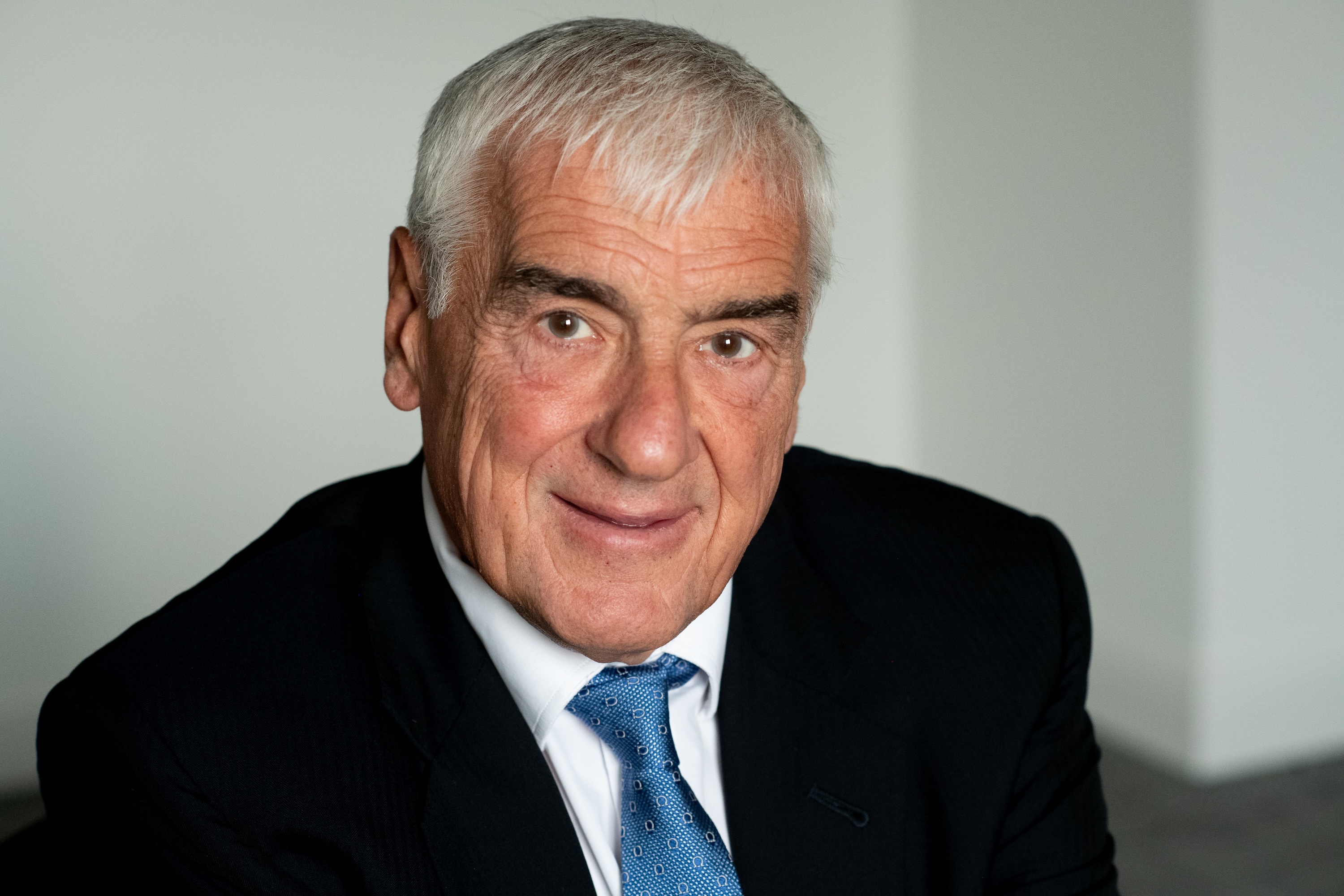
Billionaire hedge fund manager enacts ‘little short’ on the market

Investing veteran Lord Michael Hintze says he’s taking out insurance against expensive debt and equity markets that are being propelled by passive flows.

Jonathan Shapiro

Billionaire hedge fund manager enacts ‘little short’ on the market

October 1, 2025
Investing veteran Lord Michael Hintze says he’s taking out insurance against expensive debt and equity markets that are being propelled by passive flows.
Read Transcript

The journey of Lord Michael Hintze from Harbin, China, where he was born, to the House of Lords is a fascinating one.


The English-Australian billionaire served as a captain in the Australian Army, studied at Harvard and worked at Goldman Sachs before starting his own investment firm, which he sold last year.


Now 72, Hintze is back doing what he does best: trading the market.


“We are not running the biggest short we’ve ever had, but we are running a short side to our credit portfolio,” Hintze tells The Australian Financial Review.


In other words, he’s betting that the price of the debt will fall.


“We are also protecting ourselves through insurance on the equity market. Valuations are not totally unreasonable, but you have to be cautious.”


Hintze is arguably one of Australia’s most successful investors, having founded CQS, an investment firm which had $US20 billion ($30.3 billion) under management at its peak.


It was sold to Canadian investment giant Manulife in 2024, but the transaction excluded the hedge fund strategy, which Hintze has run since 2004 and continues to manage in his newly created entity.


“This is going back to the future,” Hintze says, referring to some of his long-serving lieutenants that he has brought with him to help him beat the market.


A well-known philanthropist, he will be making his debut at the Sohn Hearts & Minds charity investment conference that kicks off in Sydney next month.


He’s a UK Conservative Party donor, has been knighted by both the Pope and Queen Elizabeth, given an Order of Australia and in 2022 he was made a baron in the House of Lords by King Charles.


Richer trading opportunities


The billionaire has previously told the Financial Review that he developed his philanthropic bent while he served in the Australian army. It’s based on three principles: respect for institutions, protect the most fragile in society and foster aspiration.


His visit to Sydney next month gives Hintze the chance to visit some of his rural properties including one in Deltroit, near Gundagai in NSW, which is also the name of his new firm.


Deltroit Asset Management has $US1.5 billion under management including a “big chunk” of his own capital.


While Hintze trades anything from stocks and bonds to commodities, his forte is the credit markets, which he says are richer with trading opportunities.


The big discussion point is whether credit spreads – that is, the trading margin of corporate debt above the risk-free rate – have become too tight. That’s because on some measures, the return for lending money is as low as it’s been since the 2008 global financial crisis.


Hintze says it’s an important question, but not an easy one to answer.


“If we are in a world where there is an enormous amount of liquidity because every man and dog is running a deficit, it’s easier to pay off debt. The probability of default is going down.”


But he cautions, “the potential loss goes up,” when the defaults climb. It’s for this reason he’s taking short credit bets and buying insurance against corporate defaults.


“There is a huge appetite for credit. Frankly given the risks we have out there, I feel [credit spreads] are tighter than I would like.”


But what about the sharemarket? Is it overheated?


Well, it depends, according to Hintze. The trajectory and valuation of the S&P 500 Index is in the hands of a few companies such as dominant chipmaker Nvidia, which he says is actually cheap relative to its expected growth rate.


AI and the influx of passive funds


“This is a $US4.5 trillion company [compared] with a global GDP of $US110 trillion. At this point the growth is fine, but how much can it keep growing?”


Hintze says you really “have to have your wits about you” when trading fast-growing stocks on high valuations.


“You have to understand the G [growth] but you also have to understand the E [earnings] and you have to understand sentiment.”


“These things can change on a dime. What’s the difference between a PE [price-earnings ratio] of 38 times and a PE of 33? I don’t know, but it [equates to] a 10 per cent stock price move.”


There is one sector of the sharemarket, however, where Hintze does see value: electricity generators, which after years of being dismissed as low growth utilities are benefiting from increased electrification and the power demands of artificial intelligence.


He is torn about AI. While it’s driving productivity, innovation and scientific advancement, he also says that it’s creating “real societal dangers”.


“It’s powerful. We will probably need less analysts. But it’s unbundling the training process in our society and our ability to think.”


One other trend that most active fund managers have derided as dangerous is the increasing flow of money into low-cost passive funds. Today about half the sharemarket comprises price-agnostic rules-based capital that tracks a benchmark.


The passive money is also flooding into the credit markets via exchange-traded funds, making it far easier to trade corporate debt. Hintze says he’s had to adapt his strategy in a world where passive flows dominate.


“The fundamentals matter less until they matter a lot. It’s the reason why the short guys have walked away from the market.”


This article was originally posted by The Australian Financial Review here.

Licensed by Copyright Agency. You must not copy this work without permission.

The journey of Lord Michael Hintze from Harbin, China, where he was born, to the House of Lords is a fascinating one.


The English-Australian billionaire served as a captain in the Australian Army, studied at Harvard and worked at Goldman Sachs before starting his own investment firm, which he sold last year.


Now 72, Hintze is back doing what he does best: trading the market.


“We are not running the biggest short we’ve ever had, but we are running a short side to our credit portfolio,” Hintze tells The Australian Financial Review.


In other words, he’s betting that the price of the debt will fall.


“We are also protecting ourselves through insurance on the equity market. Valuations are not totally unreasonable, but you have to be cautious.”


Hintze is arguably one of Australia’s most successful investors, having founded CQS, an investment firm which had $US20 billion ($30.3 billion) under management at its peak.


It was sold to Canadian investment giant Manulife in 2024, but the transaction excluded the hedge fund strategy, which Hintze has run since 2004 and continues to manage in his newly created entity.


“This is going back to the future,” Hintze says, referring to some of his long-serving lieutenants that he has brought with him to help him beat the market.


A well-known philanthropist, he will be making his debut at the Sohn Hearts & Minds charity investment conference that kicks off in Sydney next month.


He’s a UK Conservative Party donor, has been knighted by both the Pope and Queen Elizabeth, given an Order of Australia and in 2022 he was made a baron in the House of Lords by King Charles.


Richer trading opportunities


The billionaire has previously told the Financial Review that he developed his philanthropic bent while he served in the Australian army. It’s based on three principles: respect for institutions, protect the most fragile in society and foster aspiration.


His visit to Sydney next month gives Hintze the chance to visit some of his rural properties including one in Deltroit, near Gundagai in NSW, which is also the name of his new firm.


Deltroit Asset Management has $US1.5 billion under management including a “big chunk” of his own capital.


While Hintze trades anything from stocks and bonds to commodities, his forte is the credit markets, which he says are richer with trading opportunities.


The big discussion point is whether credit spreads – that is, the trading margin of corporate debt above the risk-free rate – have become too tight. That’s because on some measures, the return for lending money is as low as it’s been since the 2008 global financial crisis.


Hintze says it’s an important question, but not an easy one to answer.


“If we are in a world where there is an enormous amount of liquidity because every man and dog is running a deficit, it’s easier to pay off debt. The probability of default is going down.”


But he cautions, “the potential loss goes up,” when the defaults climb. It’s for this reason he’s taking short credit bets and buying insurance against corporate defaults.


“There is a huge appetite for credit. Frankly given the risks we have out there, I feel [credit spreads] are tighter than I would like.”


But what about the sharemarket? Is it overheated?


Well, it depends, according to Hintze. The trajectory and valuation of the S&P 500 Index is in the hands of a few companies such as dominant chipmaker Nvidia, which he says is actually cheap relative to its expected growth rate.


AI and the influx of passive funds


“This is a $US4.5 trillion company [compared] with a global GDP of $US110 trillion. At this point the growth is fine, but how much can it keep growing?”


Hintze says you really “have to have your wits about you” when trading fast-growing stocks on high valuations.


“You have to understand the G [growth] but you also have to understand the E [earnings] and you have to understand sentiment.”


“These things can change on a dime. What’s the difference between a PE [price-earnings ratio] of 38 times and a PE of 33? I don’t know, but it [equates to] a 10 per cent stock price move.”


There is one sector of the sharemarket, however, where Hintze does see value: electricity generators, which after years of being dismissed as low growth utilities are benefiting from increased electrification and the power demands of artificial intelligence.


He is torn about AI. While it’s driving productivity, innovation and scientific advancement, he also says that it’s creating “real societal dangers”.


“It’s powerful. We will probably need less analysts. But it’s unbundling the training process in our society and our ability to think.”


One other trend that most active fund managers have derided as dangerous is the increasing flow of money into low-cost passive funds. Today about half the sharemarket comprises price-agnostic rules-based capital that tracks a benchmark.


The passive money is also flooding into the credit markets via exchange-traded funds, making it far easier to trade corporate debt. Hintze says he’s had to adapt his strategy in a world where passive flows dominate.


“The fundamentals matter less until they matter a lot. It’s the reason why the short guys have walked away from the market.”


This article was originally posted by The Australian Financial Review here.

Licensed by Copyright Agency. You must not copy this work without permission.

Disclaimer: This material has been prepared by Australian Financial Review, published on Oct 01, 2025. HM1 is not responsible for the content of linked websites or content prepared by third party. The inclusion of these links and third-party content does not in any way imply any form of endorsement by HM1 of the products or services provided by persons or organisations who are responsible for the linked websites and third-party content. This information is for general information only and does not consider the objectives, financial situation or needs of any person. Before making an investment decision, you should read the relevant disclosure document (if appropriate) and seek professional advice to determine whether the investment and information is suitable for you.

facebook
linkedin
All
Thank you! Your submission has been received!
Oops! Something went wrong while submitting the form.
Azora Capital founder Ravi Chopra. Picture: Renee NowytargerAzora Capital founder Ravi Chopra. Picture: Renee NowytargerAzora Capital founder Ravi Chopra. Picture: Renee NowytargerAzora Capital founder Ravi Chopra. Picture: Renee Nowytarger
November 17, 2023

Webster Financial ‘Avoided The Mistakes Of US Bank Failures’

The US financial sector is not without its problems but Ravi Chopra backs Webster Financial Corporation as his stock pick for the 2023 Sohn Hearts & Minds Investment Leaders Conference.

Read More
November 17, 2023

Why Stock Picker Cathie Wood Of ARK Can’t Stand Google

The world’s highest-profile tech investor, Cathie Wood, might be bruised but she is certainly bullish. Nor is she holding back.

Read More
Munro Partners partner and portfolio manager Kieran Moore at the Sohn Hearts & Minds conference in Sydney. Picture: Renee NowytargerMunro Partners partner and portfolio manager Kieran Moore at the Sohn Hearts & Minds conference in Sydney. Picture: Renee NowytargerMunro Partners partner and portfolio manager Kieran Moore at the Sohn Hearts & Minds conference in Sydney. Picture: Renee NowytargerMunro Partners partner and portfolio manager Kieran Moore at the Sohn Hearts & Minds conference in Sydney. Picture: Renee Nowytarger
November 17, 2023

Wise Share Price Could Rise 50pc By 2025, Says Munro Partners

Global growth fund manager Munro has about $4.3bn in funds under management across four global funds, and usually invests in companies that are poised to win from massive structural change.

Read More
November 16, 2023

Hedge Fund Veteran Talks Lowest Moment In Toscafund’s 23-Year Run

Most hedge fund managers brag about their wins and shy away from their losses – Martin Hughes is not most hedge fund managers.

Read More
November 16, 2023

The ‘Armageddon Scenario’ Worrying The Future Fund CIO

Mr Samild shared his thoughts on the bond market – which underpins the returns of other assets – ahead of his appearance at Friday’s Sohn Hearts & Minds charity conference at the Sydney Opera House.

Read More
Daniel MacArthur with Melbourne scientist and assistant professor Misty Jenkins. Both will be speaking at the Sohn Hearts & Minds conference in Sydney.Daniel MacArthur with Melbourne scientist and assistant professor Misty Jenkins. Both will be speaking at the Sohn Hearts & Minds conference in Sydney.Daniel MacArthur with Melbourne scientist and assistant professor Misty Jenkins. Both will be speaking at the Sohn Hearts & Minds conference in Sydney.Daniel MacArthur with Melbourne scientist and assistant professor Misty Jenkins. Both will be speaking at the Sohn Hearts & Minds conference in Sydney.
November 15, 2023

Advancing Medicine Is In Daniel MacArthur’s DNA

When genomic scientist Daniel MacArthur had the opportunity to set up a new Centre for Population Genomics in Australia in 2019, he jumped at the chance to return home after 12 years living overseas.

Read More
November 15, 2023

Ashish Swarup - Invest In Snacks, Let's Get That Bread | Aikya Investment Management

Ashish Swarup, Portfolio Manager and Investment Analyst of Aikya Investment Management joins Bryce and Ren to discuss emerging markets, and two stock deep dives.

Read More
November 15, 2023

Daniel Loeb’s Wall St Hedge Fund Third Point Raises Bets On Corporate Credit Crunch

An “obsession” around balance sheet strength and debt is creating a new wave of investment bets for the influential Wall Street hedge fund run by Daniel Loeb.

Read More
November 13, 2023

Bond Bullish On Commodity Stocks, Uranium

Mining stocks are poised to rise amid tight supply for key commodities such as copper, nickel and uranium, says Terra Capital founder Jeremy Bond.

Read More
November 13, 2023

This Hedge Fund Manager Is Making A 100-Year Bet On Luxury

European leisure and luxury – a designer handbag, a last-minute flight to Monte Carlo, a stay in a five-star hotel – is where many choose to spend their hard-earned cash. For Sharif el Khazen, it’s where he makes it.

Read More
November 12, 2023

How Munro Will Pick Its Next Stock Winner

Munro partner and portfolio manager Kieran Moore must select a single company to pitch to an audience of industry heavyweights at the prestigious Sohn Hearts & Minds conference in Sydney.

Read More
November 12, 2023

The Australian At The Centre Of Dalio’s Bridgewater – Who Loves It

The culture at Ray Dalio’s massive hedge fund has been a source of intrigue, and with a new book, controversy. Atul Lele says it’s made him a better investor.

Read More
November 10, 2023

Meet The Goldman Sachs Legend Shaking Up Venture Capital

Sheila Patel says it was time for the venture capital sector to “grow up” and higher rates will help do that job. VC firms need to think differently about how they invest.

Read More
November 8, 2023

Tom Naughton - There's Money In Mi Goreng | Prusik Investment

Tom Naughton is Managing Partner and CIO at Prusik Investment. In this episode, he chats to Equity Mates ahead of his appearance at the 2023 Sohn Hearts and Minds Conference.

Read More
November 6, 2023

Why Chris Kourtis just bought CSL and ResMed

A true contrarian investor, Chris Kourtis can find himself sounding a lot like a bull when in the company of bears, and there’s a lot to be bearish about at the moment.

Read More