He nailed Trump’s big plan. Now he fears Australia’s China-US squeeze

Strategist Michael Every says Trump’s economic statecraft is working, even when it looks messy. But he fears a moment of truth is coming for Australia.

James Thomson

He nailed Trump’s big plan. Now he fears Australia’s China-US squeeze

September 23, 2026
Strategist Michael Every says Trump’s economic statecraft is working, even when it looks messy. But he fears a moment of truth is coming for Australia.
Read Transcript

Michele Bullock knew her crisis would arrive, eventually.

As the Reserve Bank of Australia governor told a Committee for Economic Development of Australia event in Sydney on Tuesday, her predecessors all had their big moments when “something went pear-shaped” – the bursting of the dotcom bubble for Ian Macfarlane, the global financial crisis for Glenn Stevens and the pandemic for Philip Lowe.

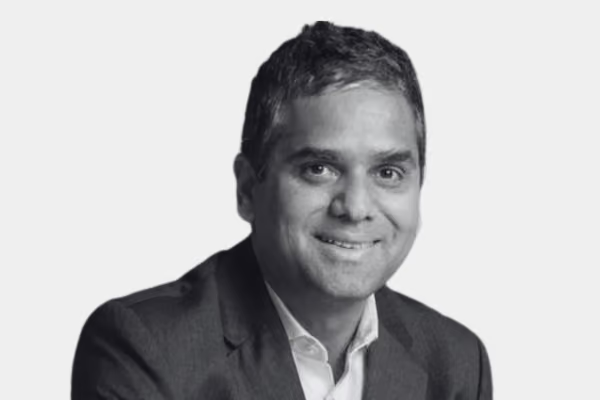
Michael Every says Trump’s big agenda may still be underestimated by many in markets. David Rowe

Bullock finds herself fighting a new wave of global inflation that is being driven by a war being fought 12,910 kilometres from Martin Place. “I think it is pretty much the world we live in now,” she said.

For Michael Every, global strategist at Rabobank, Bullock’s predicament is hardly surprising.

“The joke in markets goes that rate strategists are now oil strategists. And I’d add that now they have to be military strategists,” Every says.

He adds – only half jokingly – that the best way for the US Federal Reserve to figure out where interest rates should go next is to talk not just to the US Treasury, but to the Department of Defence, so it can get a sense of America’s plans for the conflict in the Middle East, and the direction oil prices are heading.

“That’s just as true for the RBA, of course,” says Every, who will appear at the Sohn Hearts & Minds Investment Leaders Conference in Queenstown, New Zealand on November 6; it’s the first time the event has been staged outside Australia.

The idea that Bullock and her team might be more interested in military strategy than employment, productivity or even housing – all topics she was expertly quizzed on by Chelsey Drake, chair of law firm Allens, during Tuesday’s discussion – sounds silly at first. But Every notes that the Bank of England, widely acknowledged as the world’s first central bank, was set up to help fund England’s war on France.

And as Bullock herself acknowledged, the supply shocks that the RBA is battling – Russia’s invasion of Ukraine, the tariff war started by US President Donald Trump and now the expanding conflict in the Middle East – are all born of a shift in the global world order, whereby decades of free and open trade are being replaced by a world of geopolitical tensions and even outright conflict.

Trump’s economic statecraft

On the day Trump was re-elected in 2024, Every used his daily market note to declare that the central theme of Trump’s second coming would be “economic statecraft”, an age-old concept whereby leaders seek to use the economy as a political vehicle.

Sure, markets had been thinking harder about geopolitics for a few years, but Every suggested investors need to consider what he called “grand macro strategy”, where countries clearly identify their national interests and use three tools to obtain them: the economy, political power and military power.

For Every, this is a natural result of the end of a 45-year period where America’s military might underpinned a period of globalisation, open trade flows, falling interest rates and, largely, peace.

But eventually, he says, that system began to destroy itself. Not only did that system lead to inequality and increasing polarisation, but nations such as America have found that “if you send all your factories to Asia, you eventually won’t be able to build aircraft carriers rapidly enough to deter other people”.

Trump’s economic statecraft is a reaction to that, in Every’s view.

The US president has used a combination of economic tools (think tariffs), military power (think the “invasion” of Venezuela and the far less successful sequel in Iran) and political pressure (think about how the US has forced Europe and others to start investing in defence again) to try to pressure other nations to support his America-first goals, through either formal or informal alliances.

Has it always worked? Canada’s proposed associate membership of the European Union suggests not.

But Every suggests thinking of Trump as the pilot of an aeroplane. For the past 45 years, he argues, the plane has been on autopilot, and everyone’s forgotten how economic statecraft works. Now, Trump and his team are in the cockpit twiddling various dials, and not everything has gone to plan.

And Every argues the broad brush strokes of Trump’s grand macro strategy are there. If Trump’s favoured candidate, Flavio Bolsonaro, wins Brazil’s general election in late October, then a loose pro-Trump alliance would sit over the Americas, which he describes as “the swing producer for the entire world”.

Or take oil, Bullock’s big problem. America’s dominant position in energy production has been strengthened via the move on Venezuela, and even by his moves in Iran. Clearly, the situation looks like a mess. But Every notes it’s a mess that makes America the world’s only truly dominant energy player; he predicts a ramp-up in hostilities after the November midterm elections, whereby either the US and its Middle Eastern allies knock Iran out, or the mess gets deeper.

“If the Middle East is destabilised and no one can get anything out at a reasonable price, you effectively have to kind of put a cross through it,” he says. “That makes the Americas even more important.”

Brave new world

Every has been connecting the dots on these big macro moves for decades and admits it’s exhausting. Every day he posts on social media a barrage of headlines from around the world that suggest the next few chess moves.

Still, isn’t it all a bit big-picture for a strategist from a bank best known – in Australia at least – for serving farming and agribusiness clients?

Every disagrees. For starters, an Australian farmer’s supply chain and export targets could change dramatically in the next 25 years depending on how this new world is reshaped.

But Every’s description of this brave new world isn’t that far away from the one Bullock offered on Tuesday, when she said we are in an environment where “different countries and jurisdictions are looking at trying to protect themselves”.

And that suggests investors, businesses, policymakers and central bankers may be underestimating what’s coming.

“We are not set up for a geopolitical world,” Every says. “We’re not resilient in any sense, despite the fact that we talk about it. We don’t have optionality on imports or on exports. We don’t have fail-safes or spare capacity.

“All of that’s going to have to change,” he says. “And the macro implications of that are just enormous. If lines on maps can move, lines on your screen will move a lot.”

Moment of truth

As Trump prepares to meet Chinese President Xi Jinping at the White House later this week, the ramifications of a world that splits into blocs aligned with each superpower will be brought sharply into focus.

Every says the moment of truth for Australia is probably coming. “I’ve been coming down here for 10 years and banging this drum, warning people that there’s a cold war looming, and that ultimately either China or the US will say, ‘Are you with us or against us?’”

It’s possible, he says that artificial intelligence could be that decision point.

Every admits he’s no tech expert, but he does love his science fiction, and he can’t help but think that the moment one of the American AI giants announces they’ve truly cracked artificial general intelligence (the machines thinking for themselves) is the moment that this technology will be seized by the US government as a matter of national security – with the added benefit that it will have all been funded by the private sector.

Then, Every says, allies will be forced to choose whether they’re on the side of the bloc with AGI, or not “in the same way they did when nuclear weapons arrived”.

You get the feeling that central bankers will have lots to think about in the coming years. As will grand macro strategists.

“There hasn’t been more of a Michael Every moment than where we are now,” the man himself says. “But I don’t think this is peak Michael Every.”

This article was originally posted by Australian Financial Review. Licensed by Copyright Agency. You must not copy this work without permission.

Michele Bullock knew her crisis would arrive, eventually.

As the Reserve Bank of Australia governor told a Committee for Economic Development of Australia event in Sydney on Tuesday, her predecessors all had their big moments when “something went pear-shaped” – the bursting of the dotcom bubble for Ian Macfarlane, the global financial crisis for Glenn Stevens and the pandemic for Philip Lowe.

Michael Every says Trump’s big agenda may still be underestimated by many in markets. David Rowe

Bullock finds herself fighting a new wave of global inflation that is being driven by a war being fought 12,910 kilometres from Martin Place. “I think it is pretty much the world we live in now,” she said.

For Michael Every, global strategist at Rabobank, Bullock’s predicament is hardly surprising.

“The joke in markets goes that rate strategists are now oil strategists. And I’d add that now they have to be military strategists,” Every says.

He adds – only half jokingly – that the best way for the US Federal Reserve to figure out where interest rates should go next is to talk not just to the US Treasury, but to the Department of Defence, so it can get a sense of America’s plans for the conflict in the Middle East, and the direction oil prices are heading.

“That’s just as true for the RBA, of course,” says Every, who will appear at the Sohn Hearts & Minds Investment Leaders Conference in Queenstown, New Zealand on November 6; it’s the first time the event has been staged outside Australia.

The idea that Bullock and her team might be more interested in military strategy than employment, productivity or even housing – all topics she was expertly quizzed on by Chelsey Drake, chair of law firm Allens, during Tuesday’s discussion – sounds silly at first. But Every notes that the Bank of England, widely acknowledged as the world’s first central bank, was set up to help fund England’s war on France.

And as Bullock herself acknowledged, the supply shocks that the RBA is battling – Russia’s invasion of Ukraine, the tariff war started by US President Donald Trump and now the expanding conflict in the Middle East – are all born of a shift in the global world order, whereby decades of free and open trade are being replaced by a world of geopolitical tensions and even outright conflict.

Trump’s economic statecraft

On the day Trump was re-elected in 2024, Every used his daily market note to declare that the central theme of Trump’s second coming would be “economic statecraft”, an age-old concept whereby leaders seek to use the economy as a political vehicle.

Sure, markets had been thinking harder about geopolitics for a few years, but Every suggested investors need to consider what he called “grand macro strategy”, where countries clearly identify their national interests and use three tools to obtain them: the economy, political power and military power.

For Every, this is a natural result of the end of a 45-year period where America’s military might underpinned a period of globalisation, open trade flows, falling interest rates and, largely, peace.

But eventually, he says, that system began to destroy itself. Not only did that system lead to inequality and increasing polarisation, but nations such as America have found that “if you send all your factories to Asia, you eventually won’t be able to build aircraft carriers rapidly enough to deter other people”.

Trump’s economic statecraft is a reaction to that, in Every’s view.

The US president has used a combination of economic tools (think tariffs), military power (think the “invasion” of Venezuela and the far less successful sequel in Iran) and political pressure (think about how the US has forced Europe and others to start investing in defence again) to try to pressure other nations to support his America-first goals, through either formal or informal alliances.

Has it always worked? Canada’s proposed associate membership of the European Union suggests not.

But Every suggests thinking of Trump as the pilot of an aeroplane. For the past 45 years, he argues, the plane has been on autopilot, and everyone’s forgotten how economic statecraft works. Now, Trump and his team are in the cockpit twiddling various dials, and not everything has gone to plan.

And Every argues the broad brush strokes of Trump’s grand macro strategy are there. If Trump’s favoured candidate, Flavio Bolsonaro, wins Brazil’s general election in late October, then a loose pro-Trump alliance would sit over the Americas, which he describes as “the swing producer for the entire world”.

Or take oil, Bullock’s big problem. America’s dominant position in energy production has been strengthened via the move on Venezuela, and even by his moves in Iran. Clearly, the situation looks like a mess. But Every notes it’s a mess that makes America the world’s only truly dominant energy player; he predicts a ramp-up in hostilities after the November midterm elections, whereby either the US and its Middle Eastern allies knock Iran out, or the mess gets deeper.

“If the Middle East is destabilised and no one can get anything out at a reasonable price, you effectively have to kind of put a cross through it,” he says. “That makes the Americas even more important.”

Brave new world

Every has been connecting the dots on these big macro moves for decades and admits it’s exhausting. Every day he posts on social media a barrage of headlines from around the world that suggest the next few chess moves.

Still, isn’t it all a bit big-picture for a strategist from a bank best known – in Australia at least – for serving farming and agribusiness clients?

Every disagrees. For starters, an Australian farmer’s supply chain and export targets could change dramatically in the next 25 years depending on how this new world is reshaped.

But Every’s description of this brave new world isn’t that far away from the one Bullock offered on Tuesday, when she said we are in an environment where “different countries and jurisdictions are looking at trying to protect themselves”.

And that suggests investors, businesses, policymakers and central bankers may be underestimating what’s coming.

“We are not set up for a geopolitical world,” Every says. “We’re not resilient in any sense, despite the fact that we talk about it. We don’t have optionality on imports or on exports. We don’t have fail-safes or spare capacity.

“All of that’s going to have to change,” he says. “And the macro implications of that are just enormous. If lines on maps can move, lines on your screen will move a lot.”

Moment of truth

As Trump prepares to meet Chinese President Xi Jinping at the White House later this week, the ramifications of a world that splits into blocs aligned with each superpower will be brought sharply into focus.

Every says the moment of truth for Australia is probably coming. “I’ve been coming down here for 10 years and banging this drum, warning people that there’s a cold war looming, and that ultimately either China or the US will say, ‘Are you with us or against us?’”

It’s possible, he says that artificial intelligence could be that decision point.

Every admits he’s no tech expert, but he does love his science fiction, and he can’t help but think that the moment one of the American AI giants announces they’ve truly cracked artificial general intelligence (the machines thinking for themselves) is the moment that this technology will be seized by the US government as a matter of national security – with the added benefit that it will have all been funded by the private sector.

Then, Every says, allies will be forced to choose whether they’re on the side of the bloc with AGI, or not “in the same way they did when nuclear weapons arrived”.

You get the feeling that central bankers will have lots to think about in the coming years. As will grand macro strategists.

“There hasn’t been more of a Michael Every moment than where we are now,” the man himself says. “But I don’t think this is peak Michael Every.”

This article was originally posted by Australian Financial Review. Licensed by Copyright Agency. You must not copy this work without permission.
Disclaimer: This material has been prepared by Australian Financial Review, published on September 23, 2026. HM1 is not responsible for the content of linked websites or content prepared by third party. The inclusion of these links and third-party content does not in any way imply any form of endorsement by HM1 of the products or services provided by persons or organisations who are responsible for the linked websites and third-party content. This information is for general information only and does not consider the objectives, financial situation or needs of any person. Before making an investment decision, you should read the relevant disclosure document (if appropriate) and seek professional advice to determine whether the investment and information is suitable for you.

facebook
linkedin
All
Thank you! Your submission has been received!
Oops! Something went wrong while submitting the form.
Beeneet Kothari is ready to shock the Sohn Hearts & Minds event.Beeneet Kothari is ready to shock the Sohn Hearts & Minds event.Beeneet Kothari is ready to shock the Sohn Hearts & Minds event.Beeneet Kothari is ready to shock the Sohn Hearts & Minds event.
October 29, 2024

Why this fundie wants you to ‘wince’ at his stock picks

When fund managers come to pitch their favourite stock at the annual Sohn Hearts & Minds conference, there are two ways they can go: they can play it safe, or they can take a risk and shock the room.

Read More
October 27, 2024

IFM Investors’ Rikki Bannan backs small cap investments to rebound after mixed performance

IFM Investors executive director Rikki Bannan believes this year could be a good one to invest in some select small cap stocks.

Read More
October 22, 2024

Meet the 2024 Conference Managers

Following a global search, the Conference Fund Manager Selection Committee is pleased to share eleven new managers for 2024.

Read More
October 21, 2024

Chris Kourtis is on a winning streak. Here’s his next ASX pick

Chris Kourtis of Ellerston Capital thinks he’s found another winner and thinks it’s the last chance to have a bite at the cherry before the strategy plays out.

Read More
Ellerston Capital portfolio manager Chris Kourtis. Picture: Britta CampionEllerston Capital portfolio manager Chris Kourtis. Picture: Britta CampionEllerston Capital portfolio manager Chris Kourtis. Picture: Britta CampionEllerston Capital portfolio manager Chris Kourtis. Picture: Britta Campion
October 21, 2024

Why Ellerston Capital’s Chris Kourtis plans to back a ‘hated’ stock

Chris Kourtis of Ellerston Capital plans to tip one of the “most hated” stocks in Australia when he presents at the 2024 Sohn Hearts & Minds Conference.

Read More
October 14, 2024

Alex Pollak champions rewards of disruptive investment

Alex Pollak’s funds management company Loftus Peak rode the Nvidia wave and he is now looking at more opportunities in disruptive industry stocks.

Read More
September 30, 2024

Missed out on Nvidia and Ozempic? This fundie says it’s never too late

Northcape Capital’s Fleur Wright is still kicking herself for not owning market darlings Nvidia and Novo Nordisk, the maker of the weight loss wonder drug Ozempic, before shares of those companies rocketed in 2023.

Read More
September 23, 2024

Scalar Gauge Fund founder Sumit Gautam cautious about over-hyped AI

Tech investor Sumit Gautam carefully avoids the word bubble when describing the investor frenzy surrounding the rise of artificial intelligence, but warns there are dangers of getting caught up in the hype.

Read More
September 9, 2024

The Wellcome Trust’s Nick Moakes made a 100-year bet. It’s paying off

Chief Investment Officer, Nick Moakes raised almost $3 billion at ultra-low rates. Sometimes the long view can be the most profitable.

Read More
September 5, 2024

Honesty the only policy that matters, says Wellcome Trust’s Nicholas Moakes

The chief investment officer of the London-based $71bn Wellcome Trust, Nick Moakes, has a simple rule for the trust’s investment team: “Never invest with anyone who is or has been or should have been in prison.”

Read More
September 5, 2024

Why Howard Marks says you’re making a big mistake

Howard Marks says investors must ignore manic depressive markets and focus on the bigger picture. Rates will be higher for longer and that will bring pain – and opportunity.

Read More
July 21, 2024

Investors ‘comfortable’ about a Trump presidency, despite volatility

Economists and market experts say the outcome of the US presidential election has been largely priced in by investors as softening inflation helps to buoy sharemarkets both globally and locally.

Read More
January 24, 2024

How To Master The Art Of Winning The Room

Jonathan Pease, the creative director behind the Sohn Hearts & Minds Conference and author of the book, Winning the Room, recently sat down for a chat with Mark Bouris on Straight Talk.

Read More
November 17, 2023

‘I Know It Sounds Crazy’: Cathie Wood’s Next Big Idea

Speaking from Ark’s headquarters in Florida ahead of her appearance at the Sohn Hearts & Minds Conference on Friday, Wood says she believes disinflation is now just around the corner in the US.

Read More
November 17, 2023

ARK Founder Wood Backs Bitcoin, Banking On Spot ETF Approval

Tech investment guru Cathie Wood is still a big believer in bitcoin, so it was fitting that she chose Grayscale Bitcoin Trust as her stock pick for the 2023 Sohn Hearts & Minds Investment Leaders Conference.

Read More