This Silicon Valley VC giant has a warning for software stocks

One of the world’s largest venture capital firms says investors are underestimating the carnage artificial intelligence will create for software companies, warning their pivots towards AI are likely just marketing.
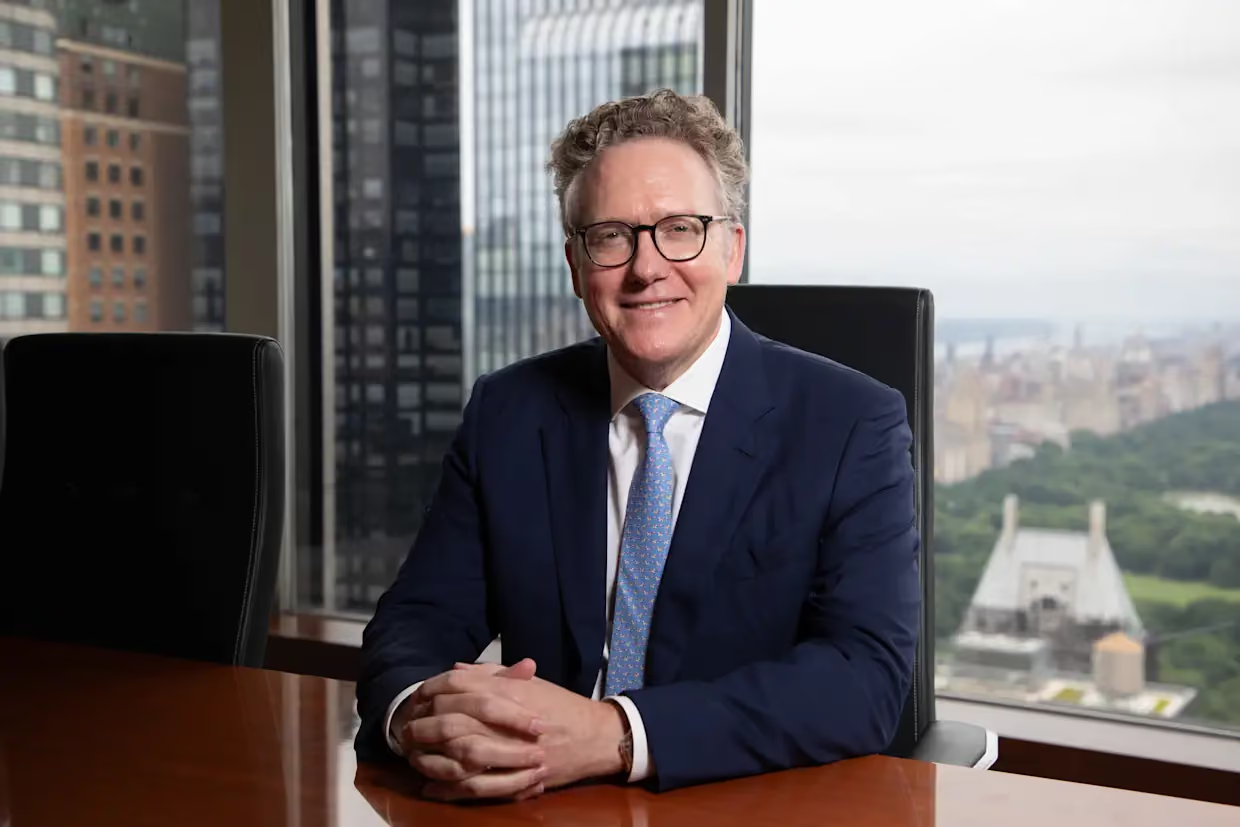
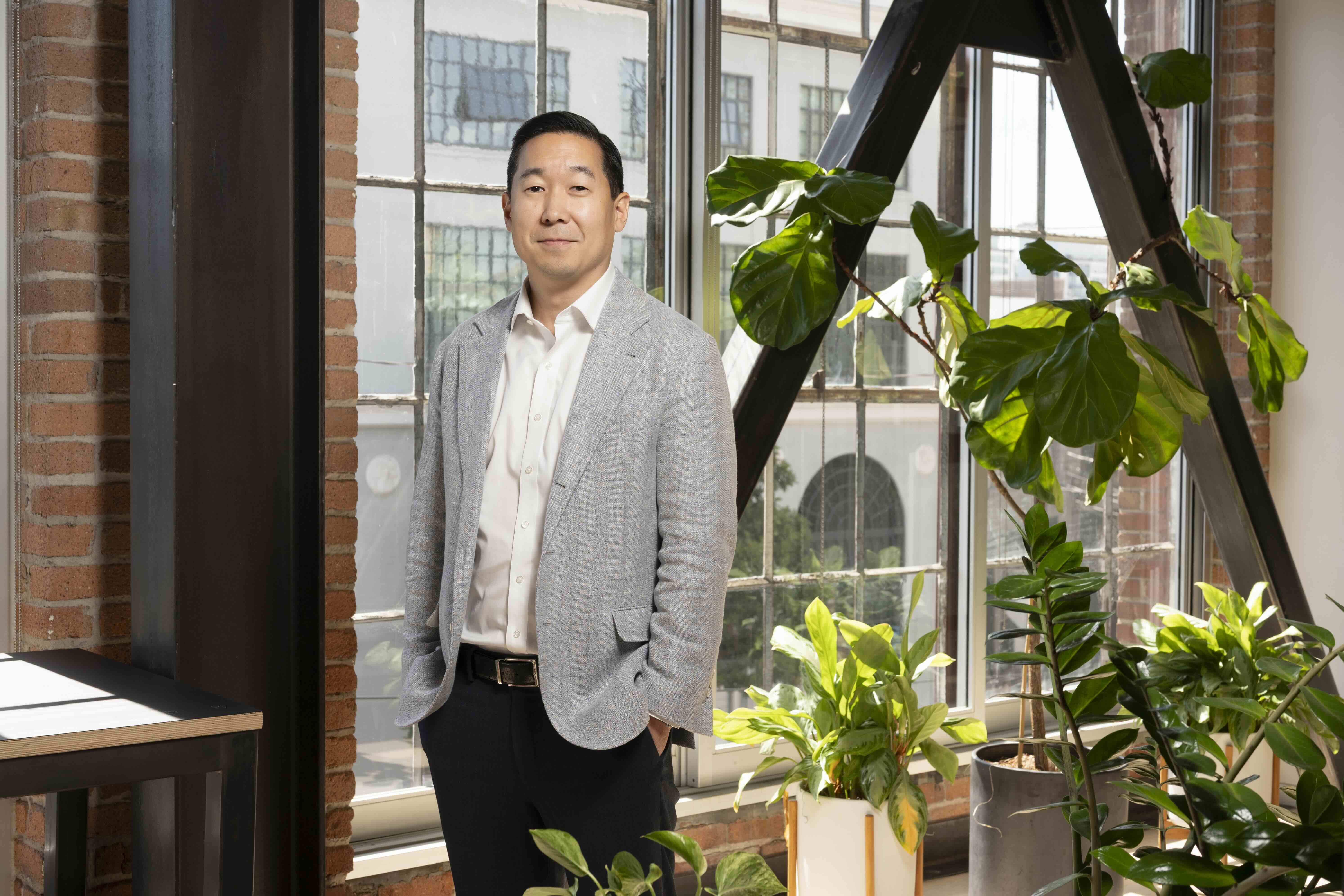
Photo: Isaac Kim (Laure Andrillon)

Emma Rapaport

This Silicon Valley VC giant has a warning for software stocks

September 11, 2026
One of the world’s largest venture capital firms says investors are underestimating the carnage artificial intelligence will create for software companies, warning their pivots towards AI are likely just marketing.
Read Transcript

One of the world’s largest venture capital firms says investors are underestimating the carnage artificial intelligence will create for software companies, warning their pivots towards AI are likely just marketing.

Lightspeed Venture Partners partner Isaac Kim said software investors were changing their narratives to justify support for companies clearly being disrupted by sophisticated AI tools. He said his firm, which oversees a portfolio worth about $70 billion, was now shunning traditional software businesses in funding rounds.

Isaac Kim, partner of Lightspeed Venture Partners, says investors are underestimating product disruption, as the $70b fund pivots capital away from legacy tech. 

“When AI [first] came out, a lot of software investors were like, ‘Don’t look over there, don’t worry about it,’” said Kim, who will be a headline speaker at the Sohn Hearts & Minds investor conference in Queenstown this year.

“Then the SaaSpocalypse hit, and people were on their heels and had to say, don’t worry about it; we’re going to take care of this; it’s fine; nothing is happening in our portfolio; we’re not seeing any revenue degradation or retention degradation. Now you see some good prints in the public market for software, and people are like, AI is the accelerator for software.

“Disruption takes time. If you have an entrenched customer base, they’re not necessarily going anywhere in a year or two years, but I guarantee you they’re planning to for two to three years down the line as it relates to AI.”

Over a period now known as the SaaSpocalypse, software stocks on Wall Street and the ASX were rapidly sold off earlier this year amid concerns that AI tools would reduce their growth and even replace their products. The sharp drop in valuations was widespread, pushing down the market capitalisations of companies as varied as Xero and REA Group. It also hurt the valuations of unlisted companies such as design software giant Canva.

Kim spent his formative years in private equity at Elliott Investment Management and Golden Gate Capital before joining Lightspeed in 2024. The firm is best known for its support of Anthropic, the developer behind Claude, one of the world’s most advanced AI platforms, along with start-ups such as Harvey, a legal platform, and Wiz, a cloud computing cybersecurity business that was acquired by Google this year for $US32 billion.

Lightspeed is among a growing list of venture capital firms that are no longer interested in investing in software businesses. Kim said another American private equity giant – Clayton, Dubilier & Rice – “doesn’t have a software team any more” while KKR is also reworking its team.

Last month, The Australian Financial Review reported that Airtree had told investors that it “would be remiss to pretend” AI was not hurting older start-ups, and said it was “pressure-testing whether our portfolio companies have a credible AI story, not as marketing, but as a genuine product”.

“If the answer is no, that’s a strategic gap that needs to be addressed quickly,” the Australian venture capital giant wrote to investors in May.

Asked how Lightspeed would approach older software businesses in its portfolio, Kim said it was “really hard”, and often a scramble for engineering talent that would be able to transform the company quickly.

“The talent game is really tough out there, and a lot of that talent doesn’t want to go into legacy businesses,” he said. “It’s a very tough thing to do, but you have to try to pivot, innovate, upgrade your team, get your team working on AI tooling, and you have to bring your customer base along.”

But Kim said venture capital firms were in a better position to deal with the disruption brought on by AI than other private equity firms, even as the sector faced pressure from investors to exit long-held assets.

“There are some massive private equity maturity walls coming up in the next three years,” he said. “When you have that looming, you have to either do unnatural things or get out and sell sooner. The good thing about VC is that often VC can be more patient, as long as you have the correct cash runway, and you can play for the option of being able to make that pivot.”

Kim said investors should scrutinise listed software stocks for claims they were pivoting to AI, adding that they could “obfuscate things pretty easily”.

“[Companies could] say, ‘we need to renew you’ ... you’re not going to get off in the short term of the software you bought before, but on the renewal, [they] want you to split that renewal up such that 20 per cent of it goes to a new AI product, and 80 per cent to the old product,” he said.

“All of a sudden, you split where the money’s coming from and going, and you can bolster your AI revenue. It doesn’t mean that it’s in production and being used.”

This article was originally posted by The Australian Financial Review here.

Licensed by Copyright Agency. You must not copy this work without permission.
One of the world’s largest venture capital firms says investors are underestimating the carnage artificial intelligence will create for software companies, warning their pivots towards AI are likely just marketing.

Lightspeed Venture Partners partner Isaac Kim said software investors were changing their narratives to justify support for companies clearly being disrupted by sophisticated AI tools. He said his firm, which oversees a portfolio worth about $70 billion, was now shunning traditional software businesses in funding rounds.

Isaac Kim, partner of Lightspeed Venture Partners, says investors are underestimating product disruption, as the $70b fund pivots capital away from legacy tech. 

“When AI [first] came out, a lot of software investors were like, ‘Don’t look over there, don’t worry about it,’” said Kim, who will be a headline speaker at the Sohn Hearts & Minds investor conference in Queenstown this year.

“Then the SaaSpocalypse hit, and people were on their heels and had to say, don’t worry about it; we’re going to take care of this; it’s fine; nothing is happening in our portfolio; we’re not seeing any revenue degradation or retention degradation. Now you see some good prints in the public market for software, and people are like, AI is the accelerator for software.

“Disruption takes time. If you have an entrenched customer base, they’re not necessarily going anywhere in a year or two years, but I guarantee you they’re planning to for two to three years down the line as it relates to AI.”

Over a period now known as the SaaSpocalypse, software stocks on Wall Street and the ASX were rapidly sold off earlier this year amid concerns that AI tools would reduce their growth and even replace their products. The sharp drop in valuations was widespread, pushing down the market capitalisations of companies as varied as Xero and REA Group. It also hurt the valuations of unlisted companies such as design software giant Canva.

Kim spent his formative years in private equity at Elliott Investment Management and Golden Gate Capital before joining Lightspeed in 2024. The firm is best known for its support of Anthropic, the developer behind Claude, one of the world’s most advanced AI platforms, along with start-ups such as Harvey, a legal platform, and Wiz, a cloud computing cybersecurity business that was acquired by Google this year for $US32 billion.

Lightspeed is among a growing list of venture capital firms that are no longer interested in investing in software businesses. Kim said another American private equity giant – Clayton, Dubilier & Rice – “doesn’t have a software team any more” while KKR is also reworking its team.

Last month, The Australian Financial Review reported that Airtree had told investors that it “would be remiss to pretend” AI was not hurting older start-ups, and said it was “pressure-testing whether our portfolio companies have a credible AI story, not as marketing, but as a genuine product”.

“If the answer is no, that’s a strategic gap that needs to be addressed quickly,” the Australian venture capital giant wrote to investors in May.

Asked how Lightspeed would approach older software businesses in its portfolio, Kim said it was “really hard”, and often a scramble for engineering talent that would be able to transform the company quickly.

“The talent game is really tough out there, and a lot of that talent doesn’t want to go into legacy businesses,” he said. “It’s a very tough thing to do, but you have to try to pivot, innovate, upgrade your team, get your team working on AI tooling, and you have to bring your customer base along.”

But Kim said venture capital firms were in a better position to deal with the disruption brought on by AI than other private equity firms, even as the sector faced pressure from investors to exit long-held assets.

“There are some massive private equity maturity walls coming up in the next three years,” he said. “When you have that looming, you have to either do unnatural things or get out and sell sooner. The good thing about VC is that often VC can be more patient, as long as you have the correct cash runway, and you can play for the option of being able to make that pivot.”

Kim said investors should scrutinise listed software stocks for claims they were pivoting to AI, adding that they could “obfuscate things pretty easily”.

“[Companies could] say, ‘we need to renew you’ ... you’re not going to get off in the short term of the software you bought before, but on the renewal, [they] want you to split that renewal up such that 20 per cent of it goes to a new AI product, and 80 per cent to the old product,” he said.

“All of a sudden, you split where the money’s coming from and going, and you can bolster your AI revenue. It doesn’t mean that it’s in production and being used.”

This article was originally posted by The Australian Financial Review here.

Licensed by Copyright Agency. You must not copy this work without permission.

Disclaimer: This material has been prepared by Australian Financial Review, published on September 11, 2026. HM1 is not responsible for the content of linked websites or content prepared by third party. The inclusion of these links and third-party content does not in any way imply any form of endorsement by HM1 of the products or services provided by persons or organisations who are responsible for the linked websites and third-party content. This information is for general information only and does not consider the objectives, financial situation or needs of any person. Before making an investment decision, you should read the relevant disclosure document (if appropriate) and seek professional advice to determine whether the investment and information is suitable for you.

facebook
linkedin
All
Thank you! Your submission has been received!
Oops! Something went wrong while submitting the form.
March 14, 2025

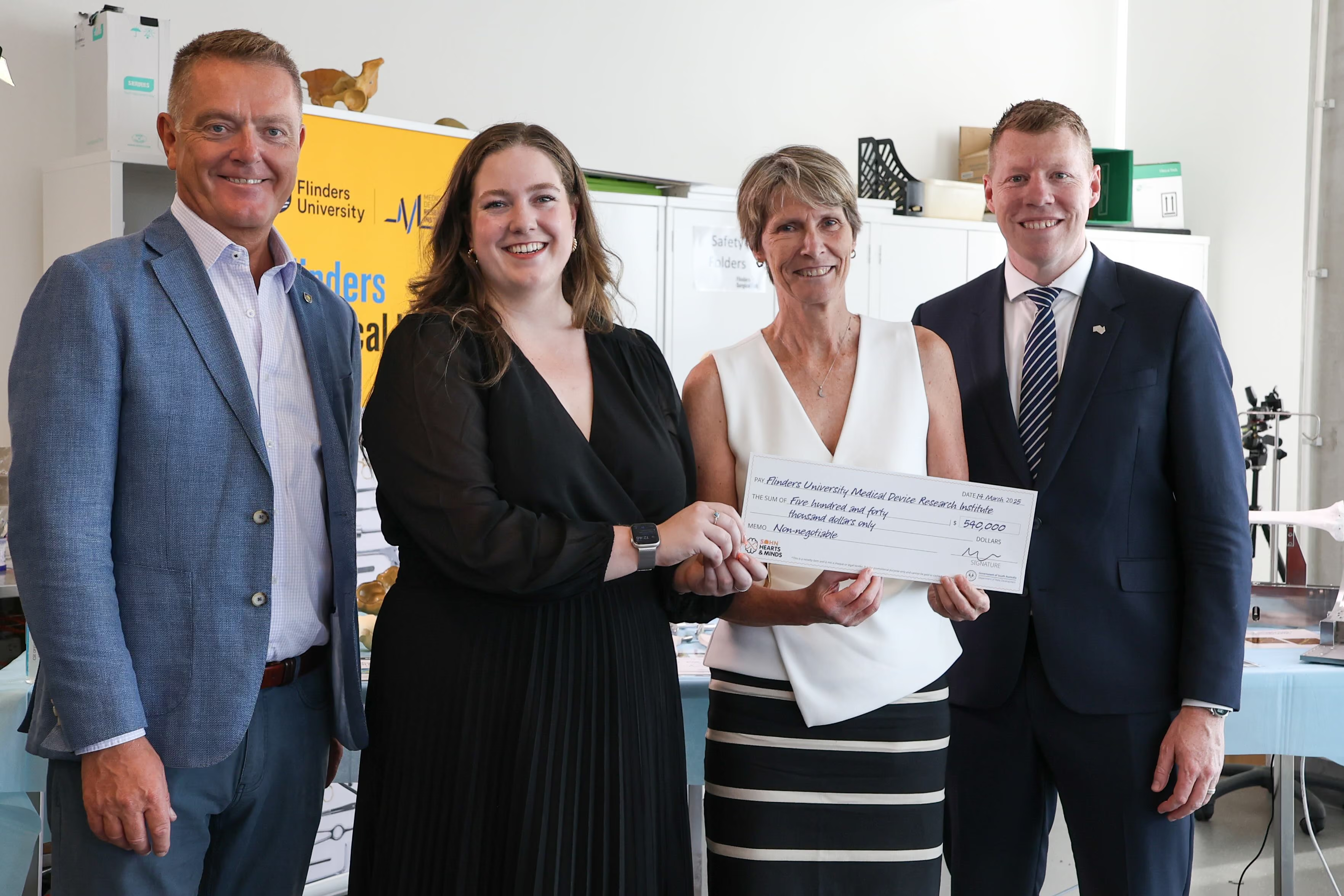
$1.4 million boost for SA medical research

South Australian medical research will receive a $1.4 million cash injection, as a direct result of a major investment and philanthropy conference held in Adelaide.

Read More
May 19, 2025

Why ‘The Mooch’ thinks Trump is more dangerous this time around

Anthony Scaramucci says Trump has fewer constraints on his worst instincts in his second administration. But he still gets bored easily.

Read More
Image caption: Anthony “The Mooch” Scaramucci at the New York headquarters of his SkyBridge Capital last week. Picture: Jaclyn LichtImage caption: Anthony “The Mooch” Scaramucci at the New York headquarters of his SkyBridge Capital last week. Picture: Jaclyn LichtImage caption: Anthony “The Mooch” Scaramucci at the New York headquarters of his SkyBridge Capital last week. Picture: Jaclyn LichtImage caption: Anthony “The Mooch” Scaramucci at the New York headquarters of his SkyBridge Capital last week. Picture: Jaclyn Licht
May 19, 2025

My biggest mistake: Anthony Scaramucci on what makes Donald Trump tick

On Elon Musk, money and the White House, fast-talking Wall Street hedge fund manager and former Trump communications director Anthony Scaramucci tells it as he sees it.

Read More
May 19, 2025

Bitcoin ‘on track’ for $US200,000: Anthony Scaramucci

Bitcoin could hit as much as $US200,000 ($311,000) by the end of this year, fuelled by surging inflows into exchange-traded funds and Donald Trump’s erratic policymaking.

Read More
Anthony Scaramucci says America has no choice but to lower tariffs on China further. Jaclyn LichtAnthony Scaramucci says America has no choice but to lower tariffs on China further. Jaclyn LichtAnthony Scaramucci says America has no choice but to lower tariffs on China further. Jaclyn LichtAnthony Scaramucci says America has no choice but to lower tariffs on China further. Jaclyn Licht
May 19, 2025

‘The Mooch’ says Trump will have to cut China tariffs below 10pc

Scaramucci, who is best known as The Mooch, is the first big-name global investor to be confirmed for the Sohn Hearts & Minds conference in Sydney in November.

Read More
Matthew McLennan in his office at First Eagle Investments in New York. Picture: Jaclyn LichtMatthew McLennan in his office at First Eagle Investments in New York. Picture: Jaclyn LichtMatthew McLennan in his office at First Eagle Investments in New York. Picture: Jaclyn LichtMatthew McLennan in his office at First Eagle Investments in New York. Picture: Jaclyn Licht
July 7, 2025

A golden year for Wall Street’s Australian stock picker

Matthew McLennan’s $14.5 billion position in gold bars and miners paid off handsomely for First Eagle this year. But he insists the precious metal still has room to run.

Read More
Stillpoint Investments founder and chief investment officer Eric Wong. Picture: Jaclyn LichtStillpoint Investments founder and chief investment officer Eric Wong. Picture: Jaclyn LichtStillpoint Investments founder and chief investment officer Eric Wong. Picture: Jaclyn LichtStillpoint Investments founder and chief investment officer Eric Wong. Picture: Jaclyn Licht
September 25, 2025

Stillpoint founder Eric Wong reveals major China tech investment strategy

Eric Wong will present his investment case at the Sohn Hearts & Minds conference at the Sydney Opera House on Friday, November 14.

Read More
October 1, 2025

Billionaire hedge fund manager enacts ‘little short’ on the market

Investing veteran Lord Michael Hintze says he’s taking out insurance against expensive debt and equity markets that are being propelled by passive flows.

Read More
October 1, 2025

Hedge fund guru Michael Hintze can't out-trade machines but he can still 'out-invest' them

Billionaire hedge fund manager Michael Hintze says the world is more dangerous than he has ever seen, artificial intelligence is stifling people’s ability to learn and process information.

Read More
Marathon Resource Advisors founder and chief investment officer Robert Mullin in San Francisco.Marathon Resource Advisors founder and chief investment officer Robert Mullin in San Francisco.Marathon Resource Advisors founder and chief investment officer Robert Mullin in San Francisco.Marathon Resource Advisors founder and chief investment officer Robert Mullin in San Francisco.
October 5, 2025

Marathon CIO Robert Mullin reveals why gold stocks are still undervalued

The son of a stockbroker, Mr Mullin has more than 30 years' investing experience and is chief investment officer at Marathon Resource Advisors in San Francisco, a company he founded.

Read More
First Eagle Investments co-head of global value Matthew McLennan. Picture: Jaclyn LichtFirst Eagle Investments co-head of global value Matthew McLennan. Picture: Jaclyn LichtFirst Eagle Investments co-head of global value Matthew McLennan. Picture: Jaclyn LichtFirst Eagle Investments co-head of global value Matthew McLennan. Picture: Jaclyn Licht
October 6, 2025

First Eagle’s Matthew McLennan on the monetary force that could be ‘rocket fuel’ for the Australian dollar

Matthew McLennan, the co-head of the global value team and portfolio manager at the $US161bn ($243bn) First Eagle Investments, stormed the market with a bullish bet on gold.

Read More
October 10, 2025

Anthony Scaramucci’s advice to our PM is to seek his Canadian counterpart’s counsel

Beyond Wall Street, The Mooch is better known for his cutting takes on US politics in the popular podcast The Rest is Politics: US, which he hosts with BBC’s long-term North American correspondent Katty Kay.

Read More
October 19, 2025

Munro Partners' Qiao Ma reveals AI investment strategy

Qiao Ma has a simple test for spotting the investment opportunities that will define the next decade. Take the technology apart and see what’s inside.

Read More
October 21, 2025

Meet the 2025 Conference Managers

Following a global search, the Conference Fund Manager Selection Committee is pleased to share ten new managers for 2025.

Read More
October 31, 2025

The 42pc gain that shows why Sohn is a stock picker’s delight

It turns out you could have outperformed the seemingly unstoppable magnificent seven tech stocks if you simply acted on the 11 stock picks at Sohn last year.

Read More