US Bank Run Has Slowed To A Walk, But Instability Remains

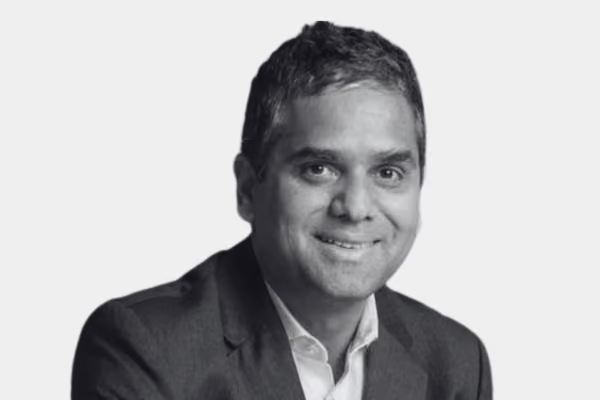
When Ravi Chopra reveals his stock pick at the prestigious Sohn Hearts & Minds conference at the Opera House in Sydney next month, it could well be a short bet on a US bank.

David Rogers

US Bank Run Has Slowed To A Walk, But Instability Remains

October 23, 2023
When Ravi Chopra reveals his stock pick at the prestigious Sohn Hearts & Minds conference at the Opera House in Sydney next month, it could well be a short bet on a US bank.
Read Transcript

When Ravi Chopra reveals his stock pick at the prestigious Sohn Hearts & Minds conference at the Opera House in Sydney next month, it could well be a short bet on a US bank.

When Ravi Chopra reveals his stock pick at the prestigious Sohn Hearts & Minds conference at the Opera House in Sydney on November 17, it could well be a short bet on a US bank.

Chopra is the chief investment office and founder of Azora Capital, a long-short hedge fund investing only in US financial services companies. As the US 10-year Treasury yield soars to 5 per cent, he says the interest rate and liquidity risk that caused the regional banking crisis in March is still out there.

He started out as an investment banking analyst at Goldman Sachs during the tech wreck, before working as a financial services analyst at Sigma Capital, a subsidiary of Steve Cohen’s SAC Capital Advisers.

In the global financial crisis he was a partner and sector head of financial services at Sigma offshoot Samlyn Capital.

His most profitable times as a fund manager have been during crises – the GFC, the coronavirus crash of March 2020, and the US regional banking crisis of March this year.

Azora had its best year ever in 2020 when US interest rates were cut to the lowest level in history.

March 2023 was its best month ever – Azora was short each of the four banks that failed.

A full year before the US regional bank failures of 2023, Chopra warned of the “tragic positioning” of some banks in terms of their investment portfolios, concluding there was “no way out”. Swift action by the Fed saved the day back then, but the warnings are still flashing red.

Chopra explains that the GFC stemmed from poorly underwritten credit and credit losses that dwarfed bank capital. So for the past 15 years, bank management teams, rating agencies and regulators have been stress-testing for credit and capital.

But they underestimated the interest rate and liquidity risks from pandemic-era monetary policy.

Unlike the GFC, where credit losses dominated, losses stemming from interest rate risk mismanagement in the current cycle will end up dwarfing losses from credit risk, Chopra says.

It started when the Fed slashed its funds rate from 2.5 per cent to zero in March 2022 and began a $US5 trillion quantitative easing program, lowering the 10-year Treasury bond yield to a record low of 32 basis points, and effectively pushing $US5 trillion on to bank balance sheets.

Typically, the US banking industry sees steady deposit growth of about 6 per cent per annum.

But in 2021, deposits leapt by an unheard of 35 per cent, most of it non-interest bearing deposits.

Some banks hoovered up a disproportionate share of those deposits.

They were typically in growth industries like technology, biotechnology and cryptocurrency.

Thanks to the massive growth in deposits, they experienced huge share price growth.

Some bank’s “carry trades” in 1 to 1.5 per cent yielding securities with 10-year maturities, funded by zero-cost non-interest-bearing deposits, were multiples of the size of the existing banks in 2019.

Then the Fed raised interest rates at the fastest pace since the 1970s and started quantitative tightening that wiped $US700bn off the value of the banking industry’s fixed-rate assets.

That was about 60 per cent of the capital base of the entire banking industry, which was similar to the peak of the GFC in terms of credit losses as a percentage of capital in the US banking industry.

Higher interest rates also make it hard for some banks to keep funding their deposits.

Azora’s analysis, marking-to-market bank balance sheets for the new interest rate environment and the unrealised losses of bond portfolios, found many banks were undercapitalised. Some were mathematically insolvent. It also looked at liquidity risks, using the percentage of each bank’s deposits that were uninsured, to come up with its list of short selling targets.

But Chopra still worries about the “recency bias” of financial institutions and regulators amid a structural shift to higher inflation and interest rates after a long period of falling inflation and rates.

“We’ve been conditioned since the GFC to think that anytime the economy sneezed, anytime there was trouble in the world, the Fed was going to cut rates and buy bonds,” he says. “It was inconceivable to think that just two years after a global pandemic that we’ve never seen in our lives, the Fed could be raising interest rates 500 basis points.”

He also notes that while the Fed’s Bank Term Funding facility allowed banks to post assets as collateral at face value in exchange for funding, legislative difficulties prevented regulators from guaranteeing deposits in excess of the $US250,000 limit as they did in the GFC.

“That was the ‘ah ha’ moment for depositors,” Chopra says.

“For the first time perhaps, depositors realised they were actually unsecured lenders to these banks, and they weren’t even getting paid for it.”

The day after the Fed’s BTF facility was announced, some banks’ share prices fell 30-50 per cent.

Bank “runs” have stopped, but bank “walks” continue, as the regional banking crisis showed depositors they were taking on an intended credit risk for no return,

They’re shifting to mutual funds paying 5.5 per cent risk free.

“To be clear, if you have zero-cost funding that’s leaving, you now have to replace that with market-rate funding. Market-rate funding could now cost you 5.5 to 6 per cent,” Chopra says.

Free money leaving and 6 per cent coming in is a big problem for the banks. He also worries that US interest rates will continue to rise, worsening unrealised losses on bond portfolios, pushing banks to use “break glass in emergency” funding to pay their depositors.

“They can cut their dividends, or raise equity capital, but no financial institution wants to go down that route – a dividend cut is a really negative signal, and a capital raise is what precipitated the failure of Silicon Valley Bank – no one wants to be the guinea pig to try that right now.”

He says to the extent that banks are looking to scale back their lending to improve their capital ratios, it will tighten their underwriting standards and weaken their loan growth. With that comes rising loan losses, because as liquidity leaves the system, it’s harder to get a loan.

“Credit bubbles start popping, and one area is commercial real estate,” Chopra says.

“Sixty per cent of all commercial real estate loans are made by the banking system, two-thirds of those are made by the smallest banks, where some of the issues are the most acute. That has led to a near complete dry-up of liquidity in certain areas of the commercial real estate market, particularly the office market, which portends greater losses to come from credit.”

Sohn Hearts & Minds delivers stock picks from investment experts around the globe, with all profits raised going to medical research. The conference is on track to raise $60m by November.

This article was originally posted by The Australian here.

Licensed by Copyright Agency. You must not copy this work without permission.

When Ravi Chopra reveals his stock pick at the prestigious Sohn Hearts & Minds conference at the Opera House in Sydney next month, it could well be a short bet on a US bank.

When Ravi Chopra reveals his stock pick at the prestigious Sohn Hearts & Minds conference at the Opera House in Sydney on November 17, it could well be a short bet on a US bank.

Chopra is the chief investment office and founder of Azora Capital, a long-short hedge fund investing only in US financial services companies. As the US 10-year Treasury yield soars to 5 per cent, he says the interest rate and liquidity risk that caused the regional banking crisis in March is still out there.

He started out as an investment banking analyst at Goldman Sachs during the tech wreck, before working as a financial services analyst at Sigma Capital, a subsidiary of Steve Cohen’s SAC Capital Advisers.

In the global financial crisis he was a partner and sector head of financial services at Sigma offshoot Samlyn Capital.

His most profitable times as a fund manager have been during crises – the GFC, the coronavirus crash of March 2020, and the US regional banking crisis of March this year.

Azora had its best year ever in 2020 when US interest rates were cut to the lowest level in history.

March 2023 was its best month ever – Azora was short each of the four banks that failed.

A full year before the US regional bank failures of 2023, Chopra warned of the “tragic positioning” of some banks in terms of their investment portfolios, concluding there was “no way out”. Swift action by the Fed saved the day back then, but the warnings are still flashing red.

Chopra explains that the GFC stemmed from poorly underwritten credit and credit losses that dwarfed bank capital. So for the past 15 years, bank management teams, rating agencies and regulators have been stress-testing for credit and capital.

But they underestimated the interest rate and liquidity risks from pandemic-era monetary policy.

Unlike the GFC, where credit losses dominated, losses stemming from interest rate risk mismanagement in the current cycle will end up dwarfing losses from credit risk, Chopra says.

It started when the Fed slashed its funds rate from 2.5 per cent to zero in March 2022 and began a $US5 trillion quantitative easing program, lowering the 10-year Treasury bond yield to a record low of 32 basis points, and effectively pushing $US5 trillion on to bank balance sheets.

Typically, the US banking industry sees steady deposit growth of about 6 per cent per annum.

But in 2021, deposits leapt by an unheard of 35 per cent, most of it non-interest bearing deposits.

Some banks hoovered up a disproportionate share of those deposits.

They were typically in growth industries like technology, biotechnology and cryptocurrency.

Thanks to the massive growth in deposits, they experienced huge share price growth.

Some bank’s “carry trades” in 1 to 1.5 per cent yielding securities with 10-year maturities, funded by zero-cost non-interest-bearing deposits, were multiples of the size of the existing banks in 2019.

Then the Fed raised interest rates at the fastest pace since the 1970s and started quantitative tightening that wiped $US700bn off the value of the banking industry’s fixed-rate assets.

That was about 60 per cent of the capital base of the entire banking industry, which was similar to the peak of the GFC in terms of credit losses as a percentage of capital in the US banking industry.

Higher interest rates also make it hard for some banks to keep funding their deposits.

Azora’s analysis, marking-to-market bank balance sheets for the new interest rate environment and the unrealised losses of bond portfolios, found many banks were undercapitalised. Some were mathematically insolvent. It also looked at liquidity risks, using the percentage of each bank’s deposits that were uninsured, to come up with its list of short selling targets.

But Chopra still worries about the “recency bias” of financial institutions and regulators amid a structural shift to higher inflation and interest rates after a long period of falling inflation and rates.

“We’ve been conditioned since the GFC to think that anytime the economy sneezed, anytime there was trouble in the world, the Fed was going to cut rates and buy bonds,” he says. “It was inconceivable to think that just two years after a global pandemic that we’ve never seen in our lives, the Fed could be raising interest rates 500 basis points.”

He also notes that while the Fed’s Bank Term Funding facility allowed banks to post assets as collateral at face value in exchange for funding, legislative difficulties prevented regulators from guaranteeing deposits in excess of the $US250,000 limit as they did in the GFC.

“That was the ‘ah ha’ moment for depositors,” Chopra says.

“For the first time perhaps, depositors realised they were actually unsecured lenders to these banks, and they weren’t even getting paid for it.”

The day after the Fed’s BTF facility was announced, some banks’ share prices fell 30-50 per cent.

Bank “runs” have stopped, but bank “walks” continue, as the regional banking crisis showed depositors they were taking on an intended credit risk for no return,

They’re shifting to mutual funds paying 5.5 per cent risk free.

“To be clear, if you have zero-cost funding that’s leaving, you now have to replace that with market-rate funding. Market-rate funding could now cost you 5.5 to 6 per cent,” Chopra says.

Free money leaving and 6 per cent coming in is a big problem for the banks. He also worries that US interest rates will continue to rise, worsening unrealised losses on bond portfolios, pushing banks to use “break glass in emergency” funding to pay their depositors.

“They can cut their dividends, or raise equity capital, but no financial institution wants to go down that route – a dividend cut is a really negative signal, and a capital raise is what precipitated the failure of Silicon Valley Bank – no one wants to be the guinea pig to try that right now.”

He says to the extent that banks are looking to scale back their lending to improve their capital ratios, it will tighten their underwriting standards and weaken their loan growth. With that comes rising loan losses, because as liquidity leaves the system, it’s harder to get a loan.

“Credit bubbles start popping, and one area is commercial real estate,” Chopra says.

“Sixty per cent of all commercial real estate loans are made by the banking system, two-thirds of those are made by the smallest banks, where some of the issues are the most acute. That has led to a near complete dry-up of liquidity in certain areas of the commercial real estate market, particularly the office market, which portends greater losses to come from credit.”

Sohn Hearts & Minds delivers stock picks from investment experts around the globe, with all profits raised going to medical research. The conference is on track to raise $60m by November.

This article was originally posted by The Australian here.

Licensed by Copyright Agency. You must not copy this work without permission.

Disclaimer: This material has been prepared by The Australian, published on Oct 23, 2023. HM1 is not responsible for the content of linked websites or content prepared by third party. The inclusion of these links and third-party content does not in any way imply any form of endorsement by HM1 of the products or services provided by persons or organisations who are responsible for the linked websites and third-party content. This information is for general information only and does not consider the objectives, financial situation or needs of any person. Before making an investment decision, you should read the relevant disclosure document (if appropriate) and seek professional advice to determine whether the investment and information is suitable for you.

facebook
linkedin
All
Thank you! Your submission has been received!
Oops! Something went wrong while submitting the form.
October 10, 2023

Beware the pitfalls of investing in healthcare, says IFM boss

“Healthcare is often viewed as a stable, defensive sector to invest in, but in small caps that hasn’t necessarily proven to be the case,” she says in an interview ahead of her appearance at the Sohn Hearts & Minds Conference 2023.

Read More
September 18, 2023

‘Volatility is opportunity’: why this manager loves shorting stocks

Angela Aldrich of Bayberry Capital Partners LP bet against Treasury Wine Estates at the top of the market and now she's preparing to make her next big call at this year's Sohn Hearts & Minds Conference.

Read More
Barrenjoey co-executive chairman Matthew Grounds and New York-based Eminence Capital fund manager Ricky Sandler will be at the eighth Sohn Hearts & Minds conference. Picture: Peter RaeBarrenjoey co-executive chairman Matthew Grounds and New York-based Eminence Capital fund manager Ricky Sandler will be at the eighth Sohn Hearts & Minds conference. Picture: Peter RaeBarrenjoey co-executive chairman Matthew Grounds and New York-based Eminence Capital fund manager Ricky Sandler will be at the eighth Sohn Hearts & Minds conference. Picture: Peter RaeBarrenjoey co-executive chairman Matthew Grounds and New York-based Eminence Capital fund manager Ricky Sandler will be at the eighth Sohn Hearts & Minds conference. Picture: Peter Rae
September 11, 2023

Top Ny Stock Picker Warns Inflation To Remain Above Pre-Covid Levels

Influential New York hedge fund manager Ricky Sandler of Eminence Capital returns for the 2023 Sohn Hearts & Minds Conference in Sydney and says no one is focused on picking interesting, idiosyncratic stocks.

Read More
January 5, 2023

Why Transurban will always be one step ahead of inflation

Loathed by motorists, but loved by investors. Transurban came under focus when Catherine Allfrey nominated the roads operator as her top pick at the recent Sohn Hearts & Minds Conference.

Read More
November 18, 2022

Why Sohn’s top stock pickers want investors to play it safe

Top global money managers are telling investors to steer clear of companies that don’t make money and invest instead in unloved but profitable businesses.

Read More
November 14, 2022

Think outside the box for green investment opportunities

James Miller, Portfolio Manager at Firetrail Investments, believes investors need to stop seeing the global decarbonisation push as a risk – and start seeing it as an opportunity.

Read More
October 30, 2022

Why this fundie is betting big on two losing companies

Speaking to the AFR before the SH&M conference, Sandler named global on-demand ride-sharing and food delivery service Uber Technologies among his top picks, alongside real estate marketplace Zillow.

Read More
October 13, 2022

This fundie fought Vladimir Putin. He says there can be no peace deal

Bill Browder, the fund manager who has become one of Vladimir Putin’s fiercest critics, says the Russian leader is increasingly desperate, but no less dangerous.

Read More
August 31, 2022

Putin critic and author Bill Browder to headline Sohn investor conference

Bill Browder, one of Putin's fiercest critics, the founder of Hermitage Capital and the man behind the Magnitsky Law, will headline this year's Sohn Hearts & Minds investor conference.

Read More
December 3, 2021

Hamish Corlett picks Spotify as his top stock again at Sohn Hearts & Minds Conference

Hamish Corlett is the only stock picker in the history of the Sohn Hearts & Minds Investment Conference to pitch exactly the same company twice.

Read More
November 15, 2021

The Millennial fund manager who pounded the table on Afterpay

Firetrail's rising star Eleanor Swanson was instrumental in getting the firm to back Afterpay when it was trading at just $20, winning over the senior investment managers.

Read More
October 27, 2021

Moderna’s miracle and why mRNA is the new powerhouse of medicine

The powerful technology that has enabled mRNA vaccines to save millions of lives during the coronavirus pandemic has much broader potential, according Bob Langer, one of the co-founders of Moderna.

Read More
October 25, 2021

Why this tech stockpicker is patient on China, bullish on bitcoin

Conference Fund Manager, Beeneet Kothari admits it’s been a ‘bloodbath’ for Chinese tech stocks this year, but there are two good reasons he thinks the sentiment will shift.

Read More