US Bank Run Has Slowed To A Walk, But Instability Remains

When Ravi Chopra reveals his stock pick at the prestigious Sohn Hearts & Minds conference at the Opera House in Sydney next month, it could well be a short bet on a US bank.

David Rogers

US Bank Run Has Slowed To A Walk, But Instability Remains

October 23, 2023
When Ravi Chopra reveals his stock pick at the prestigious Sohn Hearts & Minds conference at the Opera House in Sydney next month, it could well be a short bet on a US bank.
Read Transcript

When Ravi Chopra reveals his stock pick at the prestigious Sohn Hearts & Minds conference at the Opera House in Sydney next month, it could well be a short bet on a US bank.

When Ravi Chopra reveals his stock pick at the prestigious Sohn Hearts & Minds conference at the Opera House in Sydney on November 17, it could well be a short bet on a US bank.

Chopra is the chief investment office and founder of Azora Capital, a long-short hedge fund investing only in US financial services companies. As the US 10-year Treasury yield soars to 5 per cent, he says the interest rate and liquidity risk that caused the regional banking crisis in March is still out there.

He started out as an investment banking analyst at Goldman Sachs during the tech wreck, before working as a financial services analyst at Sigma Capital, a subsidiary of Steve Cohen’s SAC Capital Advisers.

In the global financial crisis he was a partner and sector head of financial services at Sigma offshoot Samlyn Capital.

His most profitable times as a fund manager have been during crises – the GFC, the coronavirus crash of March 2020, and the US regional banking crisis of March this year.

Azora had its best year ever in 2020 when US interest rates were cut to the lowest level in history.

March 2023 was its best month ever – Azora was short each of the four banks that failed.

A full year before the US regional bank failures of 2023, Chopra warned of the “tragic positioning” of some banks in terms of their investment portfolios, concluding there was “no way out”. Swift action by the Fed saved the day back then, but the warnings are still flashing red.

Chopra explains that the GFC stemmed from poorly underwritten credit and credit losses that dwarfed bank capital. So for the past 15 years, bank management teams, rating agencies and regulators have been stress-testing for credit and capital.

But they underestimated the interest rate and liquidity risks from pandemic-era monetary policy.

Unlike the GFC, where credit losses dominated, losses stemming from interest rate risk mismanagement in the current cycle will end up dwarfing losses from credit risk, Chopra says.

It started when the Fed slashed its funds rate from 2.5 per cent to zero in March 2022 and began a $US5 trillion quantitative easing program, lowering the 10-year Treasury bond yield to a record low of 32 basis points, and effectively pushing $US5 trillion on to bank balance sheets.

Typically, the US banking industry sees steady deposit growth of about 6 per cent per annum.

But in 2021, deposits leapt by an unheard of 35 per cent, most of it non-interest bearing deposits.

Some banks hoovered up a disproportionate share of those deposits.

They were typically in growth industries like technology, biotechnology and cryptocurrency.

Thanks to the massive growth in deposits, they experienced huge share price growth.

Some bank’s “carry trades” in 1 to 1.5 per cent yielding securities with 10-year maturities, funded by zero-cost non-interest-bearing deposits, were multiples of the size of the existing banks in 2019.

Then the Fed raised interest rates at the fastest pace since the 1970s and started quantitative tightening that wiped $US700bn off the value of the banking industry’s fixed-rate assets.

That was about 60 per cent of the capital base of the entire banking industry, which was similar to the peak of the GFC in terms of credit losses as a percentage of capital in the US banking industry.

Higher interest rates also make it hard for some banks to keep funding their deposits.

Azora’s analysis, marking-to-market bank balance sheets for the new interest rate environment and the unrealised losses of bond portfolios, found many banks were undercapitalised. Some were mathematically insolvent. It also looked at liquidity risks, using the percentage of each bank’s deposits that were uninsured, to come up with its list of short selling targets.

But Chopra still worries about the “recency bias” of financial institutions and regulators amid a structural shift to higher inflation and interest rates after a long period of falling inflation and rates.

“We’ve been conditioned since the GFC to think that anytime the economy sneezed, anytime there was trouble in the world, the Fed was going to cut rates and buy bonds,” he says. “It was inconceivable to think that just two years after a global pandemic that we’ve never seen in our lives, the Fed could be raising interest rates 500 basis points.”

He also notes that while the Fed’s Bank Term Funding facility allowed banks to post assets as collateral at face value in exchange for funding, legislative difficulties prevented regulators from guaranteeing deposits in excess of the $US250,000 limit as they did in the GFC.

“That was the ‘ah ha’ moment for depositors,” Chopra says.

“For the first time perhaps, depositors realised they were actually unsecured lenders to these banks, and they weren’t even getting paid for it.”

The day after the Fed’s BTF facility was announced, some banks’ share prices fell 30-50 per cent.

Bank “runs” have stopped, but bank “walks” continue, as the regional banking crisis showed depositors they were taking on an intended credit risk for no return,

They’re shifting to mutual funds paying 5.5 per cent risk free.

“To be clear, if you have zero-cost funding that’s leaving, you now have to replace that with market-rate funding. Market-rate funding could now cost you 5.5 to 6 per cent,” Chopra says.

Free money leaving and 6 per cent coming in is a big problem for the banks. He also worries that US interest rates will continue to rise, worsening unrealised losses on bond portfolios, pushing banks to use “break glass in emergency” funding to pay their depositors.

“They can cut their dividends, or raise equity capital, but no financial institution wants to go down that route – a dividend cut is a really negative signal, and a capital raise is what precipitated the failure of Silicon Valley Bank – no one wants to be the guinea pig to try that right now.”

He says to the extent that banks are looking to scale back their lending to improve their capital ratios, it will tighten their underwriting standards and weaken their loan growth. With that comes rising loan losses, because as liquidity leaves the system, it’s harder to get a loan.

“Credit bubbles start popping, and one area is commercial real estate,” Chopra says.

“Sixty per cent of all commercial real estate loans are made by the banking system, two-thirds of those are made by the smallest banks, where some of the issues are the most acute. That has led to a near complete dry-up of liquidity in certain areas of the commercial real estate market, particularly the office market, which portends greater losses to come from credit.”

Sohn Hearts & Minds delivers stock picks from investment experts around the globe, with all profits raised going to medical research. The conference is on track to raise $60m by November.

The Australian is a media partner.

This article was originally posted by The Australian here.

Licensed by Copyright Agency. You must not copy this work without permission.
When Ravi Chopra reveals his stock pick at the prestigious Sohn Hearts & Minds conference at the Opera House in Sydney next month, it could well be a short bet on a US bank.

When Ravi Chopra reveals his stock pick at the prestigious Sohn Hearts & Minds conference at the Opera House in Sydney on November 17, it could well be a short bet on a US bank.

Chopra is the chief investment office and founder of Azora Capital, a long-short hedge fund investing only in US financial services companies. As the US 10-year Treasury yield soars to 5 per cent, he says the interest rate and liquidity risk that caused the regional banking crisis in March is still out there.

He started out as an investment banking analyst at Goldman Sachs during the tech wreck, before working as a financial services analyst at Sigma Capital, a subsidiary of Steve Cohen’s SAC Capital Advisers.

In the global financial crisis he was a partner and sector head of financial services at Sigma offshoot Samlyn Capital.

His most profitable times as a fund manager have been during crises – the GFC, the coronavirus crash of March 2020, and the US regional banking crisis of March this year.

Azora had its best year ever in 2020 when US interest rates were cut to the lowest level in history.

March 2023 was its best month ever – Azora was short each of the four banks that failed.

A full year before the US regional bank failures of 2023, Chopra warned of the “tragic positioning” of some banks in terms of their investment portfolios, concluding there was “no way out”. Swift action by the Fed saved the day back then, but the warnings are still flashing red.

Chopra explains that the GFC stemmed from poorly underwritten credit and credit losses that dwarfed bank capital. So for the past 15 years, bank management teams, rating agencies and regulators have been stress-testing for credit and capital.

But they underestimated the interest rate and liquidity risks from pandemic-era monetary policy.

Unlike the GFC, where credit losses dominated, losses stemming from interest rate risk mismanagement in the current cycle will end up dwarfing losses from credit risk, Chopra says.

It started when the Fed slashed its funds rate from 2.5 per cent to zero in March 2022 and began a $US5 trillion quantitative easing program, lowering the 10-year Treasury bond yield to a record low of 32 basis points, and effectively pushing $US5 trillion on to bank balance sheets.

Typically, the US banking industry sees steady deposit growth of about 6 per cent per annum.

But in 2021, deposits leapt by an unheard of 35 per cent, most of it non-interest bearing deposits.

Some banks hoovered up a disproportionate share of those deposits.

They were typically in growth industries like technology, biotechnology and cryptocurrency.

Thanks to the massive growth in deposits, they experienced huge share price growth.

Some bank’s “carry trades” in 1 to 1.5 per cent yielding securities with 10-year maturities, funded by zero-cost non-interest-bearing deposits, were multiples of the size of the existing banks in 2019.

Then the Fed raised interest rates at the fastest pace since the 1970s and started quantitative tightening that wiped $US700bn off the value of the banking industry’s fixed-rate assets.

That was about 60 per cent of the capital base of the entire banking industry, which was similar to the peak of the GFC in terms of credit losses as a percentage of capital in the US banking industry.

Higher interest rates also make it hard for some banks to keep funding their deposits.

Azora’s analysis, marking-to-market bank balance sheets for the new interest rate environment and the unrealised losses of bond portfolios, found many banks were undercapitalised. Some were mathematically insolvent. It also looked at liquidity risks, using the percentage of each bank’s deposits that were uninsured, to come up with its list of short selling targets.

But Chopra still worries about the “recency bias” of financial institutions and regulators amid a structural shift to higher inflation and interest rates after a long period of falling inflation and rates.

“We’ve been conditioned since the GFC to think that anytime the economy sneezed, anytime there was trouble in the world, the Fed was going to cut rates and buy bonds,” he says. “It was inconceivable to think that just two years after a global pandemic that we’ve never seen in our lives, the Fed could be raising interest rates 500 basis points.”

He also notes that while the Fed’s Bank Term Funding facility allowed banks to post assets as collateral at face value in exchange for funding, legislative difficulties prevented regulators from guaranteeing deposits in excess of the $US250,000 limit as they did in the GFC.

“That was the ‘ah ha’ moment for depositors,” Chopra says.

“For the first time perhaps, depositors realised they were actually unsecured lenders to these banks, and they weren’t even getting paid for it.”

The day after the Fed’s BTF facility was announced, some banks’ share prices fell 30-50 per cent.

Bank “runs” have stopped, but bank “walks” continue, as the regional banking crisis showed depositors they were taking on an intended credit risk for no return,

They’re shifting to mutual funds paying 5.5 per cent risk free.

“To be clear, if you have zero-cost funding that’s leaving, you now have to replace that with market-rate funding. Market-rate funding could now cost you 5.5 to 6 per cent,” Chopra says.

Free money leaving and 6 per cent coming in is a big problem for the banks. He also worries that US interest rates will continue to rise, worsening unrealised losses on bond portfolios, pushing banks to use “break glass in emergency” funding to pay their depositors.

“They can cut their dividends, or raise equity capital, but no financial institution wants to go down that route – a dividend cut is a really negative signal, and a capital raise is what precipitated the failure of Silicon Valley Bank – no one wants to be the guinea pig to try that right now.”

He says to the extent that banks are looking to scale back their lending to improve their capital ratios, it will tighten their underwriting standards and weaken their loan growth. With that comes rising loan losses, because as liquidity leaves the system, it’s harder to get a loan.

“Credit bubbles start popping, and one area is commercial real estate,” Chopra says.

“Sixty per cent of all commercial real estate loans are made by the banking system, two-thirds of those are made by the smallest banks, where some of the issues are the most acute. That has led to a near complete dry-up of liquidity in certain areas of the commercial real estate market, particularly the office market, which portends greater losses to come from credit.”

Sohn Hearts & Minds delivers stock picks from investment experts around the globe, with all profits raised going to medical research. The conference is on track to raise $60m by November.

The Australian is a media partner.

This article was originally posted by The Australian here.

Licensed by Copyright Agency. You must not copy this work without permission.

Disclaimer: This material has been prepared by The Australian, published on Oct 23, 2023. HM1 is not responsible for the content of linked websites or content prepared by third party. The inclusion of these links and third-party content does not in any way imply any form of endorsement by HM1 of the products or services provided by persons or organisations who are responsible for the linked websites and third-party content. This information is for general information only and does not consider the objectives, financial situation or needs of any person. Before making an investment decision, you should read the relevant disclosure document (if appropriate) and seek professional advice to determine whether the investment and information is suitable for you.

facebook
linkedin
All
Thank you! Your submission has been received!
Oops! Something went wrong while submitting the form.
March 14, 2025

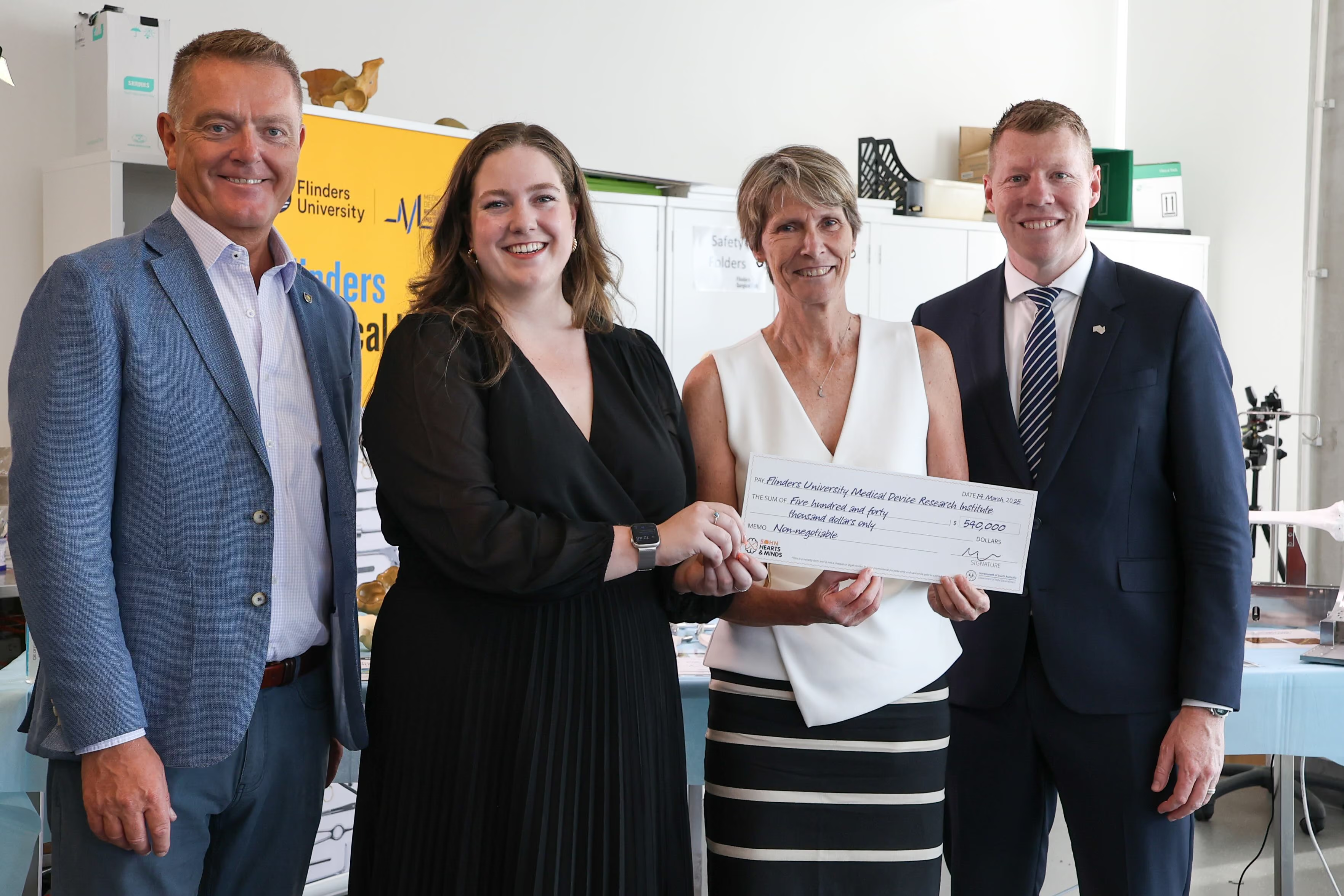
$1.4 million boost for SA medical research

South Australian medical research will receive a $1.4 million cash injection, as a direct result of a major investment and philanthropy conference held in Adelaide.

Read More
Anthony Scaramucci’s time in the White House was brief but memorable. APAnthony Scaramucci’s time in the White House was brief but memorable. APAnthony Scaramucci’s time in the White House was brief but memorable. APAnthony Scaramucci’s time in the White House was brief but memorable. AP
May 19, 2025

Why ‘The Mooch’ thinks Trump is more dangerous this time around

Anthony Scaramucci says Trump has fewer constraints on his worst instincts in his second administration. But he still gets bored easily.

Read More
Image caption: Anthony “The Mooch” Scaramucci at the New York headquarters of his SkyBridge Capital last week. Picture: Jaclyn LichtImage caption: Anthony “The Mooch” Scaramucci at the New York headquarters of his SkyBridge Capital last week. Picture: Jaclyn LichtImage caption: Anthony “The Mooch” Scaramucci at the New York headquarters of his SkyBridge Capital last week. Picture: Jaclyn LichtImage caption: Anthony “The Mooch” Scaramucci at the New York headquarters of his SkyBridge Capital last week. Picture: Jaclyn Licht
May 19, 2025

My biggest mistake: Anthony Scaramucci on what makes Donald Trump tick

On Elon Musk, money and the White House, fast-talking Wall Street hedge fund manager and former Trump communications director Anthony Scaramucci tells it as he sees it.

Read More
A bull case for Bitcoin even as it trades near record levels. Picture: AFPA bull case for Bitcoin even as it trades near record levels. Picture: AFPA bull case for Bitcoin even as it trades near record levels. Picture: AFPA bull case for Bitcoin even as it trades near record levels. Picture: AFP
May 19, 2025

Bitcoin ‘on track’ for $US200,000: Anthony Scaramucci

Bitcoin could hit as much as $US200,000 ($311,000) by the end of this year, fuelled by surging inflows into exchange-traded funds and Donald Trump’s erratic policymaking.

Read More
Anthony Scaramucci says America has no choice but to lower tariffs on China further. Jaclyn LichtAnthony Scaramucci says America has no choice but to lower tariffs on China further. Jaclyn LichtAnthony Scaramucci says America has no choice but to lower tariffs on China further. Jaclyn LichtAnthony Scaramucci says America has no choice but to lower tariffs on China further. Jaclyn Licht
May 19, 2025

‘The Mooch’ says Trump will have to cut China tariffs below 10pc

Scaramucci, who is best known as The Mooch, is the first big-name global investor to be confirmed for the Sohn Hearts & Minds conference in Sydney in November.

Read More
Matthew McLennan in his office at First Eagle Investments in New York. Picture: Jaclyn LichtMatthew McLennan in his office at First Eagle Investments in New York. Picture: Jaclyn LichtMatthew McLennan in his office at First Eagle Investments in New York. Picture: Jaclyn LichtMatthew McLennan in his office at First Eagle Investments in New York. Picture: Jaclyn Licht
July 7, 2025

A golden year for Wall Street’s Australian stock picker

Matthew McLennan’s $14.5 billion position in gold bars and miners paid off handsomely for First Eagle this year. But he insists the precious metal still has room to run.

Read More
Stillpoint Investments founder and chief investment officer Eric Wong. Picture: Jaclyn LichtStillpoint Investments founder and chief investment officer Eric Wong. Picture: Jaclyn LichtStillpoint Investments founder and chief investment officer Eric Wong. Picture: Jaclyn LichtStillpoint Investments founder and chief investment officer Eric Wong. Picture: Jaclyn Licht
September 25, 2025

Stillpoint founder Eric Wong reveals major China tech investment strategy

Eric Wong will present his investment case at the Sohn Hearts & Minds conference at the Sydney Opera House on Friday, November 14.

Read More
October 1, 2025

Billionaire hedge fund manager enacts ‘little short’ on the market

Investing veteran Lord Michael Hintze says he’s taking out insurance against expensive debt and equity markets that are being propelled by passive flows.

Read More
October 1, 2025

Hedge fund guru Michael Hintze can't out-trade machines but he can still 'out-invest' them

Billionaire hedge fund manager Michael Hintze says the world is more dangerous than he has ever seen, artificial intelligence is stifling people’s ability to learn and process information.

Read More
Marathon Resource Advisors founder and chief investment officer Robert Mullin in San Francisco.Marathon Resource Advisors founder and chief investment officer Robert Mullin in San Francisco.Marathon Resource Advisors founder and chief investment officer Robert Mullin in San Francisco.Marathon Resource Advisors founder and chief investment officer Robert Mullin in San Francisco.
October 5, 2025

Marathon CIO Robert Mullin reveals why gold stocks are still undervalued

The son of a stockbroker, Mr Mullin has more than 30 years' investing experience and is chief investment officer at Marathon Resource Advisors in San Francisco, a company he founded.

Read More
First Eagle Investments co-head of global value Matthew McLennan. Picture: Jaclyn LichtFirst Eagle Investments co-head of global value Matthew McLennan. Picture: Jaclyn LichtFirst Eagle Investments co-head of global value Matthew McLennan. Picture: Jaclyn LichtFirst Eagle Investments co-head of global value Matthew McLennan. Picture: Jaclyn Licht
October 6, 2025

First Eagle’s Matthew McLennan on the monetary force that could be ‘rocket fuel’ for the Australian dollar

Matthew McLennan, the co-head of the global value team and portfolio manager at the $US161bn ($243bn) First Eagle Investments, stormed the market with a bullish bet on gold.

Read More
October 10, 2025

Anthony Scaramucci’s advice to our PM is to seek his Canadian counterpart’s counsel

Beyond Wall Street, The Mooch is better known for his cutting takes on US politics in the popular podcast The Rest is Politics: US, which he hosts with BBC’s long-term North American correspondent Katty Kay.

Read More
October 19, 2025

Munro Partners' Qiao Ma reveals AI investment strategy

Qiao Ma has a simple test for spotting the investment opportunities that will define the next decade. Take the technology apart and see what’s inside.

Read More
October 21, 2025

Meet the 2025 Conference Managers

Following a global search, the Conference Fund Manager Selection Committee is pleased to share ten new managers for 2025.

Read More
October 31, 2025

The 42pc gain that shows why Sohn is a stock picker’s delight

It turns out you could have outperformed the seemingly unstoppable magnificent seven tech stocks if you simply acted on the 11 stock picks at Sohn last year.

Read More