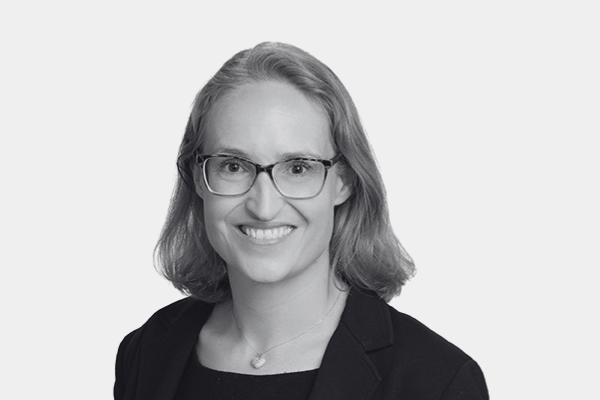
Why Samantha D'Amore of Cymer Capital is looking beyond US

Samantha D'Amore shares where she's finding compelling opportunities beyond the US and the global themes shaping her investment approach.

David Rogers

Why Samantha D'Amore of Cymer Capital is looking beyond US

October 24, 2026
Samantha D'Amore shares where she's finding compelling opportunities beyond the US and the global themes shaping her investment approach.
Read Transcript

There is a particular kind of confidence required to leave a secure, two-decade career on Wall Street and start a funds management business from scratch.

‍

Cymer Capital founder and chief investment officer Samantha D’Amore has plenty of it.

‍

Cymer is the Welsh word for “confluence” – the point where two rivers meet. It is a fitting choice for a woman from working-class Wales, the first in her family to finish high school and go to university.

‍

A news story inspired her to apply to Harvard; financial aid and cleaning bathrooms covered the rest. “Capitalism is just brilliant at solving problems,” D’Amore says. “But most of institutional asset management wants to put you in a box.”

‍

Her answer was to throw out the box altogether. Instead of starting with a sector or a region, she starts with the problem – ageing populations and care capacity, climate adaptation, digital complexity, food security, infrastructure resilience – then goes looking for the companies best placed to solve it, wherever they are listed.

‍

“If you ask the question that way, and be actually really inclusive, it opens up a really interesting array of companies,” she says.

‍

That creates durable, resilient growth that is underappreciated.”

‍

The scale of the search is deliberately wide. Cymer tracks 14 persistent problems and more than 60 solutions addressing them, drawing from a universe of roughly 800 non-US companies worth more than $US10bn ($14bn). Fundamental research narrows that to a working universe of about 300 names, from which the fund holds just 30-45 of its highest-conviction ideas at any time.

‍

Much of that opportunity, in D’Amore’s view, now sits outside the US. After years of extraordinary outperformance by US ­sharemarkets, many investors have become unintentionally overweight US stocks, just as the case for diversification is strengthening as the tech giants start to falter.

‍

“Policy coherence globally is problematic, and maybe the US doesn’t have as strong a foothold on superb policy coherence relative to the rest of the world,” she says. “For me, just from a pure diversification perspective, this creates a fantastic opportunity in those international markets.”

‍

Benchmarked against the MSCI ACWI ex-US index, Cymer’s active share runs in the high 80 per cent to low 90 per cent range. In plain terms, roughly 90 per cent of what she owns looks nothing like the index.

‍

The fund runs inside tight guardrails: no leverage, no shorting, no derivatives, no currency hedging, and no more than 15 per cent in any single position.

‍

It currently manages only D’Amore’s own capital and is not yet open to outside investors.

‍

Her process reflects a scientific instinct, built on a physics degree.

‍

The bulk of her time – roughly three-quarters – goes on assessing three to five-year fundamentals: competitive advantages, end markets, management execution and financial quality.

‍

Valuation is treated as a timing tool rather than the thesis itself.

‍

That rigour was sharpened by an unlikely early posting.

‍

Just before the subprime crisis morphed into the global financial crisis in 2008, D’Amore joined an energy-focused long/short hedge fund just as global markets turned sharply.

‍

“Stocks, from a valuation perspective, can go way higher and way lower than you think is ­rational,” she says. Underwriting the downside case first, she says, became a reflex – one she carried with her even after deciding long-only investing suits her best.

‍

She points to Mercado Libre, the Latin American e-commerce and fintech giant, as an example of that mindset at work. D’Amore admires the business but doesn’t own it, after an unexpected chief financial officer change in 2023 was followed by the founder stepping back in 2025. “Whenever you have a leadership transition, everybody should be allowed to transition off,” she says. “But when you have a change in the management team, you have to re-underwrite the thesis.”

‍

In a portfolio as concentrated as Cymer’s, every holding has to earn its place, and uncertainty over who really owns the strategy was enough to keep her out.

‍

More than a decade at Jennison Associates, covering industrials, materials and Asian infra­structure, gave D’Amore a “pattern library” of companies and cycles across geographies.

‍

A later stint at sustainable investor Trillium Asset Management taught her that non-financial data can be a genuine fundamental signal, not just a values screen.

‍

D’Amore is explicit that the strategy is thematically aligned but not an impact fund. Buying shares on the public market, she says, gives an investor no attribution to a company’s actions. Environmental, social and governance factors are “simply data points” that help explain the quality and durability of a company’s cash flow.

‍

“This is a financial-returns-first product,” she says – one that uses a lens around persistent global problems to find durable growth, without claiming to change company behaviour simply by buying shares on the public market.

‍

Cymer is also notable for being, in D’Amore’s words, “100 per cent woman-owned and founder-led” – a fact she states openly, given that fewer than 2 per cent of industry assets sit with female managers. But it’s less about identity than about a broader belief in diversity of thought.

‍

“I don’t really care where you’re from or what you look like,” she says. “I’m more interested in how you think.”

‍

That philosophy extends to hiring, where she looks for kindness and curiosity over finance degrees.

‍

“I’m living proof you can learn anything on the job,” she says, adding that she wants people around her willing to tell her when she is wrong, not simply nod along.

‍

Looking ahead, D’Amore sees two forces reshaping where the opportunities – and the risks – lie: shifting policy settings around the world, and the rapid, uneven rollout of artificial intelligence.

‍

“I don’t think anyone really has the answers to which companies are being honest about that, and where the opportunities lie,” she says. “That creates a tremendous amount of opportunity, and also a tremendous amount of instability.”

‍

The 2026 Sohn Hearts & Minds Investment Leaders Conference will be held in Queenstown, New Zealand on Friday, November 6.

The Australian is a media partner and tickets can be purchased at sohnheartsandminds.com.au

‍

This article was originally posted by The Australian here. Licensed by Copyright Agency. You must not copy this work without permission.

‍

There is a particular kind of confidence required to leave a secure, two-decade career on Wall Street and start a funds management business from scratch.

‍

Cymer Capital founder and chief investment officer Samantha D’Amore has plenty of it.

‍

Cymer is the Welsh word for “confluence” – the point where two rivers meet. It is a fitting choice for a woman from working-class Wales, the first in her family to finish high school and go to university.

‍

A news story inspired her to apply to Harvard; financial aid and cleaning bathrooms covered the rest. “Capitalism is just brilliant at solving problems,” D’Amore says. “But most of institutional asset management wants to put you in a box.”

‍

Her answer was to throw out the box altogether. Instead of starting with a sector or a region, she starts with the problem – ageing populations and care capacity, climate adaptation, digital complexity, food security, infrastructure resilience – then goes looking for the companies best placed to solve it, wherever they are listed.

‍

“If you ask the question that way, and be actually really inclusive, it opens up a really interesting array of companies,” she says.

‍

That creates durable, resilient growth that is underappreciated.”

‍

The scale of the search is deliberately wide. Cymer tracks 14 persistent problems and more than 60 solutions addressing them, drawing from a universe of roughly 800 non-US companies worth more than $US10bn ($14bn). Fundamental research narrows that to a working universe of about 300 names, from which the fund holds just 30-45 of its highest-conviction ideas at any time.

‍

Much of that opportunity, in D’Amore’s view, now sits outside the US. After years of extraordinary outperformance by US ­sharemarkets, many investors have become unintentionally overweight US stocks, just as the case for diversification is strengthening as the tech giants start to falter.

‍

“Policy coherence globally is problematic, and maybe the US doesn’t have as strong a foothold on superb policy coherence relative to the rest of the world,” she says. “For me, just from a pure diversification perspective, this creates a fantastic opportunity in those international markets.”

‍

Benchmarked against the MSCI ACWI ex-US index, Cymer’s active share runs in the high 80 per cent to low 90 per cent range. In plain terms, roughly 90 per cent of what she owns looks nothing like the index.

‍

The fund runs inside tight guardrails: no leverage, no shorting, no derivatives, no currency hedging, and no more than 15 per cent in any single position.

‍

It currently manages only D’Amore’s own capital and is not yet open to outside investors.

‍

Her process reflects a scientific instinct, built on a physics degree.

‍

The bulk of her time – roughly three-quarters – goes on assessing three to five-year fundamentals: competitive advantages, end markets, management execution and financial quality.

‍

Valuation is treated as a timing tool rather than the thesis itself.

‍

That rigour was sharpened by an unlikely early posting.

‍

Just before the subprime crisis morphed into the global financial crisis in 2008, D’Amore joined an energy-focused long/short hedge fund just as global markets turned sharply.

‍

“Stocks, from a valuation perspective, can go way higher and way lower than you think is ­rational,” she says. Underwriting the downside case first, she says, became a reflex – one she carried with her even after deciding long-only investing suits her best.

‍

She points to Mercado Libre, the Latin American e-commerce and fintech giant, as an example of that mindset at work. D’Amore admires the business but doesn’t own it, after an unexpected chief financial officer change in 2023 was followed by the founder stepping back in 2025. “Whenever you have a leadership transition, everybody should be allowed to transition off,” she says. “But when you have a change in the management team, you have to re-underwrite the thesis.”

‍

In a portfolio as concentrated as Cymer’s, every holding has to earn its place, and uncertainty over who really owns the strategy was enough to keep her out.

‍

More than a decade at Jennison Associates, covering industrials, materials and Asian infra­structure, gave D’Amore a “pattern library” of companies and cycles across geographies.

‍

A later stint at sustainable investor Trillium Asset Management taught her that non-financial data can be a genuine fundamental signal, not just a values screen.

‍

D’Amore is explicit that the strategy is thematically aligned but not an impact fund. Buying shares on the public market, she says, gives an investor no attribution to a company’s actions. Environmental, social and governance factors are “simply data points” that help explain the quality and durability of a company’s cash flow.

‍

“This is a financial-returns-first product,” she says – one that uses a lens around persistent global problems to find durable growth, without claiming to change company behaviour simply by buying shares on the public market.

‍

Cymer is also notable for being, in D’Amore’s words, “100 per cent woman-owned and founder-led” – a fact she states openly, given that fewer than 2 per cent of industry assets sit with female managers. But it’s less about identity than about a broader belief in diversity of thought.

‍

“I don’t really care where you’re from or what you look like,” she says. “I’m more interested in how you think.”

‍

That philosophy extends to hiring, where she looks for kindness and curiosity over finance degrees.

‍

“I’m living proof you can learn anything on the job,” she says, adding that she wants people around her willing to tell her when she is wrong, not simply nod along.

‍

Looking ahead, D’Amore sees two forces reshaping where the opportunities – and the risks – lie: shifting policy settings around the world, and the rapid, uneven rollout of artificial intelligence.

‍

“I don’t think anyone really has the answers to which companies are being honest about that, and where the opportunities lie,” she says. “That creates a tremendous amount of opportunity, and also a tremendous amount of instability.”

‍

The 2026 Sohn Hearts & Minds Investment Leaders Conference will be held in Queenstown, New Zealand on Friday, November 6.

The Australian is a media partner and tickets can be purchased at sohnheartsandminds.com.au

‍

This article was originally posted by The Australian here. Licensed by Copyright Agency. You must not copy this work without permission.
‍

Disclaimer: This material has been prepared by The Australian, published on October 24, 2026. HM1 is not responsible for the content of linked websites or content prepared by third party. The inclusion of these links and third-party content does not in any way imply any form of endorsement by HM1 of the products or services provided by persons or organisations who are responsible for the linked websites and third-party content. This information is for general information only and does not consider the objectives, financial situation or needs of any person. Before making an investment decision, you should read the relevant disclosure document (if appropriate) and seek professional advice to determine whether the investment and information is suitable for you.

facebook
linkedin
All
Thank you! Your submission has been received!
Oops! Something went wrong while submitting the form.
November 6, 2024

Why this New York hedge fund manager sees opportunity in European stocks

Influential New York-hedge fund manager Ricky Sandler will turn to Europe for his next stock pick.

Read More
November 5, 2024

Antipodes’ Ross says short-term wealth hinges on US election

The portfolio manager says defensive stocks pose a bigger risk than the magnificent seven for investors that are overexposed to the American sharemarket.

Read More
November 5, 2024

Concentration risk key for investors: Antipodes Partners’ Vihari Ross

The concentration risk in global stock indexes that has built up during the strong rise over the past year must now be a key consideration for global investors, according to Vihari Ross.

Read More
November 5, 2024

The fundie betting big on China – with help from AI

Mr Mehta is sticking to his well-worn strategy: he’s hunting for companies across Asia that aren’t battling intense competition and have management teams focused on costs, cash generation and high payouts to shareholders.

Read More
Beeneet Kothari is ready to shock the Sohn Hearts & Minds event.Beeneet Kothari is ready to shock the Sohn Hearts & Minds event.Beeneet Kothari is ready to shock the Sohn Hearts & Minds event.Beeneet Kothari is ready to shock the Sohn Hearts & Minds event.
October 29, 2024

Why this fundie wants you to ‘wince’ at his stock picks

When fund managers come to pitch their favourite stock at the annual Sohn Hearts & Minds conference, there are two ways they can go: they can play it safe, or they can take a risk and shock the room.

Read More
October 27, 2024

IFM Investors’ Rikki Bannan backs small cap investments to rebound after mixed performance

IFM Investors executive director Rikki Bannan believes this year could be a good one to invest in some select small cap stocks.

Read More
October 22, 2024

Meet the 2024 Conference Managers

Following a global search, the Conference Fund Manager Selection Committee is pleased to share eleven new managers for 2024.

Read More
October 21, 2024

Chris Kourtis is on a winning streak. Here’s his next ASX pick

Chris Kourtis of Ellerston Capital thinks he’s found another winner and thinks it’s the last chance to have a bite at the cherry before the strategy plays out.

Read More
Ellerston Capital portfolio manager Chris Kourtis. Picture: Britta CampionEllerston Capital portfolio manager Chris Kourtis. Picture: Britta CampionEllerston Capital portfolio manager Chris Kourtis. Picture: Britta CampionEllerston Capital portfolio manager Chris Kourtis. Picture: Britta Campion
October 21, 2024

Why Ellerston Capital’s Chris Kourtis plans to back a ‘hated’ stock

Chris Kourtis of Ellerston Capital plans to tip one of the “most hated” stocks in Australia when he presents at the 2024 Sohn Hearts & Minds Conference.

Read More
October 14, 2024

Alex Pollak champions rewards of disruptive investment

Alex Pollak’s funds management company Loftus Peak rode the Nvidia wave and he is now looking at more opportunities in disruptive industry stocks.

Read More
September 30, 2024

Missed out on Nvidia and Ozempic? This fundie says it’s never too late

Northcape Capital’s Fleur Wright is still kicking herself for not owning market darlings Nvidia and Novo Nordisk, the maker of the weight loss wonder drug Ozempic, before shares of those companies rocketed in 2023.

Read More
September 23, 2024

Scalar Gauge Fund founder Sumit Gautam cautious about over-hyped AI

Tech investor Sumit Gautam carefully avoids the word bubble when describing the investor frenzy surrounding the rise of artificial intelligence, but warns there are dangers of getting caught up in the hype.

Read More
September 9, 2024

The Wellcome Trust’s Nick Moakes made a 100-year bet. It’s paying off

Chief Investment Officer, Nick Moakes raised almost $3 billion at ultra-low rates. Sometimes the long view can be the most profitable.

Read More
September 5, 2024

Honesty the only policy that matters, says Wellcome Trust’s Nicholas Moakes

The chief investment officer of the London-based $71bn Wellcome Trust, Nick Moakes, has a simple rule for the trust’s investment team: “Never invest with anyone who is or has been or should have been in prison.”

Read More
September 5, 2024

Why Howard Marks says you’re making a big mistake

Howard Marks says investors must ignore manic depressive markets and focus on the bigger picture. Rates will be higher for longer and that will bring pain – and opportunity.

Read More